
154 countries
(and areas)
 - Azerbaijan
- Bahrain
- Barbados
- Belgium
- Belize
- Benin
- Bhutan
- Bolivia
- Bonaire
- Bosnia and Herzegovina
- Botswana
- Brazil
- British Virgin Islands
- Brunei
- Bulgaria
- Cambodia
- Canada
- Cape Verde
- Chile
- China
- Costa Rica
- Croatia
- Cuba
- Curacao
- Cyprus
- Czech Republic
- Denmark
- Dominica
- Dominican Republic
- Egypt
- El Salvador
- England
- Estonia
- Eswatini (Swaziland)
- Ethiopia
- Fiji
- Finland
- France
- French Guiana
- Georgia
- Germany
- Gibraltar
- Greece
- Grenada
- Guadeloupe
- Guatemala
- Honduras
- Hong Kong
- Hungary
- Iceland
- India
- Indonesia
- Iran
- Ireland
- Israel
- Italy
- Jamaica
- Japan
- Jordan
- Kazakhstan
- Kenya
- Kosovo
- Kuwait
- Kyrgyzstan
- Laos
- Latvia
- Lebanon
- Lesotho
- Liechtenstein
- Lithuania
- Luxembourg
- Macau
- Madagascar
- Malawi
- Malaysia
- Maldives
- Malta
- Martinique
- Mexico
- Moldova
- Monaco
- Mongolia
- Montenegro
- Morocco
- Mozambique
- Namibia
- Nepal
- Netherlands
- New Zealand
- Nicaragua
- North Macedonia
- Northern Ireland
- Norway
- Oman
- Pakistan
- Palestine
- Peru
- Philippines
- Poland
- Portugal
- Qatar
- Republic of Korea
- Romania
- Russia
- Saint Kitts and Nevis
- Saint Lucia
- Saint Martin
- Saint Vincent and the Grenadines
- San Marino
- São Tomé and Principe
- Saudi Arabia
- Scotland
- Senegal
- Serbia
- Singapore
- Sint Maarten
- Slovakia
- Slovenia
- South Africa
- Spain
- Sri Lanka
- Suriname
- Sweden
- Switzerland
- Tajikistan
- Tanzania
- Thailand
- The Gambia
- Tibet
- Togo
- Transnistria
- Trinidad and Tobago
- Tunisia
- Turkey
- Turkmenistan
- Uganda
- United Arab Emirates
- United States
- Uruguay
- Uzbekistan
- Vatican City
- Vietnam
- Wales
- Zambia
- Zanzibar
- Azerbaijan
- Bahrain
- Barbados
- Belgium
- Belize
- Benin
- Bhutan
- Bolivia
- Bonaire
- Bosnia and Herzegovina
- Botswana
- Brazil
- British Virgin Islands
- Brunei
- Bulgaria
- Cambodia
- Canada
- Cape Verde
- Chile
- China
- Costa Rica
- Croatia
- Cuba
- Curacao
- Cyprus
- Czech Republic
- Denmark
- Dominica
- Dominican Republic
- Egypt
- El Salvador
- England
- Estonia
- Eswatini (Swaziland)
- Ethiopia
- Fiji
- Finland
- France
- French Guiana
- Georgia
- Germany
- Gibraltar
- Greece
- Grenada
- Guadeloupe
- Guatemala
- Honduras
- Hong Kong
- Hungary
- Iceland
- India
- Indonesia
- Iran
- Ireland
- Israel
- Italy
- Jamaica
- Japan
- Jordan
- Kazakhstan
- Kenya
- Kosovo
- Kuwait
- Kyrgyzstan
- Laos
- Latvia
- Lebanon
- Lesotho
- Liechtenstein
- Lithuania
- Luxembourg
- Macau
- Madagascar
- Malawi
- Malaysia
- Maldives
- Malta
- Martinique
- Mexico
- Moldova
- Monaco
- Mongolia
- Montenegro
- Morocco
- Mozambique
- Namibia
- Nepal
- Netherlands
- New Zealand
- Nicaragua
- North Macedonia
- Northern Ireland
- Norway
- Oman
- Pakistan
- Palestine
- Peru
- Philippines
- Poland
- Portugal
- Qatar
- Republic of Korea
- Romania
- Russia
- Saint Kitts and Nevis
- Saint Lucia
- Saint Martin
- Saint Vincent and the Grenadines
- San Marino
- São Tomé and Principe
- Saudi Arabia
- Scotland
- Senegal
- Serbia
- Singapore
- Sint Maarten
- Slovakia
- Slovenia
- South Africa
- Spain
- Sri Lanka
- Suriname
- Sweden
- Switzerland
- Tajikistan
- Tanzania
- Thailand
- The Gambia
- Tibet
- Togo
- Transnistria
- Trinidad and Tobago
- Tunisia
- Turkey
- Turkmenistan
- Uganda
- United Arab Emirates
- United States
- Uruguay
- Uzbekistan
- Vatican City
- Vietnam
- Wales
- Zambia
- Zanzibar


Copyright 2004 - 2026
Veeronline.nl Travel Adventures
Home > France > City Trip Lille > Travelogue day 1
Travelogue City Trip Lille
July 1112 2020 (2 days)
France > Place de Charles de Gaulle
Dag 1 - Saturday 11 July 2020At nine o’clock on this Saturday morning, I load the luggage into the car and close the tailgate. Together with René, I’m heading for a weekend in Lille, northern France. Even though it’s already holiday time in the north of the country, the roads are quiet. Without too many issues, we cross the Belgian border. Oddly enough, I drove here just last week as well. Today too, traffic increases on the Antwerp ring road. Due to roadworks just after the Kennedy Tunnel, a short traffic jam forms. After that, we continue smoothly toward Ghent. Here again, a short delay due to construction works. All traffic is funnelled into a single lane, and the motorway speed limit is fifty km/h. Shortly after half past eleven, we cross into France. Lille is just twenty kilometres over the French border. Not much later, we drive into the street where our hotel is located. The hotel’s car park turns out to be full. We’re given a route map to the station car park. It’s close to the hotel, but we have to make a small detour by car to get there. At the exit, we’ll pay a special rate, the hotel staff assures us. The car park is easy to find, but finding a free space is trickier. Some cars are parked too far over the lines, leaving no room next to them. On the other side of the car park, we find ourselves near the exit again. We drive briefly against the indicated direction and end up in another section of the garage — one you probably wouldn’t reach if you strictly followed the signs. We park the car, and soon others copy our example. Back at the hotel, we’re happy to hear we can already check in. Our second-floor room is ready. We are asked to wear face masks inside the hotel to prevent the spread of COVID-19. So we do. The “maximum one person in the lift” rule, however, we don’t follow. Around one o’clock, we set off to explore Lille. Near the hotel stands the 104-metre-high Belfry, part of the city hall. Built in 1924, the belfry was meant to give the building more grandeur and was, for a long time, the tallest building in France. The Porte de Paris, at the roundabout in front of the city hall, is much older. This triumphal arch was built in 1682 on the orders of Louis XIV and formed part of the city wall. The symmetrical gardens around the gate are reminiscent of Paris. A glance at the map shows we’re walking exactly in the wrong direction to reach the city centre. We adjust our route and head toward the historic old town. On our right, we pass the Gothic Saint Maurice Church. Construction began in the 14th century, but over the following centuries, it was frequently expanded. It’s not entirely clear if masks are required inside, but most visitors are wearing them, so we follow suit.
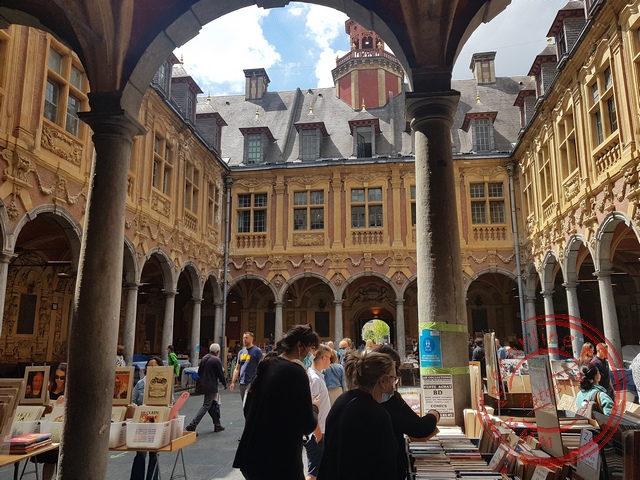
At the Opera House and the new stock exchange, we reach Place du Théâtre. This square, together with Place du Général de Gaulle, forms the heart of Lille. The two are separated by the old stock exchange, a 1652 building whose inner courtyard hosts a daily book market. People browse among old books in search of treasures, while some tourists come mainly to admire the architecture. We leave the old stock exchange toward the De Gaulle square. Charles de Gaulle, an important general during the Second World War and later a French statesman, was born in Lille. His birthplace stands in one of the side streets. In the middle of the square stands the 1845 statue La Colonne de la Déesse. At one of the lively terraces, we order a beer. Unlike in many other French cities, in Lille beer is the drink of choice. The look of the square feels more Belgian than French, due in part to the Flemish history. The region was often contested between the French, Dutch, and Austrians. In the 1713 Treaty of Utrecht, Lille was ceded to France. For a snack, we opt for a Belgian treat: fries. The medium portions turn out to be far larger than expected — one bag would have been enough for both of us. The old town is a maze of narrow streets, each more charming than the last. Some houses date from the 15th century, with many decorated with sculptures and paintings. Angels above the windows, for instance, mark where the next house begins. Through small streets and gateways, we reach the Notre-Dame de la Treille Cathedral. Its façade is modern, but the rear is Gothic. It almost looks as if its towers are missing. Were they destroyed, perhaps in a bombardment? The explanation inside the church tells a different story: construction began in 1854 with the Mary chapel, now located at the far back. Over time, more chapels were added, leading to the entire rear and side aisles. By 1947, the decision was made to stop investing in the building due to high costs. The front was left unfinished until 1999, when the current modern façade was completed.

In the daytime, thin marble panels allow daylight inside; at night, they are illuminated from within, visible from the outside. We head toward the citadel, west of the centre, passing the Saint Catherine Church, with a mix of Romanesque and Gothic interiors. Near the Deûle river, we find only a large car park. According to the map, the citadel lies beyond. Hundreds of people are enjoying the park — children in the playground, long queues for the zoo. The citadel itself is still used by the French army and not open to the public. While the signs suggest entry is forbidden, we follow other visitors through the gate. Inside, we find a second gate to the fortress. Built in the late 17th century on Louis XIV’s orders, the citadel remains an imposing sight. In the late afternoon, we sit at a terrace on the square in front of the cathedral. It’s busy — nearly all the seats are taken, and people are sitting under the trees on the grass. Young people skate nearby. We choose Beer Square, a bar with twenty beers on tap. Each tap is numbered, making it easy to select one, though we must remember to wear masks when going inside — this is checked at the entrance. After a short break at the hotel, we head out again in the evening. The centre is still bustling, terraces full. Now that the sun has set, it’s cooler. We find a pleasant restaurant on Place des Oignons, with a sheltered outdoor terrace. We order Welsh au Maroilles, a Flemish speciality, along with a special beer — a perfect way to round off our first day in Lille.
 France
  The old stock exchange building dominates Lilles main square
 The Gothic Saint Mauritius Church of Lille
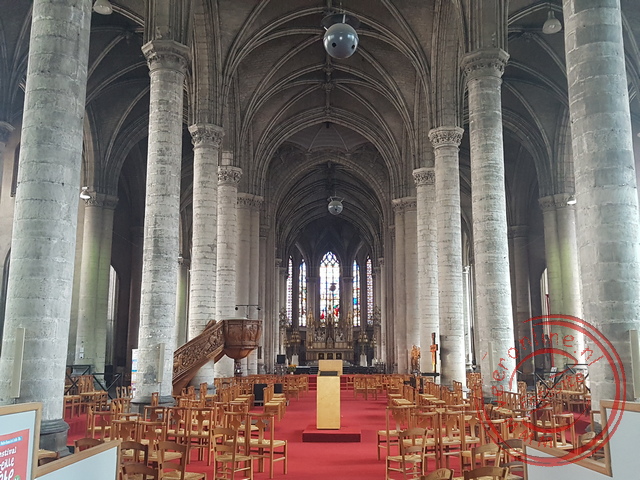 Construction of the Mauritius Church began in the 14th century
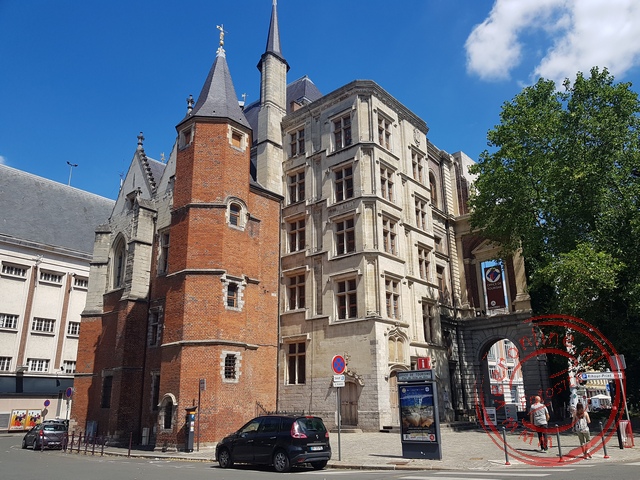 The former palace from 1454 now houses the Tourist Information