
154 countries
(and areas)
 - Azerbaijan
- Bahrain
- Barbados
- Belgium
- Belize
- Benin
- Bhutan
- Bolivia
- Bonaire
- Bosnia and Herzegovina
- Botswana
- Brazil
- British Virgin Islands
- Brunei
- Bulgaria
- Cambodia
- Canada
- Cape Verde
- Chile
- China
- Costa Rica
- Croatia
- Cuba
- Curacao
- Cyprus
- Czech Republic
- Denmark
- Dominica
- Dominican Republic
- Egypt
- El Salvador
- England
- Estonia
- Eswatini (Swaziland)
- Ethiopia
- Fiji
- Finland
- France
- French Guiana
- Georgia
- Germany
- Gibraltar
- Greece
- Grenada
- Guadeloupe
- Guatemala
- Honduras
- Hong Kong
- Hungary
- Iceland
- India
- Indonesia
- Iran
- Ireland
- Israel
- Italy
- Jamaica
- Japan
- Jordan
- Kazakhstan
- Kenya
- Kosovo
- Kuwait
- Kyrgyzstan
- Laos
- Latvia
- Lebanon
- Lesotho
- Liechtenstein
- Lithuania
- Luxembourg
- Macau
- Madagascar
- Malawi
- Malaysia
- Maldives
- Malta
- Martinique
- Mexico
- Moldova
- Monaco
- Mongolia
- Montenegro
- Morocco
- Mozambique
- Namibia
- Nepal
- Netherlands
- New Zealand
- Nicaragua
- North Macedonia
- Northern Ireland
- Norway
- Oman
- Pakistan
- Palestine
- Peru
- Philippines
- Poland
- Portugal
- Qatar
- Republic of Korea
- Romania
- Russia
- Saint Kitts and Nevis
- Saint Lucia
- Saint Martin
- Saint Vincent and the Grenadines
- San Marino
- São Tomé and Principe
- Saudi Arabia
- Scotland
- Senegal
- Serbia
- Singapore
- Sint Maarten
- Slovakia
- Slovenia
- South Africa
- Spain
- Sri Lanka
- Suriname
- Sweden
- Switzerland
- Tajikistan
- Tanzania
- Thailand
- The Gambia
- Tibet
- Togo
- Transnistria
- Trinidad and Tobago
- Tunisia
- Turkey
- Turkmenistan
- Uganda
- United Arab Emirates
- United States
- Uruguay
- Uzbekistan
- Vatican City
- Vietnam
- Wales
- Zambia
- Zanzibar
- Azerbaijan
- Bahrain
- Barbados
- Belgium
- Belize
- Benin
- Bhutan
- Bolivia
- Bonaire
- Bosnia and Herzegovina
- Botswana
- Brazil
- British Virgin Islands
- Brunei
- Bulgaria
- Cambodia
- Canada
- Cape Verde
- Chile
- China
- Costa Rica
- Croatia
- Cuba
- Curacao
- Cyprus
- Czech Republic
- Denmark
- Dominica
- Dominican Republic
- Egypt
- El Salvador
- England
- Estonia
- Eswatini (Swaziland)
- Ethiopia
- Fiji
- Finland
- France
- French Guiana
- Georgia
- Germany
- Gibraltar
- Greece
- Grenada
- Guadeloupe
- Guatemala
- Honduras
- Hong Kong
- Hungary
- Iceland
- India
- Indonesia
- Iran
- Ireland
- Israel
- Italy
- Jamaica
- Japan
- Jordan
- Kazakhstan
- Kenya
- Kosovo
- Kuwait
- Kyrgyzstan
- Laos
- Latvia
- Lebanon
- Lesotho
- Liechtenstein
- Lithuania
- Luxembourg
- Macau
- Madagascar
- Malawi
- Malaysia
- Maldives
- Malta
- Martinique
- Mexico
- Moldova
- Monaco
- Mongolia
- Montenegro
- Morocco
- Mozambique
- Namibia
- Nepal
- Netherlands
- New Zealand
- Nicaragua
- North Macedonia
- Northern Ireland
- Norway
- Oman
- Pakistan
- Palestine
- Peru
- Philippines
- Poland
- Portugal
- Qatar
- Republic of Korea
- Romania
- Russia
- Saint Kitts and Nevis
- Saint Lucia
- Saint Martin
- Saint Vincent and the Grenadines
- San Marino
- São Tomé and Principe
- Saudi Arabia
- Scotland
- Senegal
- Serbia
- Singapore
- Sint Maarten
- Slovakia
- Slovenia
- South Africa
- Spain
- Sri Lanka
- Suriname
- Sweden
- Switzerland
- Tajikistan
- Tanzania
- Thailand
- The Gambia
- Tibet
- Togo
- Transnistria
- Trinidad and Tobago
- Tunisia
- Turkey
- Turkmenistan
- Uganda
- United Arab Emirates
- United States
- Uruguay
- Uzbekistan
- Vatican City
- Vietnam
- Wales
- Zambia
- Zanzibar


Copyright 2004 - 2026
Veeronline.nl Travel Adventures

Home > Saudi Arabia > Fascinating Saudi Arabia > Travelogue day 3
Travelogue Fascinating Saudi Arabia
October 823 2022 (16 days)
Saudi Arabia > Offroad to 'the Edge'
Dag 3 - Monday 10 October 2022I slept much better last night. Just before the alarm went off, I woke up. When we called for breakfast, we were told that we hadn’t left the breakfast plates from yesterday in the hallway. But we did. No one seems to enter the apartment when we’re not there — neither to clean nor to bring fresh towels. The breakfast is similar to yesterday’s, except the yogurt has been replaced by some kind of brown bean soup. Strange for breakfast. It resembles the dish we ate last night. At eight o’clock, we get in the car. We head to the "Edge of the World," a cliff about ninety kilometers outside Riyadh. There are two routes to get there. The southern route goes through loose sand and is only passable by 4x4 vehicles. The last part of the northern route is also off-road but more solid over rocky terrain. The morning rush hour in Riyadh is manageable — at least going out of the city. On the other side of the highway, there are heavy traffic jams. We are getting used to driving through the city, weaving a bit from lane to lane. Meanwhile, other cars try to overtake on the left and right. Outside Riyadh, the traffic quickly decreases. There are no houses or buildings anymore. We drive through a vast landscape of sand and rocks. Occasionally we pass a village. Here, you have to watch out for speed bumps. They are so high that you can only pass them at walking speed. They are often the same color as the asphalt. After about an hour of driving, we arrive at the exit to the dam. Just before the dam, an unpaved gravel road begins. A large herd of camels appears in front of us. Slowly, a group of about thirty animals passes by our car. Some look curiously inside. The gravel road is an unpaved path, more like a trace of previous vehicles. You have to watch out for protruding rocks and stones on the road. At the first dry creek, we face a challenge. A bumpy track with deep holes leads to the creek bed. Can we cross this with this car? We do drive an SUV but don’t have four-wheel drive.

By giving instructions to the driver, we manage to get the car over the best part of the road. Hopefully, it won’t get worse further on. The road winds through the rocky landscape. Often, it’s impossible to drive faster than twenty kilometers per hour. The car shakes and rattles as we drive over the rocky road. Several times we pass dry rivers or large boulders. Each time, with directions, we manage to get the car over the obstacles. It is clearly a road meant for off-road vehicles. We realize we only have one spare tire with us, and this does not seem like a road many cars use for help. Fingers crossed it goes well. About two kilometers before the end point, there is a stone wall. It seems as if someone tried to block the road here. Other cars have made a track over the barrier. We follow the track. The wheels slip a little, but we get over the obstacle without too much trouble. When the navigation shows two hundred meters to the destination, we face a second raised barrier. Although there are tire tracks here too, this hill seems too high for our Chinese rental car. We park the car and continue on foot. The top lies a few hundred meters ahead. We look down into the deep valley. What a beautiful place. In front of us is a steep ‘Edge of the World’ cliff. The rock is about 300 meters high. There is a narrow path leading there. To the left is the deep valley.

To get to the ‘edge,’ we have to descend a little, then the path climbs again to the top of the cliff. Around us is a magnificent view. The hour of off-roading was definitely worth it. But we have to return as well. The way back is the same, with the same obstacles. We get better at it. We always choose the best part of the road. By giving directions at difficult parts, we manage to get the car over without problems. Without damage or flat tires, we return to the paved road around half past one. On the way back to Riyadh, we visit the old historic town ‘Old Diriyah.’ It’s not entirely clear if the town is open for visitors. According to Lonely Planet, the complex has been under maintenance for years. We’ll see. Halfway through the route, we stop in a town to get something to drink. We also order a sandwich. With full stomachs, we continue to Diriyah. Diriyah was originally the capital of the first Saudi state. The mud district has been on the UNESCO World Heritage list since 2010. The navigation takes us to a large roundabout in the city. This is not the historic center. On a second attempt, we come closer. We see the dry Wadi Hania and signs to Diriyah. The road where we expect the historic center to be is closed. A guard directs us into Diriyah. There is a museum and a souq, he says. This is not what we are looking for. We try the other side. There is a lot of construction. It turns out a large complex is being built around the historic old mud town. We drive onto a parking lot, probably used by construction workers. We see an entrance and walk into the complex. The workers look but no one asks us to leave. Just before the historic town, a guard does. The complex will only open in twenty days, he apologizes. It is not accessible. We see the old mud houses on the other side of Wadi Hania. The new complex being built has a kind of theme-park feel. We doubt if this benefits the World Heritage status.

The guard gestures that we may still walk up in the new section for the view. From above, we mostly see construction work. There is still a lot to do in the next twenty days. We return to our car. Yesterday, we tried to exchange money at a bank. Apparently, exchanging outside Riyadh and Jeddah is difficult. For many booked hotels, we need cash. We haven’t seen exchange offices on the streets. At the bank, it didn’t work because we had no account there. They did give us an address of an exchange office in Riyadh. The office opens at four in the afternoon. Just after four, we arrive at the exchange office. The man is not surprised we want to exchange a large amount but struggles with older fifty-euro notes. Only the new bills can be exchanged. With enough cash for the coming days, we drive to the Grand Mosque on the north side of the city. It’s relatively close to the exchange office and we don’t have to drive through the whole city during rush hour. With all the traffic jams, that would be nearly impossible. Even the short distance to the mosque takes relatively long. Not only because of traffic but also because the exit at the mosque is closed. The next exit is ten kilometers further. We practically end up back at the airport. At a gas station, we fill the car tank. Convenient for tomorrow when we drive a long way toward Qassim. Next to the gas station is a car wash. The car got quite dirty after this morning’s off-road trip. We have it washed. When we try the mosque again, dusk is setting in. The mosque looks beautiful with the setting sun. It is almost six o’clock when we head to the hotel.

The navigation says eleven minutes, but with traffic it will be longer. We often stop on the wide boulevards. Eventually, we arrive forty minutes later at our hotel. There is no parking space in front of the hotel. We park at the back entrance. We keep dinner simple. We go to the same restaurant where we ate yesterday. We choose two dishes we tasted from other guests yesterday. Masoob is a typical Yemeni dish with mashed bread, banana, honey, and cheese as topping. Most of the staff come from Yemen. They are happy we came back. “May we take a photo of you?” and we of them.
 Saudi Arabia
  The fort in Tabuk served to protect the water source
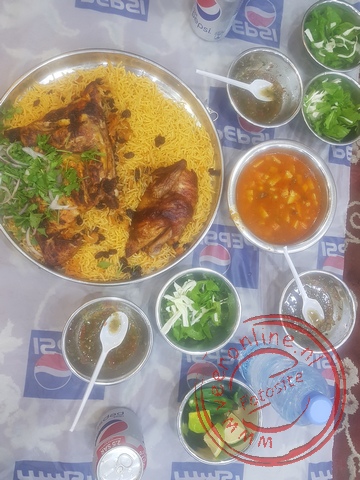 A tasty meal with chicken and rice as the base
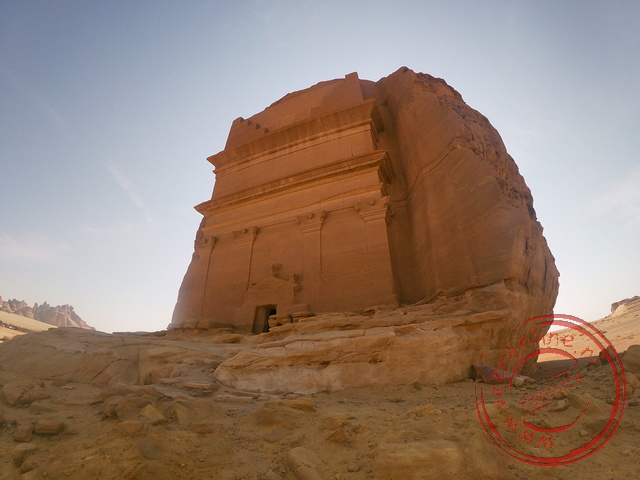 The twentymeterhigh freestanding tomb of AlFarid
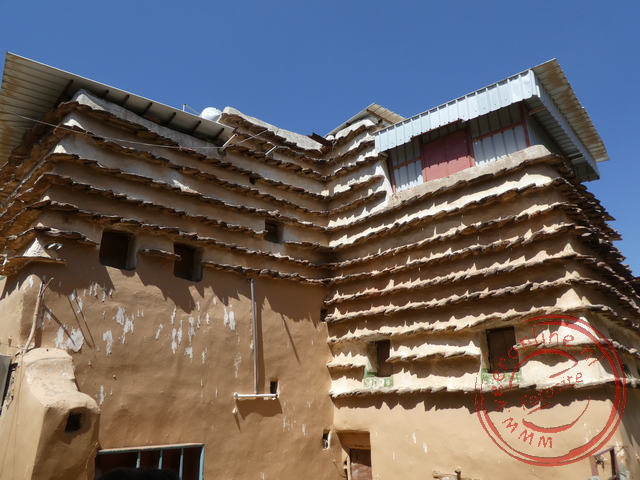 The architecture of the houses so characteristic of southern Saudi Arabia
Travelogue Fascinating Saudi Arabia
Dag 2 | Saudi Arabia > The Skybridge in Riyadh
Dag 3 | Saudi Arabia > Offroad to 'the Edge'
Dag 4 | Saudi Arabia > The Mud City of Ushaiger
Dag 5 | Saudi Arabia > The Forts of Ha'il
Dag 6 | Saudi Arabia > The Stonehenge of Saudi Arabia
Dag 7 | Saudi Arabia > The Castle of Tabuk
Dag 8 | Saudi Arabia > Overnight in Wadi Al Disah
Dag 9 | Saudi Arabia > The Historic Old Town of Al'Ula
Dag 10 | Saudi Arabia > The Tombs of Madain Saleh
Dag 11 | Saudi Arabia > The Flight to Abha
Dag 12 | Saudi Arabia > The Rijal Almaa Open-Air Museum
Dag 13 | Saudi Arabia > We Got Hit ...
Dag 14 | Saudi Arabia > The Flight to Jeddah
Dag 15 | Saudi Arabia > The Old Centre of Jeddah
Dag 16 | Saudi Arabia > Back to the Netherlands