
154 countries
(and areas)
 - Azerbaijan
- Bahrain
- Barbados
- Belgium
- Belize
- Benin
- Bhutan
- Bolivia
- Bonaire
- Bosnia and Herzegovina
- Botswana
- Brazil
- British Virgin Islands
- Brunei
- Bulgaria
- Cambodia
- Canada
- Cape Verde
- Chile
- China
- Costa Rica
- Croatia
- Cuba
- Curacao
- Cyprus
- Czech Republic
- Denmark
- Dominica
- Dominican Republic
- Egypt
- El Salvador
- England
- Estonia
- Eswatini (Swaziland)
- Ethiopia
- Fiji
- Finland
- France
- French Guiana
- Georgia
- Germany
- Gibraltar
- Greece
- Grenada
- Guadeloupe
- Guatemala
- Honduras
- Hong Kong
- Hungary
- Iceland
- India
- Indonesia
- Iran
- Ireland
- Israel
- Italy
- Jamaica
- Japan
- Jordan
- Kazakhstan
- Kenya
- Kosovo
- Kuwait
- Kyrgyzstan
- Laos
- Latvia
- Lebanon
- Lesotho
- Liechtenstein
- Lithuania
- Luxembourg
- Macau
- Madagascar
- Malawi
- Malaysia
- Maldives
- Malta
- Martinique
- Mexico
- Moldova
- Monaco
- Mongolia
- Montenegro
- Morocco
- Mozambique
- Namibia
- Nepal
- Netherlands
- New Zealand
- Nicaragua
- North Macedonia
- Northern Ireland
- Norway
- Oman
- Pakistan
- Palestine
- Peru
- Philippines
- Poland
- Portugal
- Qatar
- Republic of Korea
- Romania
- Russia
- Saint Kitts and Nevis
- Saint Lucia
- Saint Martin
- Saint Vincent and the Grenadines
- San Marino
- São Tomé and Principe
- Saudi Arabia
- Scotland
- Senegal
- Serbia
- Singapore
- Sint Maarten
- Slovakia
- Slovenia
- South Africa
- Spain
- Sri Lanka
- Suriname
- Sweden
- Switzerland
- Tajikistan
- Tanzania
- Thailand
- The Gambia
- Tibet
- Togo
- Transnistria
- Trinidad and Tobago
- Tunisia
- Turkey
- Turkmenistan
- Uganda
- United Arab Emirates
- United States
- Uruguay
- Uzbekistan
- Vatican City
- Vietnam
- Wales
- Zambia
- Zanzibar
- Azerbaijan
- Bahrain
- Barbados
- Belgium
- Belize
- Benin
- Bhutan
- Bolivia
- Bonaire
- Bosnia and Herzegovina
- Botswana
- Brazil
- British Virgin Islands
- Brunei
- Bulgaria
- Cambodia
- Canada
- Cape Verde
- Chile
- China
- Costa Rica
- Croatia
- Cuba
- Curacao
- Cyprus
- Czech Republic
- Denmark
- Dominica
- Dominican Republic
- Egypt
- El Salvador
- England
- Estonia
- Eswatini (Swaziland)
- Ethiopia
- Fiji
- Finland
- France
- French Guiana
- Georgia
- Germany
- Gibraltar
- Greece
- Grenada
- Guadeloupe
- Guatemala
- Honduras
- Hong Kong
- Hungary
- Iceland
- India
- Indonesia
- Iran
- Ireland
- Israel
- Italy
- Jamaica
- Japan
- Jordan
- Kazakhstan
- Kenya
- Kosovo
- Kuwait
- Kyrgyzstan
- Laos
- Latvia
- Lebanon
- Lesotho
- Liechtenstein
- Lithuania
- Luxembourg
- Macau
- Madagascar
- Malawi
- Malaysia
- Maldives
- Malta
- Martinique
- Mexico
- Moldova
- Monaco
- Mongolia
- Montenegro
- Morocco
- Mozambique
- Namibia
- Nepal
- Netherlands
- New Zealand
- Nicaragua
- North Macedonia
- Northern Ireland
- Norway
- Oman
- Pakistan
- Palestine
- Peru
- Philippines
- Poland
- Portugal
- Qatar
- Republic of Korea
- Romania
- Russia
- Saint Kitts and Nevis
- Saint Lucia
- Saint Martin
- Saint Vincent and the Grenadines
- San Marino
- São Tomé and Principe
- Saudi Arabia
- Scotland
- Senegal
- Serbia
- Singapore
- Sint Maarten
- Slovakia
- Slovenia
- South Africa
- Spain
- Sri Lanka
- Suriname
- Sweden
- Switzerland
- Tajikistan
- Tanzania
- Thailand
- The Gambia
- Tibet
- Togo
- Transnistria
- Trinidad and Tobago
- Tunisia
- Turkey
- Turkmenistan
- Uganda
- United Arab Emirates
- United States
- Uruguay
- Uzbekistan
- Vatican City
- Vietnam
- Wales
- Zambia
- Zanzibar


Copyright 2004 - 2026
Veeronline.nl Travel Adventures

Home > Tanzania > Kenya and Tanzania > Travelogue day 14
Travelogue Kenya and Tanzania
January 14 February 4 2023 (22 days)
Tanzania > The Ngorongoro Crater
Dag 14 - Friday, January 27, 2023I wake up before my alarm, even though it’s set for a quarter past five. During the night, I heard animals right near my tent. I suspect hyenas. I get dressed and pack my bags. Patrick is already ready to help take down the tent. Everyone managed to sleep reasonably well on the extra mats and dried-out sleeping bags. Even though it’s our last night in tents, the wet mats still need to come along. There’s no choice but to roll them up tightly as they are. Maybe we can dry them at our next destination. Meanwhile, Silvia has prepared both breakfast and lunch. I pack my lunch into a lunchbox for the road. For breakfast, I have an omelet. Around six o’clock, just as the sun is coming up, we set off. This morning, we combine the game drive with our transport to the Ngorongoro Crater, which borders the Serengeti. As before, we won’t stop for every animal, only for the more special ones. With the side windows rolled down, it’s even a bit chilly. Luckily, I still have my sweater on. On the roadside, an elephant is grazing. I estimate the distance to be less than five meters from our truck. As it eats, it slowly moves toward us. Zak starts the vehicle and gives the elephant space to pass. Farther along, a male lion walks down the road, weaving between the jeeps and heading straight toward our truck. Without even glancing our way, the lion walks alongside the vehicle and continues behind us. We drive through the vast open plains of the Serengeti—the very landscape that gave the park its name. In one of the sparse roadside bushes sits a secretary bird. It stays perched for a moment before taking off, revealing its massive wingspan. Out on the open plain, atop a termite mound, a cheetah scans for prey. It surveys large herds of zebras and wildebeests. Zebras have sharp eyesight, wildebeests have a keen sense of smell, and together they keep watch. This part of the Serengeti holds thousands of animals.

During the Great Migration, millions gather here. At this time of year, many animals are in the Maasai Mara Reserve to give birth. Serengeti National Park borders Ngorongoro National Park, with the administrative handover taking place atop a hill in the park. While Patrick handles the paperwork, I climb up to the viewpoint. From the top of the rocks, I see the Serengeti’s endless plains stretching in all directions, the herds now just tiny specks. Though this is the administrative boundary, it’s still about an hour’s drive to the park’s actual border—an hour on bumpy roads where everything shakes. One of the window holders even snaps off. To be safe, we open all the windows. Outside, I see countless zebra and wildebeest herds. I keep an eye on the trees, hoping to spot a leopard—my last chance, since they’re rarely seen in the Ngorongoro Crater. It seems I won’t be ticking the Big Five off my list this trip either. The difference between the two parks is that Serengeti is a national park, where no human activity is allowed, while Ngorongoro is a reserve where African tribes live. As soon as we enter the Ngorongoro Conservation Area, we see Maasai tribespeople. Clad in their colorful, mostly red robes, they walk along the roadside. Others herd goats and sheep in this extremely dry area, with little vegetation for shade. Passing traffic kicks up huge clouds of dust. Life here must be hard. In the distance, the contours of the crater come into view. Formed by a volcanic eruption three million years ago, the mountain’s peak collapsed inward. The crater rim is six hundred meters high, and its diameter is 19 kilometers. It’s an ideal habitat for large concentrations of lions, elephants, rhinos, and countless other species.

Suddenly, we hear a hissing sound—a flat rear tire. Zak isn’t fazed. The truck has double tires on each side, so we keep going. We pass giraffes feeding on low shrubs—funny to see them having to bend down despite their long necks. Giraffes don’t occur in the crater; the rim is too steep for them. The same goes for our truck. At the top, we transfer into three Land Cruisers with raised roofs so we can stand up. Zak and Silvia drive the truck to our lodge in Karatu Town, where we’ll be dropped off later. Rafael is my driver, and I share the vehicle with four other travel companions. Carefully, Rafael guides us down the narrow, steep road into the crater. We look out over the crater floor, the lake, and the grazing herds below. The crater is much more open than I’d expected—I thought there would be more vegetation. While this gives us good views of the animals, they’re often at a considerable distance. Perhaps we’ve been spoiled by the close-up encounters in the Serengeti. Inside the crater, we see large groups of zebras, wildebeests, topis, and Thomson’s gazelles. At the water’s edge, flamingos and storks stand, while a few hippos rest in the water. Suddenly, we spot a lion in the grass. Once it moves slightly, it nearly disappears from sight again. We may have already passed several predators without noticing. At the lake’s edge, we take a break and are allowed out of the vehicles. One of my fellow travelers opens her lunchbox, only for a few hefty kites to swoop down and steal it in a precision dive. The box is empty in seconds. I play it safe and buy a beer from a small stand. Since no waste can be left in the park, I have to drink it on the spot. After the break, we head toward the other exit. Just as I’ve given up hope, Rafael spots two rhinos on the crater’s edge, several hundred meters away—too far to see well.
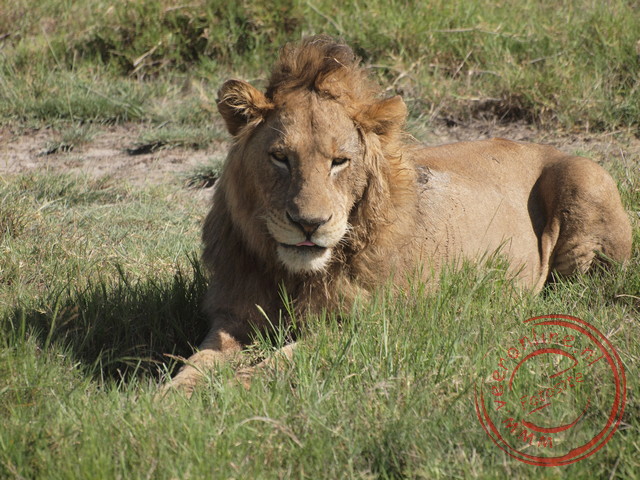
On the opposite side, we find another one, also far off. These are black rhinos; the ones I saw earlier in Nuburu were white rhinos. Along the roadside, a jeep is stopped. Could something be here? We pull over but see nothing—until we realize we’re looking past it. Right beside the road lies a sleeping lioness. We’re practically next to her. While we watch, two male lions approach. They must be brothers, Rafael explains, because otherwise they wouldn’t tolerate each other. A few females follow behind. The lions settle right beside our vehicle. One male crosses the road and lies down about fifty meters away, gazing at the growing line of vehicles. A lioness lies in the shade of the car behind us. How special it is to be this close to lions. The road out of the crater is as steep as the way in. With each bend, the view of the crater grows more beautiful. We drive along the rim, crater on the left, the landscape beyond on the right. At the highest point is a viewpoint—a perfect spot for a group photo. From here, it’s another hour to the Flamingo Lodge in Karatu Town. It’s wonderful to have a hot shower and a proper bed again. I even take a swim in the pool. We’ve asked Silvia to cook for us for two more evenings, and she’s prepared a delicious meal. The hotel had hoped we’d dine with them and complained to Patrick, but he told them he respects the guests’ choices. After dinner, I have another beer in the lobby. The internet struggles to cope, and I manage to send just a few messages. The beer doesn’t sit well, so I head to my room. I have trouble falling asleep and feel a bit nauseous—maybe from fatigue or the food. I take a paracetamol, hoping it will help. Eventually, I drift off.
 Tanzania

 Kenya
Kenya 
Travelogue Kenya and Tanzania
Dag 2 | Kenya > Camping near Mount Kenya
Dag 3 | Kenya > The Samburu National Reserve
Dag 4 | Kenya > Visiting the Samburu tribe
Dag 5 | Kenya > To the Thompson Falls
Dag 6 | Kenya > Rhinos in Nakuru N.P.
Dag 7 | Kenya > To the Keiyo Valley
Dag 8 | Kenya > Hiking in the Kerio Valley
Dag 9 | Kenya > The Mago School Project
Dag 10 | Kenya > Across the Tanzanian border
Dag 11 | Tanzania > Musoma on Lake Victoria
Dag 12 | Tanzania > To the Serengeti
Dag 13 | Tanzania > Tents blown over
Dag 14 | Tanzania > The Ngorongoro Crater
Dag 15 | Tanzania > Cycling through Karatu Town
Dag 16 | Tanzania > We're not allowed to leave
Dag 17 | Tanzania > Slave Market of Stone Town
Dag 18 | Zanzibar > Snorkeling at Fumba
Dag 19 | Zanzibar > Walking along the beach
Dag 20 | Zanzibar > Extra day on Zanzibar
Dag 21 | Zanzibar > Farewell to Zanzibar
Dag 22 | Zanzibar > Cold weather in the Netherlands