
154 countries
(and areas)
 - Belize
- Benin
- Bhutan
- Bolivia
- Bonaire
- Bosnia and Herzegovina
- Botswana
- Brazil
- British Virgin Islands
- Brunei
- Bulgaria
- Cambodia
- Canada
- Cape Verde
- Chile
- China
- Costa Rica
- Croatia
- Cuba
- Curacao
- Cyprus
- Czech Republic
- Denmark
- Dominica
- Dominican Republic
- Egypt
- El Salvador
- England
- Estonia
- Eswatini (Swaziland)
- Ethiopia
- Fiji
- Finland
- France
- French Guiana
- Georgia
- Germany
- Gibraltar
- Greece
- Grenada
- Guadeloupe
- Guatemala
- Honduras
- Hong Kong
- Hungary
- Iceland
- India
- Indonesia
- Iran
- Ireland
- Israel
- Italy
- Jamaica
- Japan
- Jordan
- Kazakhstan
- Kenya
- Kosovo
- Kuwait
- Kyrgyzstan
- Laos
- Latvia
- Lebanon
- Lesotho
- Liechtenstein
- Lithuania
- Luxembourg
- Macau
- Madagascar
- Malawi
- Malaysia
- Maldives
- Malta
- Martinique
- Mexico
- Moldova
- Monaco
- Mongolia
- Montenegro
- Morocco
- Mozambique
- Namibia
- Nepal
- Netherlands
- New Zealand
- Nicaragua
- North Macedonia
- Northern Ireland
- Norway
- Oman
- Pakistan
- Palestine
- Peru
- Philippines
- Poland
- Portugal
- Qatar
- Republic of Korea
- Romania
- Russia
- Saint Kitts and Nevis
- Saint Lucia
- Saint Martin
- Saint Vincent and the Grenadines
- San Marino
- São Tomé and Principe
- Saudi Arabia
- Scotland
- Senegal
- Serbia
- Singapore
- Sint Maarten
- Slovakia
- Slovenia
- South Africa
- Spain
- Sri Lanka
- Suriname
- Sweden
- Switzerland
- Tajikistan
- Tanzania
- Thailand
- The Gambia
- Tibet
- Togo
- Transnistria
- Trinidad and Tobago
- Tunisia
- Turkey
- Turkmenistan
- Uganda
- United Arab Emirates
- United States
- Uruguay
- Uzbekistan
- Vatican City
- Vietnam
- Wales
- Zambia
- Zanzibar
- Belize
- Benin
- Bhutan
- Bolivia
- Bonaire
- Bosnia and Herzegovina
- Botswana
- Brazil
- British Virgin Islands
- Brunei
- Bulgaria
- Cambodia
- Canada
- Cape Verde
- Chile
- China
- Costa Rica
- Croatia
- Cuba
- Curacao
- Cyprus
- Czech Republic
- Denmark
- Dominica
- Dominican Republic
- Egypt
- El Salvador
- England
- Estonia
- Eswatini (Swaziland)
- Ethiopia
- Fiji
- Finland
- France
- French Guiana
- Georgia
- Germany
- Gibraltar
- Greece
- Grenada
- Guadeloupe
- Guatemala
- Honduras
- Hong Kong
- Hungary
- Iceland
- India
- Indonesia
- Iran
- Ireland
- Israel
- Italy
- Jamaica
- Japan
- Jordan
- Kazakhstan
- Kenya
- Kosovo
- Kuwait
- Kyrgyzstan
- Laos
- Latvia
- Lebanon
- Lesotho
- Liechtenstein
- Lithuania
- Luxembourg
- Macau
- Madagascar
- Malawi
- Malaysia
- Maldives
- Malta
- Martinique
- Mexico
- Moldova
- Monaco
- Mongolia
- Montenegro
- Morocco
- Mozambique
- Namibia
- Nepal
- Netherlands
- New Zealand
- Nicaragua
- North Macedonia
- Northern Ireland
- Norway
- Oman
- Pakistan
- Palestine
- Peru
- Philippines
- Poland
- Portugal
- Qatar
- Republic of Korea
- Romania
- Russia
- Saint Kitts and Nevis
- Saint Lucia
- Saint Martin
- Saint Vincent and the Grenadines
- San Marino
- São Tomé and Principe
- Saudi Arabia
- Scotland
- Senegal
- Serbia
- Singapore
- Sint Maarten
- Slovakia
- Slovenia
- South Africa
- Spain
- Sri Lanka
- Suriname
- Sweden
- Switzerland
- Tajikistan
- Tanzania
- Thailand
- The Gambia
- Tibet
- Togo
- Transnistria
- Trinidad and Tobago
- Tunisia
- Turkey
- Turkmenistan
- Uganda
- United Arab Emirates
- United States
- Uruguay
- Uzbekistan
- Vatican City
- Vietnam
- Wales
- Zambia
- Zanzibar


Copyright 2004 - 2026
Veeronline.nl Travel Adventures

Home > Tanzania > Kenya and Tanzania > Travelogue day 17
Travelogue Kenya and Tanzania
January 14 February 4 2023 (22 days)
Tanzania > Slave Market of Stone Town
Dag 17 - Monday, January 30, 2023
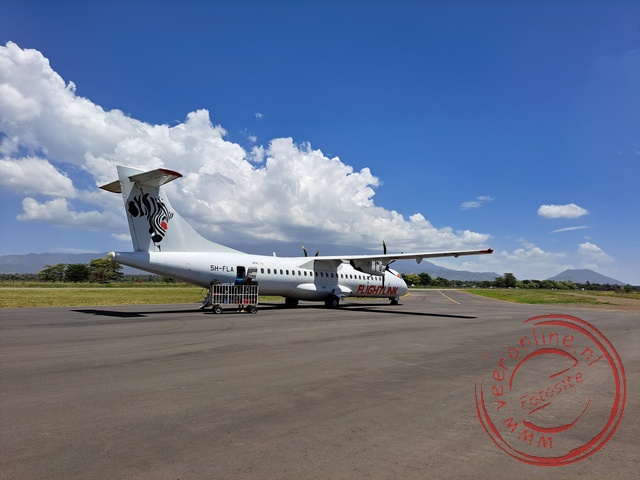
I wake up around seven o’clock. I actually feel pretty decent—it could have been worse. I take a nice warm shower and shave. With a clean T-shirt on, I already feel much better. At breakfast, I limit myself to a broth soup, toast, and tea. At least it tastes good. Several fellow travelers now have stomach problems. Odd that this happens on the first day Silvia is no longer cooking. At half past ten, we get into the truck for the last time. In twenty minutes, Zak drives us to the airport. I give Silvia and Zak a warm hug goodbye. The luggage is weighed on an old-fashioned scale under a canopy. I doubt anyone actually does anything with the results. The baggage tag is generic—no link to the suitcase’s owner. Around a quarter to one, someone calls out that the flight to Zanzibar is boarding. Boarding passes are collected, and then we are escorted on foot to the plane. One of the staff says that Kilimanjaro will be visible from the left side of the plane. I choose a window seat on that side. A little later, the small propeller plane with sixty passengers on board takes off for Zanzibar. I see Arusha getting smaller beneath me, but I do not see Africa’s highest mountain. When I ask Patrick when the mountain will appear, he tells me we’ve already passed it—it was visible right after takeoff. Strange. I didn’t see a thing. After exactly one hour, the plane lands at Zanzibar Airport. This is clearly a larger airport. Instead of walking to the terminal, a bus now takes us there.
In the arrivals hall, the visa is checked. I’m also handed an entry form. Afterward, it’s unclear where this should be handed in—none of the counters are staffed. Someone from another office gestures for us to just walk on to the baggage carousel. While I’m waiting for my suitcase, someone comes to collect the entry forms. No idea what the point of that was. Outside the airport, I meet Moesa, the local driver. He drives us to our hotel in Stone Town, the capital of Zanzibar, in twenty minutes. Since ancient times, it has been a hub for Arab, Persian, Indian, and African traders. In the 19th century, Zanzibar became a center for the slave trade. After the revolution in 1964, it became an autonomous region of Tanzania. The island, however, still has its own president, flag, and language. The Mizingani Seafront Hotel is right by the sea. Ferries to Dar es Salaam depart from in front of the hotel. Built in a Moroccan style, it has beautiful rooms arranged around a swimming pool. My room is on the second floor, overlooking the pool. In the afternoon, I walk into Stone Town with a few fellow travelers. We first eat something simple at a restaurant by the water. I choose a soup—it shouldn’t take long to prepare. This gives us a little time to explore the city. Via the boulevard, we reach the fort. The Old Fort of Stone Town, also known as Ngome Kongwe, is one of the oldest buildings in the city. Built in the late 17th century by the Omani Arabs, the fort originally served to defend the island. Today, it functions as a cultural center, with shops and an amphitheater. The towers house art studios. Behind the fort begins the old town—a maze of narrow streets.

Everywhere, the streets are bustling with activity. It’s not hard to get lost here. We ask several times for directions to the slave market. We probably don’t follow the instructions exactly, because we seem to be circling around it. Since we don’t really know what to expect from this market, we check every square we come across to see if it might be the place. A tuk-tuk driver points us toward the last stretch. “It’s just around the corner,” he says kindly. The slave market is more like a museum. First, we go through a security check, then we buy an entrance ticket. The market can only be visited with a guide. Amok walks with us. We first enter the Anglican church. Amok explains that until 1873, slaves were traded at this location. It was mainly the Arabs who gave the slaves the choice of converting to Islam or being taken away as slaves. After 1873, construction began on the church and a small school. The founder of the church died before it was completed; he is buried behind the altar. Amok also tells an anecdote about the twelve marble columns. They symbolize the twelve apostles, but the columns were placed upside down. When the client saw it, he said, “Don’t worry—hakuna matata.” This later became Zanzibar’s slogan. Next to the church is the slave monument—a statue of chained slaves. We follow Amok to the former prisons: low, musty rooms where dozens of slaves were held before transport. At high tide, seawater would wash into the rooms, carrying away human waste. The tour ends with an exhibition on the slave trade. It’s a bit too much to read every panel, so we choose a few and leave the rest.

We walk back to the hotel. Since we didn’t find a suitable terrace for a drink along the way, we sit on the hotel balcony. Here, we order a drink while watching the sun set into the sea. When darkness falls, the boulevard comes alive with numerous street food stalls. Just to be safe, we don’t eat here and instead return to Mercury’s Bar restaurant, where we were earlier in the day. On the terrace, with a view of the ferries leaving for Dar es Salaam, I order a pizza.
 Tanzania
 Kenya
Kenya 


Travelogue Kenya and Tanzania
Dag 2 | Kenya > Camping near Mount Kenya
Dag 3 | Kenya > The Samburu National Reserve
Dag 4 | Kenya > Visiting the Samburu tribe
Dag 5 | Kenya > To the Thompson Falls
Dag 6 | Kenya > Rhinos in Nakuru N.P.
Dag 7 | Kenya > To the Keiyo Valley
Dag 8 | Kenya > Hiking in the Kerio Valley
Dag 9 | Kenya > The Mago School Project
Dag 10 | Kenya > Across the Tanzanian border
Dag 11 | Tanzania > Musoma on Lake Victoria
Dag 12 | Tanzania > To the Serengeti
Dag 13 | Tanzania > Tents blown over
Dag 14 | Tanzania > The Ngorongoro Crater
Dag 15 | Tanzania > Cycling through Karatu Town
Dag 16 | Tanzania > We're not allowed to leave
Dag 17 | Tanzania > Slave Market of Stone Town
Dag 18 | Zanzibar > Snorkeling at Fumba
Dag 19 | Zanzibar > Walking along the beach
Dag 20 | Zanzibar > Extra day on Zanzibar
Dag 21 | Zanzibar > Farewell to Zanzibar
Dag 22 | Zanzibar > Cold weather in the Netherlands