
154 countries
(and areas)
 - Azerbaijan
- Bahrain
- Barbados
- Belgium
- Belize
- Benin
- Bhutan
- Bolivia
- Bonaire
- Bosnia and Herzegovina
- Botswana
- Brazil
- British Virgin Islands
- Brunei
- Bulgaria
- Cambodia
- Canada
- Cape Verde
- Chile
- China
- Costa Rica
- Croatia
- Cuba
- Curacao
- Cyprus
- Czech Republic
- Denmark
- Dominica
- Dominican Republic
- Egypt
- El Salvador
- England
- Estonia
- Eswatini (Swaziland)
- Ethiopia
- Fiji
- Finland
- France
- French Guiana
- Georgia
- Germany
- Gibraltar
- Greece
- Grenada
- Guadeloupe
- Guatemala
- Honduras
- Hong Kong
- Hungary
- Iceland
- India
- Indonesia
- Iran
- Ireland
- Israel
- Italy
- Jamaica
- Japan
- Jordan
- Kazakhstan
- Kenya
- Kosovo
- Kuwait
- Kyrgyzstan
- Laos
- Latvia
- Lebanon
- Lesotho
- Liechtenstein
- Lithuania
- Luxembourg
- Macau
- Madagascar
- Malawi
- Malaysia
- Maldives
- Malta
- Martinique
- Mexico
- Moldova
- Monaco
- Mongolia
- Montenegro
- Morocco
- Mozambique
- Namibia
- Nepal
- Netherlands
- New Zealand
- Nicaragua
- North Macedonia
- Northern Ireland
- Norway
- Oman
- Pakistan
- Palestine
- Peru
- Philippines
- Poland
- Portugal
- Qatar
- Republic of Korea
- Romania
- Russia
- Saint Kitts and Nevis
- Saint Lucia
- Saint Martin
- Saint Vincent and the Grenadines
- San Marino
- São Tomé and Principe
- Saudi Arabia
- Scotland
- Senegal
- Serbia
- Singapore
- Sint Maarten
- Slovakia
- Slovenia
- South Africa
- Spain
- Sri Lanka
- Suriname
- Sweden
- Switzerland
- Tajikistan
- Tanzania
- Thailand
- The Gambia
- Tibet
- Togo
- Transnistria
- Trinidad and Tobago
- Tunisia
- Turkey
- Turkmenistan
- Uganda
- United Arab Emirates
- United States
- Uruguay
- Uzbekistan
- Vatican City
- Vietnam
- Wales
- Zambia
- Zanzibar
- Azerbaijan
- Bahrain
- Barbados
- Belgium
- Belize
- Benin
- Bhutan
- Bolivia
- Bonaire
- Bosnia and Herzegovina
- Botswana
- Brazil
- British Virgin Islands
- Brunei
- Bulgaria
- Cambodia
- Canada
- Cape Verde
- Chile
- China
- Costa Rica
- Croatia
- Cuba
- Curacao
- Cyprus
- Czech Republic
- Denmark
- Dominica
- Dominican Republic
- Egypt
- El Salvador
- England
- Estonia
- Eswatini (Swaziland)
- Ethiopia
- Fiji
- Finland
- France
- French Guiana
- Georgia
- Germany
- Gibraltar
- Greece
- Grenada
- Guadeloupe
- Guatemala
- Honduras
- Hong Kong
- Hungary
- Iceland
- India
- Indonesia
- Iran
- Ireland
- Israel
- Italy
- Jamaica
- Japan
- Jordan
- Kazakhstan
- Kenya
- Kosovo
- Kuwait
- Kyrgyzstan
- Laos
- Latvia
- Lebanon
- Lesotho
- Liechtenstein
- Lithuania
- Luxembourg
- Macau
- Madagascar
- Malawi
- Malaysia
- Maldives
- Malta
- Martinique
- Mexico
- Moldova
- Monaco
- Mongolia
- Montenegro
- Morocco
- Mozambique
- Namibia
- Nepal
- Netherlands
- New Zealand
- Nicaragua
- North Macedonia
- Northern Ireland
- Norway
- Oman
- Pakistan
- Palestine
- Peru
- Philippines
- Poland
- Portugal
- Qatar
- Republic of Korea
- Romania
- Russia
- Saint Kitts and Nevis
- Saint Lucia
- Saint Martin
- Saint Vincent and the Grenadines
- San Marino
- São Tomé and Principe
- Saudi Arabia
- Scotland
- Senegal
- Serbia
- Singapore
- Sint Maarten
- Slovakia
- Slovenia
- South Africa
- Spain
- Sri Lanka
- Suriname
- Sweden
- Switzerland
- Tajikistan
- Tanzania
- Thailand
- The Gambia
- Tibet
- Togo
- Transnistria
- Trinidad and Tobago
- Tunisia
- Turkey
- Turkmenistan
- Uganda
- United Arab Emirates
- United States
- Uruguay
- Uzbekistan
- Vatican City
- Vietnam
- Wales
- Zambia
- Zanzibar


Copyright 2004 - 2026
Veeronline.nl Travel Adventures

Home > Benin > Under the Spell of Voodoo > Travelogue day 18
Travelogue Under the Spell of Voodoo
December 21 2010 January 12 2011 (23 days)
Benin > Sleeping in a stilt house in Ganvié
Dag 18 - Friday, January 7, 2011When I wake up, the stifling heat hits me immediately. Last night, when I went to bed, it was still 29 degrees Celsius. I tried the old air conditioner, but the device makes more noise than it cools. After an hour of rattling, the temperature had only dropped by one degree. I decided to spend the night without the air conditioner. Despite the hard double bed, I sleep well. I just can’t get used to the pillows in Benin—they feel like a bag of cement from the hardware store. In the morning, when I enter the bathroom, there is no water. So, no shower. Using a few leftover drops from the tap, I wash my face and go have breakfast. After breakfast, I walk with a few fellow travelers to the city center. Along the boulevard, we pass the lagoon. Because of the bushes and vegetation in the water, there is no clear view.

In the scorching sun, bottles of gasoline are being sold along the roadside. How that never goes terribly wrong is beyond me. At the colonial house of the Silva Museum, we turn left and walk to the cathedral of Porto Novo. The old Portuguese cathedral is built in colonial style, with a particularly beautiful bell tower. Inside, the church is simple but neat. We continue to the Grand Market. As in other cities in Togo and Benin, it is extremely busy. A maze of stalls mainly selling fruit and fish. I am surprised that some of the stalls are practically above a small stream of black, filthy water mixed with oil flowing beneath them. Next to the market stands the 13th-century Araromi Mosque. Originally built as a church, it is now a mosque. Bystanders tell us it is closed for visitors at the moment but will reopen after four o’clock. By then, we have already left Porto Novo. We walk back and order a cola. The bottles are so cold that the cola is frozen inside. We receive a wine cooler with lukewarm water to thaw the bottles. Passing the Assembly and the botanical garden, we return to the hotel. Fortunately, there is water in my room again

. Before departure, I take a shower. While shaving and trying to get some water from the tap, the knob completely breaks off, sending water spraying across the bathroom. Down in the lobby, someone knows how to find the main valve and goes to see how to fix it while I check out. All luggage is loaded onto the bus. We drive less than 300 meters to the boat—this short distance could have been walked. Carrying only luggage for one night, we board a Pinasse (wooden boat). The rest of the luggage stays on the bus and will meet us tomorrow. Our skipper skillfully navigates the Pinasse through the shallow waters of the Porto Novo Lagoon. Various aquatic plants float on the surface. Occasionally, he lifts the engine to check for plants caught in the propeller. He also has to avoid numerous fishing nets. Fishermen in their canoes set the nets or throw them into the water with a lasso-like motion. Some fishermen wave enthusiastically at us, while others cover their faces to avoid being photographed. Behind our boat, the fish come alive. Birds—terns, I think—take advantage of this. They dive vertically from about ten meters high to catch fish from the water. A funny sight. We sail out of the lagoon and enter Nakoué Lake, a large but shallow lake. In the far distance, I can make out the outline of Cotonou, the largest city in Benin with over a million residents. We bypass Cotonou and head toward Ganvié. After almost three hours, the stilted village of Ganvié appears. Hundreds of wooden houses stand on stilts above the water. Ganvié originally arose during the slave trade when mainland residents fled to the water to escape being exported as slaves.
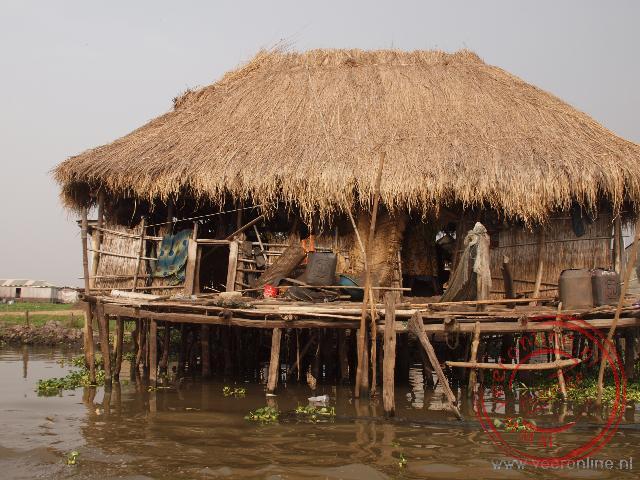
Today, about 20,000 people still live there. Ganvié is often called the Venice of Africa, as everyone moves around by boat. Upon entering Ganvié, we are greeted by a fanfare boat playing enthusiastic music in front of us. This draws attention, and everyone comes to watch. From other boats and open windows, people chant “Jové, Jové.” At the Auberge “Chez M,” we dock. This is where we will spend the night. The rooms are all on stilts, simply furnished, and separated only by a two-meter-high partition. Inside the small room is a double bed with a mosquito net, and there is a private toilet and shower with drainage into the lake. A fine place to sleep. In front of the auberge, a busy hub of boats is active. With a beer in hand, I watch the scene. Directly opposite is a water station where residents fetch drinking water by boat. A long line of boats waits, sometimes pushing and calling to move forward. The boats sit low in the water when full. Some are slightly overfilled and sink, but with some effort, they are brought back up and bailed out. Boats then have to return to the end of the line. In the evening, I go to bed on time. I carefully secure the mosquito net around the mattress. Many mosquitoes hover around the water. Through the gaps in the floor, I see the water sloshing. Right next to my room, boats pass by. In the distance, by the mosque, a party is going on. Music echoes through Ganvié, and I fall asleep to these sounds.
 Togo
Togo 
 Benin
Benin 


Travelogue Under the Spell of Voodoo
Dag 2 | Togo > Getting to know the city of Lomé
Dag 3 | Togo > The voodoo priest and the voodoo ceremony
Dag 4 | Togo > A dance performance on Christmas Eve
Dag 5 | Togo > 'Jové, Jové”
Dag 6 | Togo > The fire dance of the Tem tribe
Dag 7 | Togo > The iron blast furnaces of Bangeli
Dag 8 | Togo > Walking tour through Djamdé
Dag 9 | Togo > Climbing Mount Kabyé
Dag 10 | Togo > A Djembe as a souvenir
Dag 11 | Benin > New Year's Eve among the Beninese
Dag 12 | Benin > A look at the Somba tribes
Dag 13 | Benin > Meeting the chief of the Taneka-Beri tribe
Dag 14 | Benin > Singing with the children in Moupemou
Dag 15 | Benin > From north to south Benin
Dag 16 | Benin > Visit to the palace of Abomey
Dag 17 | Benin > The King of Ketou
Dag 18 | Benin > Sleeping in a stilt house in Ganvié
Dag 19 | Benin > Slave route to the 'Door of No Return'
Dag 20 | Benin > Eating a local pizza in the dark
Dag 21 | Benin > Voodoo festival of Quidah
Dag 22 | Togo > Farewell to Lomé
Dag 23 | Togo > Does the Djembe fit or not?