
154 countries
(and areas)
 - Belize
- Benin
- Bhutan
- Bolivia
- Bonaire
- Bosnia and Herzegovina
- Botswana
- Brazil
- British Virgin Islands
- Brunei
- Bulgaria
- Cambodia
- Canada
- Cape Verde
- Chile
- China
- Costa Rica
- Croatia
- Cuba
- Curacao
- Cyprus
- Czech Republic
- Denmark
- Dominica
- Dominican Republic
- Egypt
- El Salvador
- England
- Estonia
- Eswatini (Swaziland)
- Ethiopia
- Fiji
- Finland
- France
- French Guiana
- Georgia
- Germany
- Gibraltar
- Greece
- Grenada
- Guadeloupe
- Guatemala
- Honduras
- Hong Kong
- Hungary
- Iceland
- India
- Indonesia
- Iran
- Ireland
- Israel
- Italy
- Jamaica
- Japan
- Jordan
- Kazakhstan
- Kenya
- Kosovo
- Kuwait
- Kyrgyzstan
- Laos
- Latvia
- Lebanon
- Lesotho
- Liechtenstein
- Lithuania
- Luxembourg
- Macau
- Madagascar
- Malawi
- Malaysia
- Maldives
- Malta
- Martinique
- Mexico
- Moldova
- Monaco
- Mongolia
- Montenegro
- Morocco
- Mozambique
- Namibia
- Nepal
- Netherlands
- New Zealand
- Nicaragua
- North Macedonia
- Northern Ireland
- Norway
- Oman
- Pakistan
- Palestine
- Peru
- Philippines
- Poland
- Portugal
- Qatar
- Republic of Korea
- Romania
- Russia
- Saint Kitts and Nevis
- Saint Lucia
- Saint Martin
- Saint Vincent and the Grenadines
- San Marino
- São Tomé and Principe
- Saudi Arabia
- Scotland
- Senegal
- Serbia
- Singapore
- Sint Maarten
- Slovakia
- Slovenia
- South Africa
- Spain
- Sri Lanka
- Suriname
- Sweden
- Switzerland
- Tajikistan
- Tanzania
- Thailand
- The Gambia
- Tibet
- Togo
- Transnistria
- Trinidad and Tobago
- Tunisia
- Turkey
- Turkmenistan
- Uganda
- United Arab Emirates
- United States
- Uruguay
- Uzbekistan
- Vatican City
- Vietnam
- Wales
- Zambia
- Zanzibar
- Belize
- Benin
- Bhutan
- Bolivia
- Bonaire
- Bosnia and Herzegovina
- Botswana
- Brazil
- British Virgin Islands
- Brunei
- Bulgaria
- Cambodia
- Canada
- Cape Verde
- Chile
- China
- Costa Rica
- Croatia
- Cuba
- Curacao
- Cyprus
- Czech Republic
- Denmark
- Dominica
- Dominican Republic
- Egypt
- El Salvador
- England
- Estonia
- Eswatini (Swaziland)
- Ethiopia
- Fiji
- Finland
- France
- French Guiana
- Georgia
- Germany
- Gibraltar
- Greece
- Grenada
- Guadeloupe
- Guatemala
- Honduras
- Hong Kong
- Hungary
- Iceland
- India
- Indonesia
- Iran
- Ireland
- Israel
- Italy
- Jamaica
- Japan
- Jordan
- Kazakhstan
- Kenya
- Kosovo
- Kuwait
- Kyrgyzstan
- Laos
- Latvia
- Lebanon
- Lesotho
- Liechtenstein
- Lithuania
- Luxembourg
- Macau
- Madagascar
- Malawi
- Malaysia
- Maldives
- Malta
- Martinique
- Mexico
- Moldova
- Monaco
- Mongolia
- Montenegro
- Morocco
- Mozambique
- Namibia
- Nepal
- Netherlands
- New Zealand
- Nicaragua
- North Macedonia
- Northern Ireland
- Norway
- Oman
- Pakistan
- Palestine
- Peru
- Philippines
- Poland
- Portugal
- Qatar
- Republic of Korea
- Romania
- Russia
- Saint Kitts and Nevis
- Saint Lucia
- Saint Martin
- Saint Vincent and the Grenadines
- San Marino
- São Tomé and Principe
- Saudi Arabia
- Scotland
- Senegal
- Serbia
- Singapore
- Sint Maarten
- Slovakia
- Slovenia
- South Africa
- Spain
- Sri Lanka
- Suriname
- Sweden
- Switzerland
- Tajikistan
- Tanzania
- Thailand
- The Gambia
- Tibet
- Togo
- Transnistria
- Trinidad and Tobago
- Tunisia
- Turkey
- Turkmenistan
- Uganda
- United Arab Emirates
- United States
- Uruguay
- Uzbekistan
- Vatican City
- Vietnam
- Wales
- Zambia
- Zanzibar


Copyright 2004 - 2026
Veeronline.nl Travel Adventures

Home > Bhutan > Tour of Bhutan > Travelogue day 7
Travelogue Tour of Bhutan
October 28 November 6 2023 (10 days)
Bhutan > Hiking in the Phobjikha Valley
Dag 7 - Friday, 3 November 2023
At breakfast, we look out over the beautiful Phobjikha Valley. It was cold last night. The dew on the ground even seems frozen. Even without the cranes, the valley is stunning. Perhaps against better judgment, I scan the grassy fields while enjoying my bread, egg, and tea. At nine o’clock, we meet Rinchen in front of the hotel. This time, however, we do not get into the car. From the hotel, we walk into the Phobjikha Valley. We leave the parking lot and walk to the asphalt road. Here we turn right. The road winds into the valley. After a few hundred meters, we take a dirt path. This path is used by farmers and is the access road to some houses on the other side of the valley. Along the road, cows and bulls graze. They barely look up as we pass. All cows roam freely in the valley. It is the crops that are protected from the grazing cows by wooden fences. Further in the meadows, horses also graze. The meadows form a protected nature reserve. It is not allowed to use these fields for building or farming. This is how Bhutan wants to protect nature, including the population of protected cranes. When we are almost at the houses on the other side of the valley, we turn onto a narrow nature path. This path leads toward a stupa on a small hill. From this stupa, we have a beautiful view of the Phobjikha Valley. From the viewpoint, the vastness of the valley is striking. It does not seem strange that three cranes were spotted here last week and that these animals can hide in this valley. As we walk further and gain some height, we also see a small pond. The cranes often gather here in winter, Rinchen says. Unfortunately, today there are only a few geese. The path continues to a spotters’ hut. From here, the path enters the forest. Between the pine trees, the path slowly rises. The valley that we occasionally see between the trees lies lower and lower.

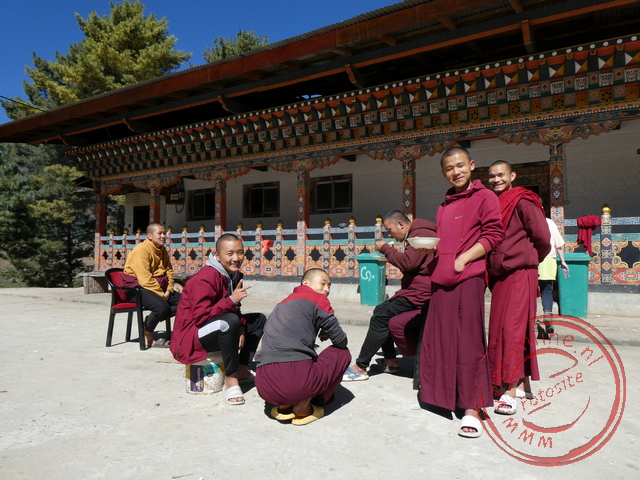
We pass a farm where a truck is being loaded. Large sacks of potatoes are being loaded via a wooden plank. Men and women lift the heavy sacks. Within two days, the potatoes will be driven to the Indian border to be sold there. The last stretch to Goenpa climbs steeply. It is important to climb at a steady pace. We are at 2,900 meters and the air is thin. Other tourists walk the path the other way. They are mostly descending. The time estimate of about one and a half hours seems a bit optimistic. After more than two and a half hours, we arrive in the village of Goenpa, where we visited the monastery yesterday. Today’s goal is the college monastery. A monastery for monks who have completed their training at the Goenpa monastery. The Gangteng Buddhist College lies just a bit higher on the mountain. Around noon, we approach the monastery. The young monks are having lunch. One of them shows that they eat rice with potatoes. We walk around the temple. At the back is a freestanding staircase. Rinchen invites us to climb the stairs to the top floor of the temple. This leads to the walkway around the temple. From here, there is a beautiful view over the monastery and the valley. How special it is that we are allowed to come here. The temple itself is relatively new. Inside, besides the overwhelming Buddha decorations, the pillars especially stand out. The pillars are surrounded by wood-carved dragons. Also, where the pillars meet the ceiling, there are large images of dragons. We have not seen this like this in other temples. We look at the three large statues that are central in this temple. Of course, the enormous Buddha himself stands in the middle. By car, we return to Gangtey, the small village where our hotel is located.
A few hundred meters before the hotel, we stop at a restaurant. A fine lunch is served with various dishes: rice, pasta, chicken, cauliflower, broccoli, and datshi, a mix of cheese and potatoes. In the afternoon, we visit the villages on the other side of the valley. Although the chance is small, we might encounter the cranes here. During the day, they more often move to the southern part of the valley to look for food. In the afternoon, they seek overnight shelter in the northern part. Gelle drives us a bit into the valley. Walking the whole way would be far and especially boring. About halfway, we get out. The wind has picked up and it feels chilly. I don’t hesitate long whether to bring my jacket. I put it on immediately. Via the narrow asphalt road, we walk deeper into the valley. The view is beautiful. In the middle of the valley, a creek meanders. The asphalt road ends at the Shechen Nunnery monastery. Just like the boys in the Goenpa monastery, the girls here can take their initial training. Afterwards, they can go to the monastery in Thimphu for further training. One of the young nuns opens the temple. Rinchen is less familiar with this temple. He asks about some images and translates for us. Although all temples have more or less the same layout, this temple is special again. At the large Buddha statues, the faces are covered with a white cloth. It appears that restoration work is underway and the dust must not get on the faces. Around half past three, we return to the hotel. I retreat to my room for a while. At the end of the afternoon, we order a drink in the bar. With a beer in hand, we look over the valley. If there are cranes, this is normally the time they would arrive flying in. The sun disappears behind the mountains and darkness falls. We will not see the cranes here anymore. For dinner, Rinchen gave two options.
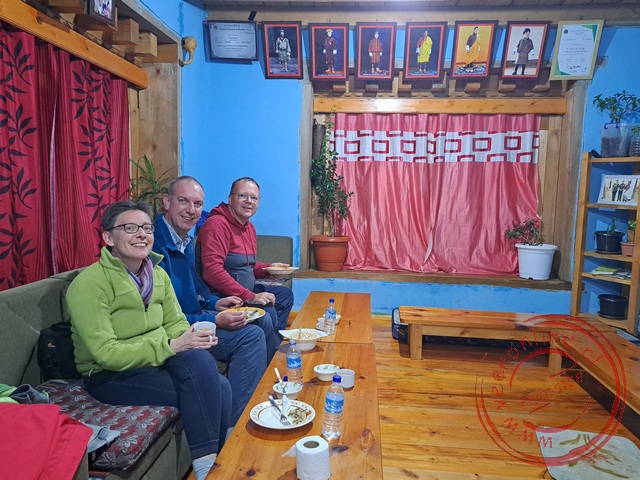
Either eat at the hotel restaurant, which is a similar buffet as yesterday, or eat at a farmhouse in Gangtey. The latter seems the most fun for all three of us. At seven o’clock, we drive to the farmhouse. Outside, darkness has fallen, and without street lighting, it is dark on the road. Gelle steers the car around a cow lying on the road. Carefully, he continues driving. We stop at a homestay. "I have sometimes stayed here with guests," Rinchen says. The lady of the house is already waiting for us at the door. Fortunately, the wood stove is burning inside. Outside, the temperature is just above freezing. Especially Rinchen and Gelle hurry to the stove. Their sleeping quarters have no heating. Meanwhile, tea is served. A buffet of various Bhutanese dishes appears on the table: rice, meat, vegetables, and of course emu datshi. The owner says that last year, the potatoes yielded little. They only got 200-250 rupees per sack, about two to two and a half euros. For transport to India, they already paid 150 rupees per sack. After the meal, the owner brings a bottle of ara, a locally brewed drink. Like in the first homestay, we taste a little. Fortunately, the alcohol strength is manageable here as well. We thank them for their hospitality and drive back to the hotel. This experience was much nicer than dining at the hotel.
 Bhutan
  We pass a stupa on the way to Goenpa
 Phobjikha Valley grows smaller behind us
 An old stupa on the edge of Phobjikha Valley
 The Lhakhang Karpo monastery seen from the mountains
Travelogue Tour of Bhutan
Dag 2 | Bhutan > Welcome to Bhutan
Dag 3 | Bhutan > The Kila Goenpa Monastery
Dag 4 | Bhutan > A Buddha in the mountains
Dag 5 | Bhutan > The Punakha Monastery
Dag 6 | Bhutan > Over the Lawala mountain pass
Dag 7 | Bhutan > Hiking in the Phobjikha Valley
Dag 8 | Bhutan > Back towards Paro
Dag 9 | Bhutan > The Tiger's Nest climb
Dag 10 | Bhutan > Farewell in Delhi