
154 countries
(and areas)
 - Belize
- Benin
- Bhutan
- Bolivia
- Bonaire
- Bosnia and Herzegovina
- Botswana
- Brazil
- British Virgin Islands
- Brunei
- Bulgaria
- Cambodia
- Canada
- Cape Verde
- Chile
- China
- Costa Rica
- Croatia
- Cuba
- Curacao
- Cyprus
- Czech Republic
- Denmark
- Dominica
- Dominican Republic
- Egypt
- El Salvador
- England
- Estonia
- Eswatini (Swaziland)
- Ethiopia
- Fiji
- Finland
- France
- French Guiana
- Georgia
- Germany
- Gibraltar
- Greece
- Grenada
- Guadeloupe
- Guatemala
- Honduras
- Hong Kong
- Hungary
- Iceland
- India
- Indonesia
- Iran
- Ireland
- Israel
- Italy
- Jamaica
- Japan
- Jordan
- Kazakhstan
- Kenya
- Kosovo
- Kuwait
- Kyrgyzstan
- Laos
- Latvia
- Lebanon
- Lesotho
- Liechtenstein
- Lithuania
- Luxembourg
- Macau
- Madagascar
- Malawi
- Malaysia
- Maldives
- Malta
- Martinique
- Mexico
- Moldova
- Monaco
- Mongolia
- Montenegro
- Morocco
- Mozambique
- Namibia
- Nepal
- Netherlands
- New Zealand
- Nicaragua
- North Macedonia
- Northern Ireland
- Norway
- Oman
- Pakistan
- Palestine
- Peru
- Philippines
- Poland
- Portugal
- Qatar
- Republic of Korea
- Romania
- Russia
- Saint Kitts and Nevis
- Saint Lucia
- Saint Martin
- Saint Vincent and the Grenadines
- San Marino
- São Tomé and Principe
- Saudi Arabia
- Scotland
- Senegal
- Serbia
- Singapore
- Sint Maarten
- Slovakia
- Slovenia
- South Africa
- Spain
- Sri Lanka
- Suriname
- Sweden
- Switzerland
- Tajikistan
- Tanzania
- Thailand
- The Gambia
- Tibet
- Togo
- Transnistria
- Trinidad and Tobago
- Tunisia
- Turkey
- Turkmenistan
- Uganda
- United Arab Emirates
- United States
- Uruguay
- Uzbekistan
- Vatican City
- Vietnam
- Wales
- Zambia
- Zanzibar
- Belize
- Benin
- Bhutan
- Bolivia
- Bonaire
- Bosnia and Herzegovina
- Botswana
- Brazil
- British Virgin Islands
- Brunei
- Bulgaria
- Cambodia
- Canada
- Cape Verde
- Chile
- China
- Costa Rica
- Croatia
- Cuba
- Curacao
- Cyprus
- Czech Republic
- Denmark
- Dominica
- Dominican Republic
- Egypt
- El Salvador
- England
- Estonia
- Eswatini (Swaziland)
- Ethiopia
- Fiji
- Finland
- France
- French Guiana
- Georgia
- Germany
- Gibraltar
- Greece
- Grenada
- Guadeloupe
- Guatemala
- Honduras
- Hong Kong
- Hungary
- Iceland
- India
- Indonesia
- Iran
- Ireland
- Israel
- Italy
- Jamaica
- Japan
- Jordan
- Kazakhstan
- Kenya
- Kosovo
- Kuwait
- Kyrgyzstan
- Laos
- Latvia
- Lebanon
- Lesotho
- Liechtenstein
- Lithuania
- Luxembourg
- Macau
- Madagascar
- Malawi
- Malaysia
- Maldives
- Malta
- Martinique
- Mexico
- Moldova
- Monaco
- Mongolia
- Montenegro
- Morocco
- Mozambique
- Namibia
- Nepal
- Netherlands
- New Zealand
- Nicaragua
- North Macedonia
- Northern Ireland
- Norway
- Oman
- Pakistan
- Palestine
- Peru
- Philippines
- Poland
- Portugal
- Qatar
- Republic of Korea
- Romania
- Russia
- Saint Kitts and Nevis
- Saint Lucia
- Saint Martin
- Saint Vincent and the Grenadines
- San Marino
- São Tomé and Principe
- Saudi Arabia
- Scotland
- Senegal
- Serbia
- Singapore
- Sint Maarten
- Slovakia
- Slovenia
- South Africa
- Spain
- Sri Lanka
- Suriname
- Sweden
- Switzerland
- Tajikistan
- Tanzania
- Thailand
- The Gambia
- Tibet
- Togo
- Transnistria
- Trinidad and Tobago
- Tunisia
- Turkey
- Turkmenistan
- Uganda
- United Arab Emirates
- United States
- Uruguay
- Uzbekistan
- Vatican City
- Vietnam
- Wales
- Zambia
- Zanzibar


Copyright 2004 - 2026
Veeronline.nl Travel Adventures

Home > Iran > Impressive and Hospitable Iran > Travelogue day 10
Travelogue Impressive and Hospitable Iran
April 29 May 9 2010 (11 days)
Iran > The Mausoleum of Fatima in Qom
Dag 10 - Saturday, May 8, 2010It’s actually the last day of the trip. Officially, we fly home tomorrow, but that’s just after midnight. Already at 7:30, we leave Esfahan heading toward Qom. It’s striking that everyone I spoke to over the past week about our itinerary strongly advised against going to Qom. Qom is the seat of the government and the birthplace of Khomeini. I assured everyone that I would only arrive in Qom in the afternoon and leave for the airport in the early evening. This reassures many people. Qom and Kashan, the city we visit around lunchtime, are far more conservative than, for example, Esfahan. In these cities, clothing is more traditional, mostly black, and the headscarf covers all the hair. In Esfahan and Tehran, this was different. As we leave the outskirts of Esfahan, I close my eyes and reflect on the wonderful city and its remarkable people. I would have loved to spend a few more days there. I imagine spending even a single day just among the people at Imam Square.

Around eleven, we enter Kashan, famous for its beautiful bazaar and traditional merchant houses from before the revolution. We get out at the bazaar and quickly go inside. It’s very hot outside, and it’s clear that people dress more conservatively here. Almost all the women are in tight black clothing, many also wearing a chador. I see little joy on faces, and many look timid. Contacting people is less easy here. The bazaar, however, is stunning. There are, of course, many small shops selling all sorts of goods, as well as the beautiful inner courtyards. The caravanserais are covered with intricately crafted domes. The sunlight streaming through the windows creates a truly picturesque scene. I strike up a conversation with a retired German teacher. In my broken German, I ask if it’s possible to visit the bazaar roof. Via a narrow staircase, we reach the roof. From here, there is a view of the undulating roof of the covered shops. The roof is made of clay, and I fervently hope it’s strong enough to hold our weight. For safety, I stick to the edges. After the bazaar, we buy some fruit at a vegetable shop for lunch, giving us more time to explore Kashan. We enter the Aghabozorg Mosque, which has a lower level on its courtyard where students live. The mosque functions as both a place of worship and a Quran school. This is probably the last mosque we will visit on this trip. Just outside, I’m approached by Iranian youth, this time speaking French. They want to invite me to an afternoon meeting. Using a mix of English, French, and gestures, I explain that we will already be in Qom and won’t be staying in Kashan. They quickly take a group photo with one of their phones, and I continue on. It starts to rain lightly, and thunder rumbles in the distance. In the southwest of the city lie several traditional merchant houses, formerly owned by wealthy families before the revolution. The mansions are now museums. We first visit a smaller merchant house, already displaying considerable grandeur. A female student visiting the museum shares her opinion on the religious leaders, handing us a bracelet with a green “V,” the symbol of the revolution, and asking us to “pray for the victory.” We will pray. Around the corner lies the old bathhouse, Hammam-e Sultan Mir Ahman, one of the most beautiful I’ve ever seen. As we leave, the bookseller at the entrance leads us up a small staircase to the roof where the old water mills once supplied water. Finally, we visit a second merchant house, the Khan-e Tabatabai, much larger and more impressive.
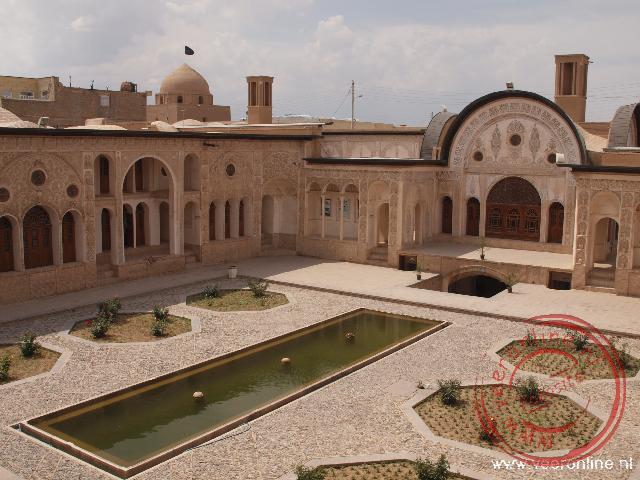
The spacious courtyard is surrounded by carvings, decorations, mirrors, and exquisite stained glass windows. Each corner has small staircases, gates, and niches. A delight to wander through. At three o’clock sharp, we are back at the bazaar and are picked up by the bus driver for the last leg to Qom. Just outside Kashan, the rain pours down, with lightning flashes to the left and right of the bus. The bus shutters aren’t completely waterproof, and water streams inside. Fortunately, there are spare seats. Hopefully, the luggage stays dry. In the afternoon, we arrive in Qom, a city of nearly a million, the center of Shia Islam. The mausoleum of Fatima, sister of the eighth Imam Reza, is an important pilgrimage site. Normally, buses are not allowed in the center during the day, but our driver drives right up to the hotel, which is located on a busy road near the mausoleum. We quickly take our luggage to the room and walk to the mausoleum. It’s dry now, but there are large puddles on the streets. I’m wearing my most conservative clothing. Non-Muslims are technically not allowed inside, but perhaps we’ll be lucky. At the entrance, we are stopped. Someone is called, and the guard asks us to wait. A guide arrives to accompany us. The women are given chadors. Under supervision, we pass through the gate onto the large courtyard. On the left is the mausoleum, a space reserved only for Muslims, but we are allowed to peek through the fence. I see Fatima’s tomb, richly decorated with pieces of mirror. Our guide leads us to the other side of the square, into a room where a cleric welcomes us. We sit in a row of chairs at the side. The cleric sits at a desk in a corner, making the contact somewhat formal. Our guide pours water for us. The cleric wants to know why we are in Iran, what we think of Iran, and talks about the peaceful nature of Islam. He also asks about our daily lives. It’s hilarious trying to explain what a yoga teacher does. I struggle to keep from laughing. We are given a book about Islam and our guide escorts us back out of the mausoleum. In the evening, we have dinner at the hotel and go to bed early. It will be a short night.
 Iran
Iran  The bazaar of Esfahan
 A shop in the bazaar selling only brooms
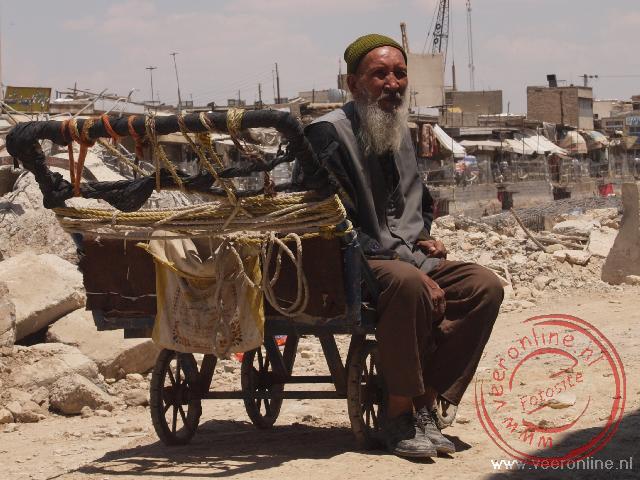 An old man takes a rest on his cart
 The Gate of All Nations in Persepolis
Travelogue Impressive and Hospitable Iran
Dag 2 | Iran > The climb of the Alborz Mountains
Dag 3 | Iran > The Sadabad Palace Museum
Dag 4 | Iran > Wandering through the streets of Yazd
Dag 5 | Iran > The tombs of Cyrus and Darius
Dag 6 | Iran > 'Islam is open to everyone'
Dag 7 | Iran > Persepolis, the city of Darius I
Dag 8 | Iran > Strolling across the square in Esfahan
Dag 9 | Iran > Having tea in the park
Dag 10 | Iran > The Mausoleum of Fatima in Qom
Dag 11 | Iran > Departure from Tehran