
154 countries
(and areas)
 - Azerbaijan
- Bahrain
- Barbados
- Belgium
- Belize
- Benin
- Bhutan
- Bolivia
- Bonaire
- Bosnia and Herzegovina
- Botswana
- Brazil
- British Virgin Islands
- Brunei
- Bulgaria
- Cambodia
- Canada
- Cape Verde
- Chile
- China
- Costa Rica
- Croatia
- Cuba
- Curacao
- Cyprus
- Czech Republic
- Denmark
- Dominica
- Dominican Republic
- Egypt
- El Salvador
- England
- Estonia
- Eswatini (Swaziland)
- Ethiopia
- Fiji
- Finland
- France
- French Guiana
- Georgia
- Germany
- Gibraltar
- Greece
- Grenada
- Guadeloupe
- Guatemala
- Honduras
- Hong Kong
- Hungary
- Iceland
- India
- Indonesia
- Iran
- Ireland
- Israel
- Italy
- Jamaica
- Japan
- Jordan
- Kazakhstan
- Kenya
- Kosovo
- Kuwait
- Kyrgyzstan
- Laos
- Latvia
- Lebanon
- Lesotho
- Liechtenstein
- Lithuania
- Luxembourg
- Macau
- Madagascar
- Malawi
- Malaysia
- Maldives
- Malta
- Martinique
- Mexico
- Moldova
- Monaco
- Mongolia
- Montenegro
- Morocco
- Mozambique
- Namibia
- Nepal
- Netherlands
- New Zealand
- Nicaragua
- North Macedonia
- Northern Ireland
- Norway
- Oman
- Pakistan
- Palestine
- Peru
- Philippines
- Poland
- Portugal
- Qatar
- Republic of Korea
- Romania
- Russia
- Saint Kitts and Nevis
- Saint Lucia
- Saint Martin
- Saint Vincent and the Grenadines
- San Marino
- São Tomé and Principe
- Saudi Arabia
- Scotland
- Senegal
- Serbia
- Singapore
- Sint Maarten
- Slovakia
- Slovenia
- South Africa
- Spain
- Sri Lanka
- Suriname
- Sweden
- Switzerland
- Tajikistan
- Tanzania
- Thailand
- The Gambia
- Tibet
- Togo
- Transnistria
- Trinidad and Tobago
- Tunisia
- Turkey
- Turkmenistan
- Uganda
- United Arab Emirates
- United States
- Uruguay
- Uzbekistan
- Vatican City
- Vietnam
- Wales
- Zambia
- Zanzibar
- Azerbaijan
- Bahrain
- Barbados
- Belgium
- Belize
- Benin
- Bhutan
- Bolivia
- Bonaire
- Bosnia and Herzegovina
- Botswana
- Brazil
- British Virgin Islands
- Brunei
- Bulgaria
- Cambodia
- Canada
- Cape Verde
- Chile
- China
- Costa Rica
- Croatia
- Cuba
- Curacao
- Cyprus
- Czech Republic
- Denmark
- Dominica
- Dominican Republic
- Egypt
- El Salvador
- England
- Estonia
- Eswatini (Swaziland)
- Ethiopia
- Fiji
- Finland
- France
- French Guiana
- Georgia
- Germany
- Gibraltar
- Greece
- Grenada
- Guadeloupe
- Guatemala
- Honduras
- Hong Kong
- Hungary
- Iceland
- India
- Indonesia
- Iran
- Ireland
- Israel
- Italy
- Jamaica
- Japan
- Jordan
- Kazakhstan
- Kenya
- Kosovo
- Kuwait
- Kyrgyzstan
- Laos
- Latvia
- Lebanon
- Lesotho
- Liechtenstein
- Lithuania
- Luxembourg
- Macau
- Madagascar
- Malawi
- Malaysia
- Maldives
- Malta
- Martinique
- Mexico
- Moldova
- Monaco
- Mongolia
- Montenegro
- Morocco
- Mozambique
- Namibia
- Nepal
- Netherlands
- New Zealand
- Nicaragua
- North Macedonia
- Northern Ireland
- Norway
- Oman
- Pakistan
- Palestine
- Peru
- Philippines
- Poland
- Portugal
- Qatar
- Republic of Korea
- Romania
- Russia
- Saint Kitts and Nevis
- Saint Lucia
- Saint Martin
- Saint Vincent and the Grenadines
- San Marino
- São Tomé and Principe
- Saudi Arabia
- Scotland
- Senegal
- Serbia
- Singapore
- Sint Maarten
- Slovakia
- Slovenia
- South Africa
- Spain
- Sri Lanka
- Suriname
- Sweden
- Switzerland
- Tajikistan
- Tanzania
- Thailand
- The Gambia
- Tibet
- Togo
- Transnistria
- Trinidad and Tobago
- Tunisia
- Turkey
- Turkmenistan
- Uganda
- United Arab Emirates
- United States
- Uruguay
- Uzbekistan
- Vatican City
- Vietnam
- Wales
- Zambia
- Zanzibar


Copyright 2004 - 2026
Veeronline.nl Travel Adventures

Home > Iran > Impressive and Hospitable Iran > Travelogue day 4
Travelogue Impressive and Hospitable Iran
April 29 May 9 2010 (11 days)
Iran > Wandering through the streets of Yazd
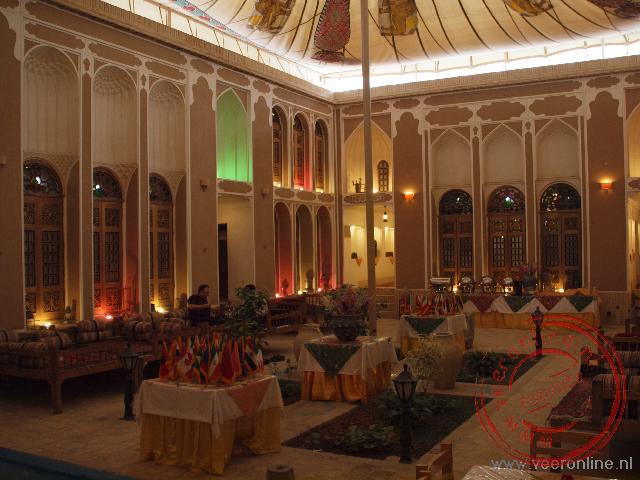
Dag 4 - Sunday, May 2, 2010Considering the circumstances, I slept quite well on the train. Just before reaching Yazd station, I wake up. I quickly pack my things, but before I’m ready, the train has already come to a stop at the final station. In four taxis, we drive to the hotel, with the luggage sticking out of the trunk. Every bump makes me hope my travel bag is still there. The driver clearly doesn’t want to be the last to arrive. Fortunately, all the luggage makes it, and shortly afterward, we arrive at the Hotel Mehr Traditional. However, the hotel has no record of our reservation. After some inquiries and phone calls, it turns out we are booked at a different hotel. New taxis are called. The driver speeds through Yazd’s narrow streets. The hotel, on the opposite side of the city center, had been expecting us. We have breakfast in the pleasant courtyard, covered with a large canvas. By now, I am quite hungry. Our cozy room is on the first floor. When I open the shutters, I look out onto the courtyard, where fellow travelers are still having breakfast.
Although I feel like lying down on the bed for a moment, I don’t. A bus is waiting for a tour to the Fire Temple and the Silence Towers on the outskirts of the city. The Fire Temple is the sanctuary of the Zoroastrians, where the sacred fire is kept burning continuously. It is believed that the fire has been burning in the temple since 470 CE. In 1474, the fire was moved to Yazd. The temple reflects in the oval pool in front of the entrance. Inside, the fire burns behind a glass panel in the entrance hall. A little further, outside the city, lie the Silence Towers. These towers were historically used by Zoroastrians for funerary ceremonies. Bodies were placed in the towers on the rocks for vultures. Today, these sky burials are no longer permitted. Leen is amazed by the expanding city. Ten years ago, when he was here, the city was nowhere near this area. Now, new neighborhoods surround the Silence Towers. Back in Yazd, we are dropped off at Amir Chakhmaq Square. The Amir Chakhmaq façade dominates the square. The building was erected to commemorate the death of Imam Hossein. Behind the façade begins the bazaar. Just before the entrance stands a wooden structure shaped like a palm leaf. With hand gestures, a man explains that the Nakhl was used in procession ceremonies. I am impressed, given the weight of the structure. We cross the square and turn right. The shops are bustling. On the left, we peek inside a smaller mosque. Across the street is the larger Hazirez Mosque with beautiful carpets in the prayer hall. After a fresh orange juice, we turn the corner at the clock tower and walk to the large Jameh Mosque.

On the right, we pass the turquoise dome of the Bogheh-ye Sayyed Roknaddin. Next to this dome, we have lunch at the Silk Road Backpackers Hotel. After lunch, we enter the Jameh Mosque. The tall prayer hall connects openly with the courtyard. On the other side, we leave the courtyard and enter the souq. Many shops are closed for the afternoon break—some have a cloth draped over their goods, others simply block the entrance with a broom. Closed! Through narrow streets and covered alleys, we wander back to the hotel. Yazd feels like a large labyrinth. Fortunately, the “Alexander Prison” is well signposted, and our hotel is right opposite it. At the hotel, I lie down on the bed and fall asleep. Just before six, I wake up and decide to explore the city a little. The streets are much busier, and without asking where I’m going, people point me in the right direction—likely toward the central Jameh Mosque and the bazaar. A man on the back of his motorbike laughs when he sees me again. Laughing, he points where I should turn right, then immediately left. Here I enter the bazaar, meanwhile looking for something quick to eat. This turns out to be a gap in the market; there are no real eateries.
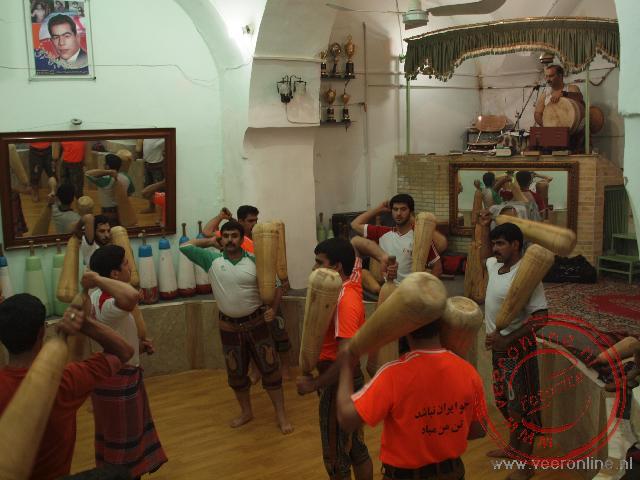
Eventually, we end up at the hotel’s restaurant. We still have half an hour before our appointment. With the receptionist’s translation, we ask if a meal is possible within half an hour. The waiter promises to indicate on the menu what is feasible. When we don’t see him for ten minutes, it becomes clear it won’t happen. I take a few muesli bars as an alternative. At exactly eight o’clock, we walk to the gym for a traditional Iranian sport. The Zurkhaneh combines sport, religion, and theater. The door is still closed, and it doesn’t look like it will open soon. We return to the hotel reception, which had arranged the appointment earlier. After some discussion, it turns out we are too early. Hammed, the hotel guard, will accompany us in an hour. Time for a cup of tea in the courtyard. Shortly after nine, we follow Hammed toward the gym. To our surprise, he turns left, while we had gone right earlier. After a few streets, he points to a small staircase down. At the bottom, we enter a small, somewhat musty room. We are welcomed by a man and take seats along the sides. Directly in front of us is a round, sunken floor about six meters in diameter, lying roughly a meter lower. Behind this circle are the wooden clubs used in the Zurkhaneh. We wait for what is to come. After about ten minutes, an athlete enters, smiles at us, shakes the men’s hands, and disappears behind a curtain to change. Slowly, other athletes arrive. Some warm up, others chat. When everyone is present, the exercises begin. To the beat of drums and the psalms of Hafez, the athletes perform their routines. Finally, they lift the large wooden clubs and move them rhythmically over their shoulders—an exhausting task matched to the stimulating music. In another exercise, the men spin as fast as possible, one by one, competing to see who can last the longest. When we leave the gym and thank them, they insist on giving a quick demonstration with bells, dancing overhead with large racks of small bells. We thank everyone warmly and leave a tip. Hammed escorts us back to the hotel.
 Iran
Iran  Yazd cityscape characterized by many small gates and alleys
 In Farsi its not always easy to understand which direction to take
 The dome of the Jameh Mosque rises high above the city of Yazd
 Practicing the ancient traditional sport Zurkhaneh a mix of sport theater and religion
Travelogue Impressive and Hospitable Iran
Dag 2 | Iran > The climb of the Alborz Mountains
Dag 3 | Iran > The Sadabad Palace Museum
Dag 4 | Iran > Wandering through the streets of Yazd
Dag 5 | Iran > The tombs of Cyrus and Darius
Dag 6 | Iran > 'Islam is open to everyone'
Dag 7 | Iran > Persepolis, the city of Darius I
Dag 8 | Iran > Strolling across the square in Esfahan
Dag 9 | Iran > Having tea in the park
Dag 10 | Iran > The Mausoleum of Fatima in Qom
Dag 11 | Iran > Departure from Tehran