
154 countries
(and areas)
 - Azerbaijan
- Bahrain
- Barbados
- Belgium
- Belize
- Benin
- Bhutan
- Bolivia
- Bonaire
- Bosnia and Herzegovina
- Botswana
- Brazil
- British Virgin Islands
- Brunei
- Bulgaria
- Cambodia
- Canada
- Cape Verde
- Chile
- China
- Costa Rica
- Croatia
- Cuba
- Curacao
- Cyprus
- Czech Republic
- Denmark
- Dominica
- Dominican Republic
- Egypt
- El Salvador
- England
- Estonia
- Eswatini (Swaziland)
- Ethiopia
- Fiji
- Finland
- France
- French Guiana
- Georgia
- Germany
- Gibraltar
- Greece
- Grenada
- Guadeloupe
- Guatemala
- Honduras
- Hong Kong
- Hungary
- Iceland
- India
- Indonesia
- Iran
- Ireland
- Israel
- Italy
- Jamaica
- Japan
- Jordan
- Kazakhstan
- Kenya
- Kosovo
- Kuwait
- Kyrgyzstan
- Laos
- Latvia
- Lebanon
- Lesotho
- Liechtenstein
- Lithuania
- Luxembourg
- Macau
- Madagascar
- Malawi
- Malaysia
- Maldives
- Malta
- Martinique
- Mexico
- Moldova
- Monaco
- Mongolia
- Montenegro
- Morocco
- Mozambique
- Namibia
- Nepal
- Netherlands
- New Zealand
- Nicaragua
- North Macedonia
- Northern Ireland
- Norway
- Oman
- Pakistan
- Palestine
- Peru
- Philippines
- Poland
- Portugal
- Qatar
- Republic of Korea
- Romania
- Russia
- Saint Kitts and Nevis
- Saint Lucia
- Saint Martin
- Saint Vincent and the Grenadines
- San Marino
- São Tomé and Principe
- Saudi Arabia
- Scotland
- Senegal
- Serbia
- Singapore
- Sint Maarten
- Slovakia
- Slovenia
- South Africa
- Spain
- Sri Lanka
- Suriname
- Sweden
- Switzerland
- Tajikistan
- Tanzania
- Thailand
- The Gambia
- Tibet
- Togo
- Transnistria
- Trinidad and Tobago
- Tunisia
- Turkey
- Turkmenistan
- Uganda
- United Arab Emirates
- United States
- Uruguay
- Uzbekistan
- Vatican City
- Vietnam
- Wales
- Zambia
- Zanzibar
- Azerbaijan
- Bahrain
- Barbados
- Belgium
- Belize
- Benin
- Bhutan
- Bolivia
- Bonaire
- Bosnia and Herzegovina
- Botswana
- Brazil
- British Virgin Islands
- Brunei
- Bulgaria
- Cambodia
- Canada
- Cape Verde
- Chile
- China
- Costa Rica
- Croatia
- Cuba
- Curacao
- Cyprus
- Czech Republic
- Denmark
- Dominica
- Dominican Republic
- Egypt
- El Salvador
- England
- Estonia
- Eswatini (Swaziland)
- Ethiopia
- Fiji
- Finland
- France
- French Guiana
- Georgia
- Germany
- Gibraltar
- Greece
- Grenada
- Guadeloupe
- Guatemala
- Honduras
- Hong Kong
- Hungary
- Iceland
- India
- Indonesia
- Iran
- Ireland
- Israel
- Italy
- Jamaica
- Japan
- Jordan
- Kazakhstan
- Kenya
- Kosovo
- Kuwait
- Kyrgyzstan
- Laos
- Latvia
- Lebanon
- Lesotho
- Liechtenstein
- Lithuania
- Luxembourg
- Macau
- Madagascar
- Malawi
- Malaysia
- Maldives
- Malta
- Martinique
- Mexico
- Moldova
- Monaco
- Mongolia
- Montenegro
- Morocco
- Mozambique
- Namibia
- Nepal
- Netherlands
- New Zealand
- Nicaragua
- North Macedonia
- Northern Ireland
- Norway
- Oman
- Pakistan
- Palestine
- Peru
- Philippines
- Poland
- Portugal
- Qatar
- Republic of Korea
- Romania
- Russia
- Saint Kitts and Nevis
- Saint Lucia
- Saint Martin
- Saint Vincent and the Grenadines
- San Marino
- São Tomé and Principe
- Saudi Arabia
- Scotland
- Senegal
- Serbia
- Singapore
- Sint Maarten
- Slovakia
- Slovenia
- South Africa
- Spain
- Sri Lanka
- Suriname
- Sweden
- Switzerland
- Tajikistan
- Tanzania
- Thailand
- The Gambia
- Tibet
- Togo
- Transnistria
- Trinidad and Tobago
- Tunisia
- Turkey
- Turkmenistan
- Uganda
- United Arab Emirates
- United States
- Uruguay
- Uzbekistan
- Vatican City
- Vietnam
- Wales
- Zambia
- Zanzibar


Copyright 2004 - 2026
Veeronline.nl Travel Adventures

Home > Iran > Impressive and Hospitable Iran > Travelogue day 8
Travelogue Impressive and Hospitable Iran
April 29 May 9 2010 (11 days)
Iran > Strolling across the square in Esfahan
Dag 8 - Thursday, May 6, 2010On the way to Esfahan’s central square, we see a lot of handicrafts in the narrow streets: copper work, porcelain painting, and a blacksmith. Everyone smiles at us warmly. It isn’t until we reach the square that the first carpet seller approaches us. He is clearly more commercially minded. Only now do I realize how little vendors actively approach you in Iran. Tourism is too limited in this country, and most other tour groups move through the city in their own groups. Today we follow the city walk suggested in the Lonely Planet, but we skip the beginning because it doesn’t fit well with our hotel’s location. At the large Ali Iman Square, we immediately stand in front of the Iman Mosque. Walking under the impressive entrance arch, we turn right to enter the actual mosque. The entrance faces the square, and the mosque, of course, faces Mecca. A group of Iranian boys demonstrates that directly under the 36-meter-high dome there is a perfect echo.
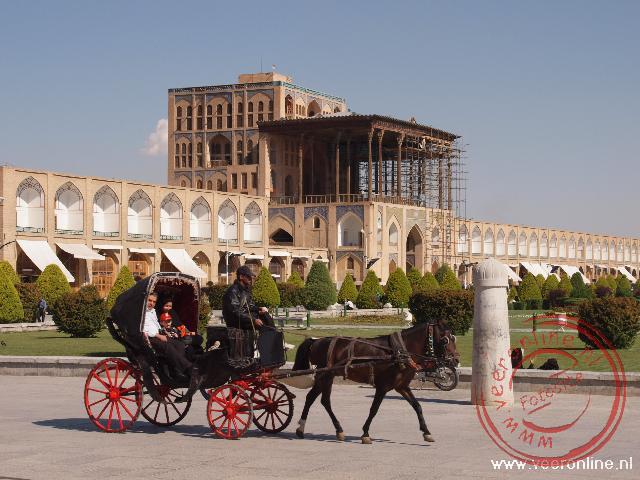
They clap and hear it return multiple times. I understand it, but cannot convey this to them. Quickly, other Iranians are called over, and in a mix of Farsi and English, the echo is explained again. Once it becomes clear that I understand, everyone bursts out laughing and shakes my hand. Inside the courtyard, I am soon surrounded by an entire boys’ school class. They ask where I’m from and my name—the familiar routine. A group photo is taken, and the teacher thankfully gathers the boys again. Back on the square, we visit the Ali Qapu Palace. At the entrance, a man calls me back as I try to pass. Surprised, I turn around. Using gestures, he indicates that I should keep my face in the corner. I don’t understand, but his daughters also point to the wall. Presumably, it brings luck, so I keep my face in the niche. The man hurries to the diagonally opposite corner and speaks softly. I can hear him, and if I spoke Farsi, I would understand. A remarkable construction. I thank him, and he looks happy to have shown me this. From the palace terrace, there’s a wide view over Ali Iman Square and a beautiful perspective of the Iman Mosque. Via a narrow spiral staircase, I reach the top floor with the music room. The ceiling is beautifully decorated, with holes made for acoustics. With some local help, I have the signs translated to find my way back down. Behind the palace, we enter the bazaar—a covered shopping street mostly with carpet sellers. At a passageway, we enter a courtyard, a so-called caravanserai, where caravans once stayed overnight. Two men repairing carpets beckon us to watch and show on an upper floor how the carpets are washed and treated. Through the souq, we reach the Hakkim Mosque. The door is closed. As we hesitate, a passerby addresses us and leads us to another entrance around the corner. This door is also closed.
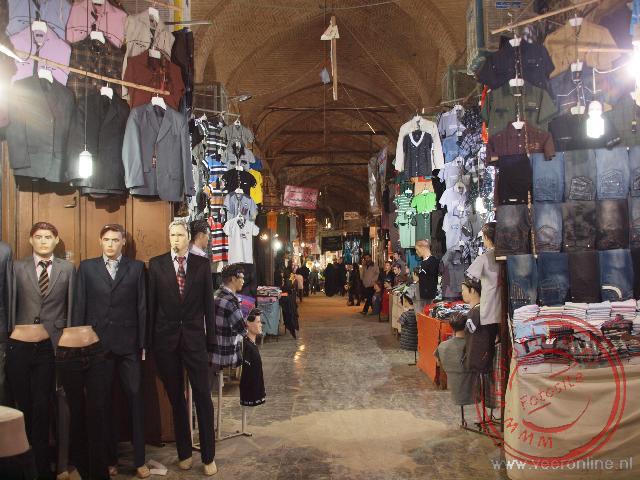
After consulting several passersby in Farsi, two men guide us to the main entrance. This entrance is remarkable for its brick facade. We are lucky: construction workers are at the gate, allowing us to visit. We thank our guides for their help. The main iwan features stunning mosaics, and a water pool sits on the large square courtyard. The ablution area is simply furnished and somewhat dilapidated, giving it a special charm. We continue the Lonely Planet route through the covered bazaar. It’s astonishing how much can be displayed in a small stall, with a seller always saying a friendly “Welcome in Iran!” as we pass. We visit a courtyard of a monastery school and eventually arrive at Esfahan’s oldest mosque, the Jameh Mosque. Unfortunately, it opens later in the afternoon, so we decide not to wait and return to Ali Iman Square for lunch. We cannot find the intended restaurant, so we ask a passerby for help. It turns out to be an Iranian living in the Netherlands, visiting with his family. After some inquiries and offers of assistance, we learn that a closed door blocks access to our restaurant, which opens only at 3:30 pm. One bystander leads us to a “good and cheap” restaurant called Behrus. Skeptically, we follow him back through the bazaar. Because we would miss the square view at the intended restaurant, Behrus first leads us up a staircase between carpet shops. Through a living room—where I politely greet two men—we reach a rooftop overlooking the bazaar. I wonder what exactly we are doing and where this “guide” is taking us. When we ask again about the restaurant, he leads us to a small restaurant a few alleys away.
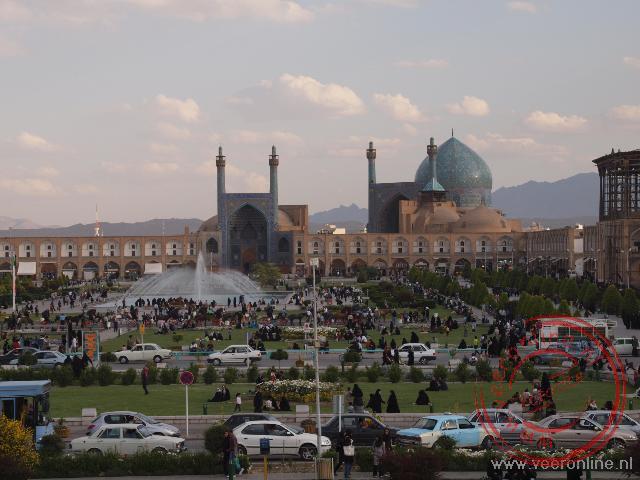
Only men sit downstairs, so we are led upstairs. Behrus orders food for us and arranges tea, promising to return in forty-five minutes. When we offer him a tip, he reacts annoyed, which he says is not necessary. We thank him politely and wait. Soon, our table is filled with Abgoose—a dish with soup, bread, and a kind of spinach. A young Iranian couple beside us shows us how to eat it: dip the bread in the soup, then eat it with the spinach. It tastes excellent and fits the local atmosphere. In the afternoon, I visit the Sultan’s Palace with its beautiful frescoes. At the entrance, a girls’ class gathers for a group photo, and I take a photo as well. The head teacher approaches and asks why I took the photo, if I’m familiar with the position of women in Iran, and what I think about it. During this “cross-examination,” I am surrounded by schoolgirls recording everything on modern cell phones. The photo is no problem, and she gives me the school’s website. She also claims that the Iranian regime has women’s best interests at heart. I decide not to argue. Back at Ali Iman Square, I find a bench to write about my travel experiences. I don’t get much time before Ali and Hoesein approach me to talk. We end up spending over an hour discussing our trip, Iran, culture, the freedoms in Amsterdam concerning sex and drugs, and even the price of a Peugeot in Iran, Syria, and the Netherlands. At 6:30 pm, I end the conversation for my tea-house appointment. The square is now busy, with families sitting on the grass. I take photos with children on the left, shake hands on the right, and call “From Holland” to a waving couple on a picnic blanket. The teahouse—now open—is at the far end of the square. From the terrace, there’s a stunning view of the entire square. I photograph two Iranian couples enjoying a water pipe, with the bustling square in the background. They try to say something in Farsi, but I don’t understand. When someone comes to translate, they ask me not to post the photo online. At dusk, I walk the square again to photograph the sunset. I meet a group of soldiers who want photos. An older man offers me walnuts, and I politely decline tea. After half an hour, I’ve crossed the entire square and take an evening shot of the Iman Mosque. In the evening, we dine at Flessenjan with a traditional Iranian meal. In the restaurant, an Iranian guide approaches me in German, asking if it’s true he saw me in Shiraz and, of course, what I think of the country. He also shares his opinion on the government. At the end of the day, lying in bed, I reflect on how many hands I shook today—over a hundred, for sure.
 Iran
Iran  The brickwork of the tower of the Shiraz citadel
 Guide Reza explains the basreliefs in Persepolis
 The impressive courtyard and Iwan of the Masjede Vakil Mosque in Shiraz
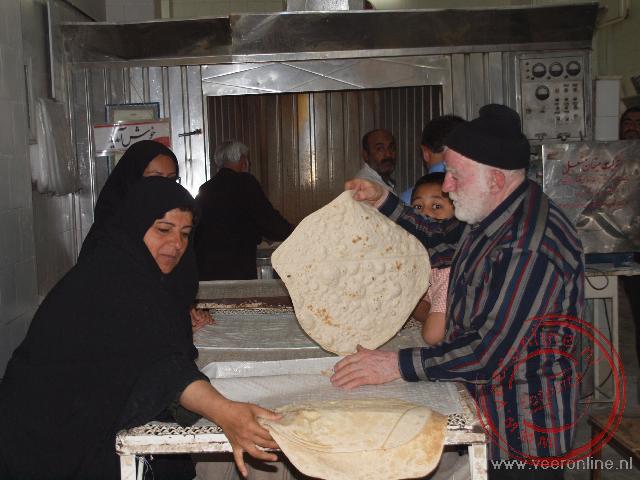 The bread is being collected
Travelogue Impressive and Hospitable Iran
Dag 2 | Iran > The climb of the Alborz Mountains
Dag 3 | Iran > The Sadabad Palace Museum
Dag 4 | Iran > Wandering through the streets of Yazd
Dag 5 | Iran > The tombs of Cyrus and Darius
Dag 6 | Iran > 'Islam is open to everyone'
Dag 7 | Iran > Persepolis, the city of Darius I
Dag 8 | Iran > Strolling across the square in Esfahan
Dag 9 | Iran > Having tea in the park
Dag 10 | Iran > The Mausoleum of Fatima in Qom
Dag 11 | Iran > Departure from Tehran