
154 countries
(and areas)
 - Azerbaijan
- Bahrain
- Barbados
- Belgium
- Belize
- Benin
- Bhutan
- Bolivia
- Bonaire
- Bosnia and Herzegovina
- Botswana
- Brazil
- British Virgin Islands
- Brunei
- Bulgaria
- Cambodia
- Canada
- Cape Verde
- Chile
- China
- Costa Rica
- Croatia
- Cuba
- Curacao
- Cyprus
- Czech Republic
- Denmark
- Dominica
- Dominican Republic
- Egypt
- El Salvador
- England
- Estonia
- Eswatini (Swaziland)
- Ethiopia
- Fiji
- Finland
- France
- French Guiana
- Georgia
- Germany
- Gibraltar
- Greece
- Grenada
- Guadeloupe
- Guatemala
- Honduras
- Hong Kong
- Hungary
- Iceland
- India
- Indonesia
- Iran
- Ireland
- Israel
- Italy
- Jamaica
- Japan
- Jordan
- Kazakhstan
- Kenya
- Kosovo
- Kuwait
- Kyrgyzstan
- Laos
- Latvia
- Lebanon
- Lesotho
- Liechtenstein
- Lithuania
- Luxembourg
- Macau
- Madagascar
- Malawi
- Malaysia
- Maldives
- Malta
- Martinique
- Mexico
- Moldova
- Monaco
- Mongolia
- Montenegro
- Morocco
- Mozambique
- Namibia
- Nepal
- Netherlands
- New Zealand
- Nicaragua
- North Macedonia
- Northern Ireland
- Norway
- Oman
- Pakistan
- Palestine
- Peru
- Philippines
- Poland
- Portugal
- Qatar
- Republic of Korea
- Romania
- Russia
- Saint Kitts and Nevis
- Saint Lucia
- Saint Martin
- Saint Vincent and the Grenadines
- San Marino
- São Tomé and Principe
- Saudi Arabia
- Scotland
- Senegal
- Serbia
- Singapore
- Sint Maarten
- Slovakia
- Slovenia
- South Africa
- Spain
- Sri Lanka
- Suriname
- Sweden
- Switzerland
- Tajikistan
- Tanzania
- Thailand
- The Gambia
- Tibet
- Togo
- Transnistria
- Trinidad and Tobago
- Tunisia
- Turkey
- Turkmenistan
- Uganda
- United Arab Emirates
- United States
- Uruguay
- Uzbekistan
- Vatican City
- Vietnam
- Wales
- Zambia
- Zanzibar
- Azerbaijan
- Bahrain
- Barbados
- Belgium
- Belize
- Benin
- Bhutan
- Bolivia
- Bonaire
- Bosnia and Herzegovina
- Botswana
- Brazil
- British Virgin Islands
- Brunei
- Bulgaria
- Cambodia
- Canada
- Cape Verde
- Chile
- China
- Costa Rica
- Croatia
- Cuba
- Curacao
- Cyprus
- Czech Republic
- Denmark
- Dominica
- Dominican Republic
- Egypt
- El Salvador
- England
- Estonia
- Eswatini (Swaziland)
- Ethiopia
- Fiji
- Finland
- France
- French Guiana
- Georgia
- Germany
- Gibraltar
- Greece
- Grenada
- Guadeloupe
- Guatemala
- Honduras
- Hong Kong
- Hungary
- Iceland
- India
- Indonesia
- Iran
- Ireland
- Israel
- Italy
- Jamaica
- Japan
- Jordan
- Kazakhstan
- Kenya
- Kosovo
- Kuwait
- Kyrgyzstan
- Laos
- Latvia
- Lebanon
- Lesotho
- Liechtenstein
- Lithuania
- Luxembourg
- Macau
- Madagascar
- Malawi
- Malaysia
- Maldives
- Malta
- Martinique
- Mexico
- Moldova
- Monaco
- Mongolia
- Montenegro
- Morocco
- Mozambique
- Namibia
- Nepal
- Netherlands
- New Zealand
- Nicaragua
- North Macedonia
- Northern Ireland
- Norway
- Oman
- Pakistan
- Palestine
- Peru
- Philippines
- Poland
- Portugal
- Qatar
- Republic of Korea
- Romania
- Russia
- Saint Kitts and Nevis
- Saint Lucia
- Saint Martin
- Saint Vincent and the Grenadines
- San Marino
- São Tomé and Principe
- Saudi Arabia
- Scotland
- Senegal
- Serbia
- Singapore
- Sint Maarten
- Slovakia
- Slovenia
- South Africa
- Spain
- Sri Lanka
- Suriname
- Sweden
- Switzerland
- Tajikistan
- Tanzania
- Thailand
- The Gambia
- Tibet
- Togo
- Transnistria
- Trinidad and Tobago
- Tunisia
- Turkey
- Turkmenistan
- Uganda
- United Arab Emirates
- United States
- Uruguay
- Uzbekistan
- Vatican City
- Vietnam
- Wales
- Zambia
- Zanzibar


Copyright 2004 - 2026
Veeronline.nl Travel Adventures

Home > San Marino > Northern Italy and San Marino > Travelogue day 13
Travelogue Northern Italy and San Marino
June 24 July 13 2022 (20 days)
San Marino > The Tiny Country San Marino
Dag 13 - Wednesday 6 July 2022As I walk toward the shower, I already smell the scent of fresh bread rolls. A little later, we sit down for breakfast. Croissants, cake, and toast — everything is available. The owner tries to make it as pleasant as possible for us. We tell him about our upcoming travel plans to San Marino and Venice. He advises us to definitely visit the Eremo delle Carceri monastery just outside Assisi before leaving. Francesco retreated there with his followers to live even more austerely. They prayed in small cells in the caves. We set the navigation to the indicated street. When we reach the street, we drive into a parking lot. We don’t see a monastery. A receptionist from a hotel explains that the monastery is indeed on this road, but we still have to go about four kilometers up into the mountains. On the other side of the parking lot, we see a large dome of a church. It turns out to be the Cattedrale di San Rufino, a church dedicated to one of Francesco’s followers. To get to the church, we pass through the city gate. Inside the church, a side altar is dedicated to the clergyman Rufino. This chapel, unlike the rather sparsely decorated church, is beautifully adorned. We drive up into the mountains. At every bend, we see Assisi growing smaller. We quickly gain altitude. Along the way, people are walking uphill, probably also on their way to the monastery. A tough task in the hot sun. At the monastery, a walking route is indicated for visitors.

Due to COVID, some rooms are still closed. Through narrow passages, we enter the small cells where the clergy prayed. The passages are sometimes barely half a meter wide and one and a half meters high. In such a prayer room of two by two meters, there is sometimes a small altar. Behind the monastery lie prayer caves. In the rock hollows, the Franciscans retreated to pray undisturbed. We have seen enough of Assisi and set course for the coast. For this, we go through the mountains. On winding roads, we drive up and then descend again. At the foot of the mountain, we fill the car with fuel and head toward Ancona. We think it would be nice to drive north along the coastal road instead of the highway. This plan turns out to be nicer in theory than in practice. The coastal road does not run along the sea; we only see buildings and industry. In one of the villages, we turn off and drive to the coast. On the beach, we order something to eat and drink. It’s nice to be on the beach for a while. We change our plan and drive via the fastest route to San Marino. San Marino is one of the smallest countries in Europe. In the year 301, the monk Marinus retreated into the mountains and founded San Marino to escape Christian persecution.

San Marino is the oldest existing republic in the world. The country is 61 km² in size and has 30,000 inhabitants. We enter San Marino almost unnoticed. There are no border controls. Although San Marino is not officially part of the Schengen area, it follows Italy’s rules. This also applies to the use of the euro currency. We follow the signs to San Marino city. The old center lies high on the 749-meter-high Monte Titano. Via sharp hairpin bends, we climb higher. Through the hotel, we received advice to park at parking lot P6 or P7. It is not possible to reach the hotel by car. The P6 parking lot, right next to the old city gate, turns out to be full. Fortunately, there is still space in the other parking lot. With our luggage, we walk to Hotel La Grotta. The hotel is located right in the historic center of San Marino. From the balcony of our room, we look out over the landscape far below. We set out to explore the capital. Immediately, we arrive at the Palazzo Pubblico. On the square stands the Statua della Libertà. The three points of the crown refer to the three towers of San Marino. These defense towers ensured that the country always remained independent. From the viewpoint, we look out over the lower part of San Marino and Italy. A cable car connects the rocky peak with the lower part of San Marino. Ideal for day trippers who want to come shopping: park below and take the gondola to the old city. The Basilica di San Marino is the most important church in the country.

At the Guaita tower, the first tower, we buy a combination ticket for the defense towers. When the employee learns that we are staying in the city, he asks if we have received a San Marino pass, which gives a discount. When we say no but show our hotel key, we still receive a discount. With the discount, besides the two towers, we can also visit four museums. The Palazzo Pubblico can also be visited. From the first tower, we look down into the valley. The surrounding land lies more than 700 meters lower—a breathtaking sight. The path to the second tower runs along the cliff edge. Everywhere the view is beautiful. From the second tower, the view of the first tower is especially impressive. This is the best-known image of San Marino. In the narrow streets of the city, many shops are located. Most are aimed at tourists or day visitors. No VAT is charged in San Marino, making shopping attractive. There are also shops openly selling weapons. We sit down at a terrace. Although the waiter is talking at another table, he seems to ignore us. After a few minutes, we leave again—willingly or not. At a second terrace, we have more luck. Someone comes to take our order. In the evening, the city is much quieter. The day trippers have left. We eat at a restaurant with a panoramic terrace. From the terrace, we see the lower part of San Marino. In the distance, we even see the sea. Slowly, the sun sets. To end the day, we take one last walk along the city walls. On the balcony of our room, we have a glass of wine. At 700 meters altitude, the temperature is pleasant.
 Italy
Italy 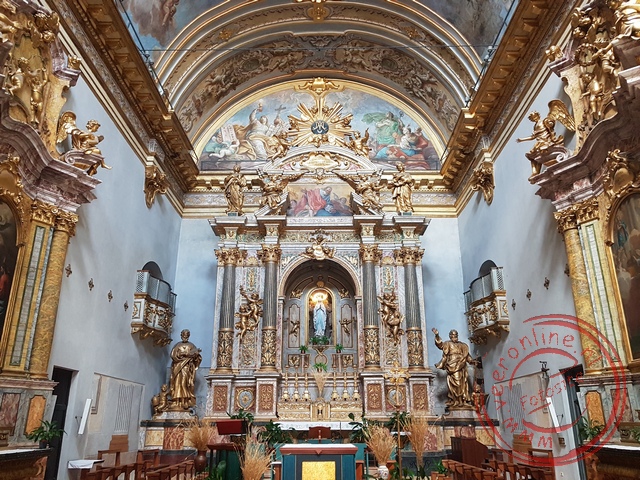 A surprising interior of the Temple of Minerva church in Assisi
 The imposing Cathedral of Como
 The inside of the Cathedral of Como
 The fourposter bed in Villa del Principe
Travelogue Northern Italy and San Marino
Dag 2 | Italy > Lake Como
Dag 3 | Italy > Wandering through Nesso
Dag 4 | Italy > The Rolli Palaces of Genoa
Dag 5 | Italy > Monastery of San Fruttuoso
Dag 6 | Italy > The Cinque Terre Fishing Villages
Dag 7 | Italy > The Leaning Tower of Pisa
Dag 8 | Italy > Cycling in Lucca
Dag 9 | Italy > The Duomo of Florence
Dag 10 | Italy > The Pitti Palace
Dag 11 | Italy > Towers of San Gimignano
Dag 12 | Italy > San Francesco of Assisi
Dag 13 | San Marino > The Tiny Country San Marino
Dag 14 | Italy > The Arcades of Bologna
Dag 15 | Italy > The Amphitheatre of Verona
Dag 16 | Italy > The Doge's Palace in Venice
Dag 17 | Italy > Around the Molveno Mountain Lake
Dag 18 | Italy > The Adolf Munkel Trail
Dag 19 | Germany > The Basilica of Mainz
Dag 20 | Germany > Back Home