
154 countries
(and areas)
 - Belize
- Benin
- Bhutan
- Bolivia
- Bonaire
- Bosnia and Herzegovina
- Botswana
- Brazil
- British Virgin Islands
- Brunei
- Bulgaria
- Cambodia
- Canada
- Cape Verde
- Chile
- China
- Costa Rica
- Croatia
- Cuba
- Curacao
- Cyprus
- Czech Republic
- Denmark
- Dominica
- Dominican Republic
- Egypt
- El Salvador
- England
- Estonia
- Eswatini (Swaziland)
- Ethiopia
- Fiji
- Finland
- France
- French Guiana
- Georgia
- Germany
- Gibraltar
- Greece
- Grenada
- Guadeloupe
- Guatemala
- Honduras
- Hong Kong
- Hungary
- Iceland
- India
- Indonesia
- Iran
- Ireland
- Israel
- Italy
- Jamaica
- Japan
- Jordan
- Kazakhstan
- Kenya
- Kosovo
- Kuwait
- Kyrgyzstan
- Laos
- Latvia
- Lebanon
- Lesotho
- Liechtenstein
- Lithuania
- Luxembourg
- Macau
- Madagascar
- Malawi
- Malaysia
- Maldives
- Malta
- Martinique
- Mexico
- Moldova
- Monaco
- Mongolia
- Montenegro
- Morocco
- Mozambique
- Namibia
- Nepal
- Netherlands
- New Zealand
- Nicaragua
- North Macedonia
- Northern Ireland
- Norway
- Oman
- Pakistan
- Palestine
- Peru
- Philippines
- Poland
- Portugal
- Qatar
- Republic of Korea
- Romania
- Russia
- Saint Kitts and Nevis
- Saint Lucia
- Saint Martin
- Saint Vincent and the Grenadines
- San Marino
- São Tomé and Principe
- Saudi Arabia
- Scotland
- Senegal
- Serbia
- Singapore
- Sint Maarten
- Slovakia
- Slovenia
- South Africa
- Spain
- Sri Lanka
- Suriname
- Sweden
- Switzerland
- Tajikistan
- Tanzania
- Thailand
- The Gambia
- Tibet
- Togo
- Transnistria
- Trinidad and Tobago
- Tunisia
- Turkey
- Turkmenistan
- Uganda
- United Arab Emirates
- United States
- Uruguay
- Uzbekistan
- Vatican City
- Vietnam
- Wales
- Zambia
- Zanzibar
- Belize
- Benin
- Bhutan
- Bolivia
- Bonaire
- Bosnia and Herzegovina
- Botswana
- Brazil
- British Virgin Islands
- Brunei
- Bulgaria
- Cambodia
- Canada
- Cape Verde
- Chile
- China
- Costa Rica
- Croatia
- Cuba
- Curacao
- Cyprus
- Czech Republic
- Denmark
- Dominica
- Dominican Republic
- Egypt
- El Salvador
- England
- Estonia
- Eswatini (Swaziland)
- Ethiopia
- Fiji
- Finland
- France
- French Guiana
- Georgia
- Germany
- Gibraltar
- Greece
- Grenada
- Guadeloupe
- Guatemala
- Honduras
- Hong Kong
- Hungary
- Iceland
- India
- Indonesia
- Iran
- Ireland
- Israel
- Italy
- Jamaica
- Japan
- Jordan
- Kazakhstan
- Kenya
- Kosovo
- Kuwait
- Kyrgyzstan
- Laos
- Latvia
- Lebanon
- Lesotho
- Liechtenstein
- Lithuania
- Luxembourg
- Macau
- Madagascar
- Malawi
- Malaysia
- Maldives
- Malta
- Martinique
- Mexico
- Moldova
- Monaco
- Mongolia
- Montenegro
- Morocco
- Mozambique
- Namibia
- Nepal
- Netherlands
- New Zealand
- Nicaragua
- North Macedonia
- Northern Ireland
- Norway
- Oman
- Pakistan
- Palestine
- Peru
- Philippines
- Poland
- Portugal
- Qatar
- Republic of Korea
- Romania
- Russia
- Saint Kitts and Nevis
- Saint Lucia
- Saint Martin
- Saint Vincent and the Grenadines
- San Marino
- São Tomé and Principe
- Saudi Arabia
- Scotland
- Senegal
- Serbia
- Singapore
- Sint Maarten
- Slovakia
- Slovenia
- South Africa
- Spain
- Sri Lanka
- Suriname
- Sweden
- Switzerland
- Tajikistan
- Tanzania
- Thailand
- The Gambia
- Tibet
- Togo
- Transnistria
- Trinidad and Tobago
- Tunisia
- Turkey
- Turkmenistan
- Uganda
- United Arab Emirates
- United States
- Uruguay
- Uzbekistan
- Vatican City
- Vietnam
- Wales
- Zambia
- Zanzibar


Copyright 2004 - 2026
Veeronline.nl Travel Adventures
Home > Italy > Northern Italy and San Marino > Travelogue day 14
Travelogue Northern Italy and San Marino
June 24 July 13 2022 (20 days)
Italy > The Arcades of Bologna
Dag 14 - Thursday 7 July 2022I slept well last night and wake up in a country where I’ve never slept before. On the ground floor of the hotel, a nice breakfast buffet is ready. It’s good to have cheese and cold cuts again after the past few days of mostly sweet breakfast items. We don’t have to check out until eleven, so we still have time to visit the Palazzo Pubblico. Entrance to the town hall is included in the combination ticket we bought yesterday. At the town hall, it turns out we’re early. The town hall only opens at half past nine. We walk to the viewpoint where the gondola departs. At half past nine, we return to the town hall. Entrance today is free—it’s UNESCO Day. The cashier is surprised herself and asks her colleagues, “Is it really free today?” The current town hall was built in 1884 as a replacement for an earlier building from the 14th century. The town hall is also where the parliament of San Marino meets. Since we are the first visitors of the day, the video is turned on especially for us. It shows the history of San Marino and the building of the town hall. On the top floor is the council chamber, which seats sixty parliament members—relatively many for the country’s 30,000 inhabitants. The chamber is beautifully decorated. After the visit, we collect our luggage and check out of the hotel.

At the parking lot, we use a special exit card. Through the hotel, we bought an exit card for four euros. To use it, we have to press the info button when leaving and show the card to the camera. The barrier opens. We drive down the mountain of San Marino via hairpin bends. At the foot of the mountain, we enter Italy again. Today we are going to Bologna. We drive along the coastal route, avoiding the toll road. Along the way, we buy some bread, cheese, and soft drinks at a small shop. We planned to have lunch by the Lido di Spina lake. This turns out to be nicer in theory than in reality. While driving along the lake, we see no parking opportunities. All access to the lake is private property. Only in the town of Comacchio can we park the car in a large parking lot. From the dyke, we see the lake, but there’s no shady spot here. We set up our chairs under a tree in the parking lot and eat our lunch—less idyllic than imagined. After lunch, we head to Bologna. Our accommodation for tonight is inside the ZTL zone, the restricted area for permit holders

. We received explicit instructions on how to drive to the lodging. If we deviate, we risk a fine. We follow the directions closely and arrive at Ospitalità San Tommaso D’Aquino. We can park on the private parking lot. We’re staying in the monastery of the San Domenico basilica. The room on the second floor is very nice. A good room. We have a few hours to explore the city. The receptionist marked some highlights on the map. Of course, we start at the adjacent Domenico basilica. The church is connected to the monastery where we are staying. Unlike the clergy, we cannot enter the church from inside the monastery. We have to walk around the block to reach the church. Officially, the church only opens at half past three for tourists. It’s just past three now. We decide to go in anyway. We’re not alone—this church is also overwhelming. After seeing so many beautiful churches during this trip, it’s hard to keep all the impressions apart. The shrine of the patron saint Dominic Guzman, founder of the Dominican order, is in a chapel. Opposite is the Rosary chapel, which is also stunning. Outside the church, we turn right and walk under the porticos—covered walkways famous in Bologna. They provide shade on hot days.

In total, there are over forty kilometers of porticos along the streets, giving the city a special charm. We arrive at Piazza Galvani, where the Basilica of Saint Petronius stands. While walking toward the front of the basilica, we see a small gate. We enter and find ourselves in the university library. The hallways and walls are richly decorated with frescoes and sculptures. We continue to the first floor, where with an entrance ticket we can visit the old anatomical hall and the old lecture hall—both gems. The anatomical hall dates from 1636 but was severely damaged during World War II. Fortunately, it has been restored to its original state. Entering the Basilica of Saint Petronius, we notice its enormous size. This church can rival the Duomo of Florence. Construction of the Gothic church began in 1390. Originally, the plan was to build a church larger than Saint Peter’s in Rome. The Pope at the time put a stop to this, and construction was halted. This is still visible in the unfinished façade of the basilica. In front of the church square, chairs are set up and a large screen is placed for evening film screenings. Through the town hall, we reach the Cathedral of Saint Peter. The receptionist recommended we visit this one, too. This somewhat smaller church is built in Baroque style. Although completely different from the previous two churches, it is beautiful as well.

In the narrow streets behind the church is a view through to a small canal. In the past, small waterways ran between houses and sometimes even underneath them. Most canals have now been filled in. This canal is only visible through a small window. Luckily, other tourists were there; otherwise, we might have missed it. Through a small window of about fifty by fifty centimeters, we see an almost dried-up canal. Here too, the heat has caused a water shortage. We end our city route at the two leaning towers of Bologna. Since the Middle Ages, these tall stone towers have defined the city’s skyline. The 97-meter-high Asinelli Tower and the 47-meter-high Garisenda Tower lean dangerously toward each other. In the past, the towers symbolized the status of rich families—the higher, the richer. Due to unstable ground, the towers started sinking in the 12th century. At the foot of the towers, we order something to drink. Meanwhile, we watch passersby and street performers hoping to earn a little money. In the evening, we eat in a side street near the cathedral. During dinner, a wind picks up, and napkins blow off the tables. Drops start to fall, so the tables are quickly moved under the porticos. We had already finished eating but enjoy our wine under the covered walkways. On the walk back to our lodging, we gratefully use the porticos again. Only in the last part of the route do we get wet in the rain.

 Italy
Italy 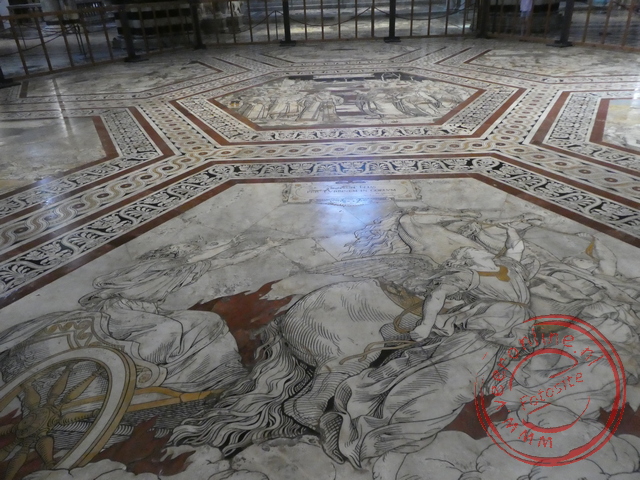 The floor is decorated with beautiful mosaics
 The harbor of Portofino and the colorful houses on the quay
 The last work of Michelangelo he was unable to finish
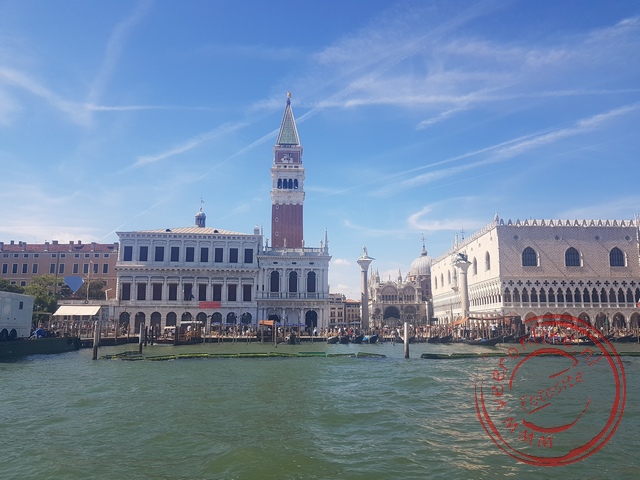 The Piazza San Marco has been the meeting place in Venice for centuries
Travelogue Northern Italy and San Marino
Dag 2 | Italy > Lake Como
Dag 3 | Italy > Wandering through Nesso
Dag 4 | Italy > The Rolli Palaces of Genoa
Dag 5 | Italy > Monastery of San Fruttuoso
Dag 6 | Italy > The Cinque Terre Fishing Villages
Dag 7 | Italy > The Leaning Tower of Pisa
Dag 8 | Italy > Cycling in Lucca
Dag 9 | Italy > The Duomo of Florence
Dag 10 | Italy > The Pitti Palace
Dag 11 | Italy > Towers of San Gimignano
Dag 12 | Italy > San Francesco of Assisi
Dag 13 | San Marino > The Tiny Country San Marino
Dag 14 | Italy > The Arcades of Bologna
Dag 15 | Italy > The Amphitheatre of Verona
Dag 16 | Italy > The Doge's Palace in Venice
Dag 17 | Italy > Around the Molveno Mountain Lake
Dag 18 | Italy > The Adolf Munkel Trail
Dag 19 | Germany > The Basilica of Mainz
Dag 20 | Germany > Back Home