
154 countries
(and areas)
 - Belize
- Benin
- Bhutan
- Bolivia
- Bonaire
- Bosnia and Herzegovina
- Botswana
- Brazil
- British Virgin Islands
- Brunei
- Bulgaria
- Cambodia
- Canada
- Cape Verde
- Chile
- China
- Costa Rica
- Croatia
- Cuba
- Curacao
- Cyprus
- Czech Republic
- Denmark
- Dominica
- Dominican Republic
- Egypt
- El Salvador
- England
- Estonia
- Eswatini (Swaziland)
- Ethiopia
- Fiji
- Finland
- France
- French Guiana
- Georgia
- Germany
- Gibraltar
- Greece
- Grenada
- Guadeloupe
- Guatemala
- Honduras
- Hong Kong
- Hungary
- Iceland
- India
- Indonesia
- Iran
- Ireland
- Israel
- Italy
- Jamaica
- Japan
- Jordan
- Kazakhstan
- Kenya
- Kosovo
- Kuwait
- Kyrgyzstan
- Laos
- Latvia
- Lebanon
- Lesotho
- Liechtenstein
- Lithuania
- Luxembourg
- Macau
- Madagascar
- Malawi
- Malaysia
- Maldives
- Malta
- Martinique
- Mexico
- Moldova
- Monaco
- Mongolia
- Montenegro
- Morocco
- Mozambique
- Namibia
- Nepal
- Netherlands
- New Zealand
- Nicaragua
- North Macedonia
- Northern Ireland
- Norway
- Oman
- Pakistan
- Palestine
- Peru
- Philippines
- Poland
- Portugal
- Qatar
- Republic of Korea
- Romania
- Russia
- Saint Kitts and Nevis
- Saint Lucia
- Saint Martin
- Saint Vincent and the Grenadines
- San Marino
- São Tomé and Principe
- Saudi Arabia
- Scotland
- Senegal
- Serbia
- Singapore
- Sint Maarten
- Slovakia
- Slovenia
- South Africa
- Spain
- Sri Lanka
- Suriname
- Sweden
- Switzerland
- Tajikistan
- Tanzania
- Thailand
- The Gambia
- Tibet
- Togo
- Transnistria
- Trinidad and Tobago
- Tunisia
- Turkey
- Turkmenistan
- Uganda
- United Arab Emirates
- United States
- Uruguay
- Uzbekistan
- Vatican City
- Vietnam
- Wales
- Zambia
- Zanzibar
- Belize
- Benin
- Bhutan
- Bolivia
- Bonaire
- Bosnia and Herzegovina
- Botswana
- Brazil
- British Virgin Islands
- Brunei
- Bulgaria
- Cambodia
- Canada
- Cape Verde
- Chile
- China
- Costa Rica
- Croatia
- Cuba
- Curacao
- Cyprus
- Czech Republic
- Denmark
- Dominica
- Dominican Republic
- Egypt
- El Salvador
- England
- Estonia
- Eswatini (Swaziland)
- Ethiopia
- Fiji
- Finland
- France
- French Guiana
- Georgia
- Germany
- Gibraltar
- Greece
- Grenada
- Guadeloupe
- Guatemala
- Honduras
- Hong Kong
- Hungary
- Iceland
- India
- Indonesia
- Iran
- Ireland
- Israel
- Italy
- Jamaica
- Japan
- Jordan
- Kazakhstan
- Kenya
- Kosovo
- Kuwait
- Kyrgyzstan
- Laos
- Latvia
- Lebanon
- Lesotho
- Liechtenstein
- Lithuania
- Luxembourg
- Macau
- Madagascar
- Malawi
- Malaysia
- Maldives
- Malta
- Martinique
- Mexico
- Moldova
- Monaco
- Mongolia
- Montenegro
- Morocco
- Mozambique
- Namibia
- Nepal
- Netherlands
- New Zealand
- Nicaragua
- North Macedonia
- Northern Ireland
- Norway
- Oman
- Pakistan
- Palestine
- Peru
- Philippines
- Poland
- Portugal
- Qatar
- Republic of Korea
- Romania
- Russia
- Saint Kitts and Nevis
- Saint Lucia
- Saint Martin
- Saint Vincent and the Grenadines
- San Marino
- São Tomé and Principe
- Saudi Arabia
- Scotland
- Senegal
- Serbia
- Singapore
- Sint Maarten
- Slovakia
- Slovenia
- South Africa
- Spain
- Sri Lanka
- Suriname
- Sweden
- Switzerland
- Tajikistan
- Tanzania
- Thailand
- The Gambia
- Tibet
- Togo
- Transnistria
- Trinidad and Tobago
- Tunisia
- Turkey
- Turkmenistan
- Uganda
- United Arab Emirates
- United States
- Uruguay
- Uzbekistan
- Vatican City
- Vietnam
- Wales
- Zambia
- Zanzibar


Copyright 2004 - 2026
Veeronline.nl Travel Adventures
Home > Tibet > Tour of Nepal and Tibet > Travelogue day 22
Travelogue Tour of Nepal and Tibet
15 September 9 October (25 days)
Tibet > Roadwork or not?
Dag 22 - Saturday, October 6, 2007At half past three, there’s a knock at the door. “Excuse me, you have to wake up.” It’s Tamdul, worried that we might oversleep. It’s only half past three… Sleepily, I put on my warm clothes, pack my luggage, and five minutes later walk to the bus. Outside, it’s quite chilly. I get on the bus to try and catch a few more minutes of sleep. At exactly four o’clock, the bus departs from the guesthouse.

It’s dark outside, and near the window it’s cold. I try to sleep a little more, but it’s not easy. Just outside Tisgri, the asphalt road ends and turns into sand and stones. The bus bumps along the road. The driver focuses in the dark on the potholes and bumps. At a construction site, the driver misjudges the height of a bump, and the back of the bus comes completely off the ground. Everything flies around in the rear of the bus. Yolande gets the now-cooled contents of a thermos spilled over her when it falls. Willem hits his head on the luggage rack. Water bottles are scattered throughout the bus, and all the glass jars for lunch are broken. Although it’s quite a mess, fortunately there’s no real damage. At the front, the driver probably doesn’t realize what’s happening behind him. He drives on undisturbed through the night. Around half past seven, we pass the high pass. According to the itinerary, there should be a beautiful view here. Unfortunately, it’s still dark outside, and ice has formed on the windows. I’ve pulled my sleeping bag over me, trying to keep it between me and the window as much as possible. The critical time for the construction sites is eight o’clock. As the clock approaches eight, we anxiously watch for roadwork. It has to be correct, right? I see some trucks parked by the roadside. Carefully, we ask Tamdul if they work on Saturdays. It’s already past eight. Tamdul says the road closes at nine.

A little later, we finally pass some work. We can drive past it fairly easily, and I assume we’ve reached the critical point. Tamdul warns that there’s more roadwork ahead. In the town, 33 kilometers from the border, we pass a barrier. The driver waves to the man at the gate, clearly relieved that we made it. We are now on the road to Zhangmu. If the barrier had been closed, we would have had to wait here until eight in the evening. A little further on, we stop for a toilet break and refuel. Soon outside the town, roadwork begins. The entire road is being upgraded. Now I realize that the last 33 kilometers have been under construction. The road is being widened. Retaining walls are built along the cliffs to prevent falling rocks, and bridges are being replaced. Hundreds of workers are working in small groups. Everywhere there’s activity. Tents are set up along the roadside for overnight stays. As we descend into a gorge, the landscape is much greener, but also much wetter. Several waterfalls cross the route, and the road is often muddy. Zhangmu lies over a thousand meters lower than the Tibetan Plateau. The road to Zhangmu runs through a steep gorge, along a ledge carved into the mountainside. Occasionally the bus drives through a mountain stream where a bridge is being rebuilt. In some places, the bus runs right along the edge of a ravine, hundreds of meters deep. It’s not a pleasant sight, especially since the bus shakes violently on the bumps and potholes. Not everyone enjoys this; some prefer to walk part of the route for their own safety. In terms of time, it doesn’t matter much because the bus frequently stops to let construction traffic pass. I now understand what they meant by “roadwork” and why you can’t pass after nine o’clock. Whenever the bus stops again for a truck unloading, we decide to walk. This gives us a view of the beautiful valley. Sometimes the bus passes us, sometimes we pass the bus. It’s also fun to watch the workers at their tasks. Walking, we finally reach Zhangmu, the border town between Tibet and Nepal. Long lines of trucks are parked along the roadside, likely waiting for the border or to transfer goods from Nepal to Tibet. This means all these trucks are also traveling back and forth on the road we just traversed, so our bus ride doesn’t seem so bad after all.

The hotel is in the center. Zhangmu is really just one main road clinging to the mountain with a few hairpin turns. At the bottom is the Chinese border post, followed by a ten-kilometer stretch of no-man’s-land. Right at the bottom, midway along the bridge, is the border with Nepal. We have lunch at the hotel. In the afternoon, we walk through the town. It’s amusing to see the big difference between Tibetan and Nepalese trucks. The Nepalese trucks, called Tatas, are heavily painted and decorated into real works of art. The Tibetan trucks are dull gray, purely functional for transporting goods. In Zhangmu, goods are transferred between them. In the evening, the four of us sleep in a somewhat musty room in the hotel basement. Just before going to sleep, there’s a commotion in the neighboring room: a large spider—really large—has settled on the window frame. After Loek takes the spider outside, everyone finally goes to bed.
 Tibet
Tibet 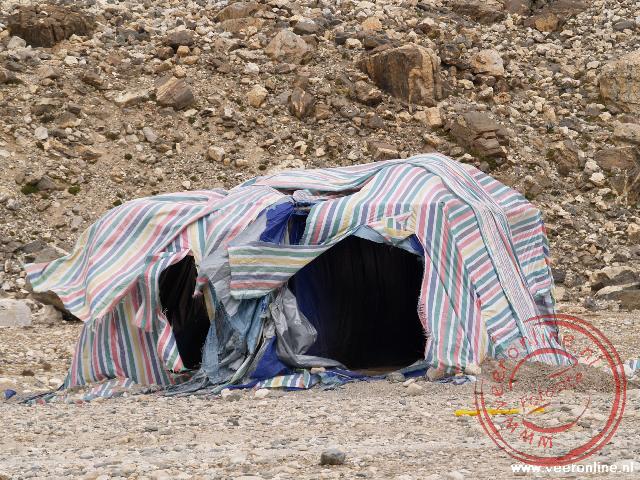 The windy toilet at Mount Everest basecamp at 5028 meters
 The tent camp for the last overnight stay near basecamp
 The tent where we stayed at 5028 meters at the foot of Mount Everest
 Ronald with Mount Everest summit in the background
Travelogue Tour of Nepal and Tibet
Dag 2 | Nepal > First impressions of Kathmandu
Dag 3 | Nepal > Durbar Square in the Thamel district
Dag 4 | Tibet > View of the Himalayan giants
Dag 5 | Tibet > May we enter the Potala Palace
Dag 6 | Tibet > Visit to Drepung monastery
Dag 7 | Tibet > Debating monks at Sera monastery
Dag 8 | Tibet > The oldest monastery of Tibet
Dag 9 | Tibet > Climb to the meditation caves
Dag 10 | Tibet > The photogenic Yumbu Lagang palace
Dag 11 | Tibet > Sky burial at the Drigung Til monastery
Dag 12 | Tibet > Having Tibetan butter tea
Dag 13 | Tibet > The heavily destroyed Ganden monastery
Dag 14 | Tibet > The worship of Buddha
Dag 15 | Tibet > The sacred Yamdrok Lake
Dag 16 | Tibet > The stupa of the Kumbum monastery
Dag 17 | Tibet > Tibetans as slaves in Pana Major
Dag 18 | Tibet > Temple fatigue?
Dag 19 | Tibet > Nobody knows our hotel
Dag 20 | Tibet > Tent camp at five kilometers altitude
Dag 21 | Tibet > Basecamp Mount Everest at 5,280 m
Dag 22 | Tibet > Roadwork or not?
Dag 23 | Nepal > Back in Nepal
Dag 24 | Nepal > The royal city Bhaktapur
Dag 25 | Nepal > In the middle of the night in Doha