
154 countries
(and areas)
 - Belize
- Benin
- Bhutan
- Bolivia
- Bonaire
- Bosnia and Herzegovina
- Botswana
- Brazil
- British Virgin Islands
- Brunei
- Bulgaria
- Cambodia
- Canada
- Cape Verde
- Chile
- China
- Costa Rica
- Croatia
- Cuba
- Curacao
- Cyprus
- Czech Republic
- Denmark
- Dominica
- Dominican Republic
- Egypt
- El Salvador
- England
- Estonia
- Eswatini (Swaziland)
- Ethiopia
- Fiji
- Finland
- France
- French Guiana
- Georgia
- Germany
- Gibraltar
- Greece
- Grenada
- Guadeloupe
- Guatemala
- Honduras
- Hong Kong
- Hungary
- Iceland
- India
- Indonesia
- Iran
- Ireland
- Israel
- Italy
- Jamaica
- Japan
- Jordan
- Kazakhstan
- Kenya
- Kosovo
- Kuwait
- Kyrgyzstan
- Laos
- Latvia
- Lebanon
- Lesotho
- Liechtenstein
- Lithuania
- Luxembourg
- Macau
- Madagascar
- Malawi
- Malaysia
- Maldives
- Malta
- Martinique
- Mexico
- Moldova
- Monaco
- Mongolia
- Montenegro
- Morocco
- Mozambique
- Namibia
- Nepal
- Netherlands
- New Zealand
- Nicaragua
- North Macedonia
- Northern Ireland
- Norway
- Oman
- Pakistan
- Palestine
- Peru
- Philippines
- Poland
- Portugal
- Qatar
- Republic of Korea
- Romania
- Russia
- Saint Kitts and Nevis
- Saint Lucia
- Saint Martin
- Saint Vincent and the Grenadines
- San Marino
- São Tomé and Principe
- Saudi Arabia
- Scotland
- Senegal
- Serbia
- Singapore
- Sint Maarten
- Slovakia
- Slovenia
- South Africa
- Spain
- Sri Lanka
- Suriname
- Sweden
- Switzerland
- Tajikistan
- Tanzania
- Thailand
- The Gambia
- Tibet
- Togo
- Transnistria
- Trinidad and Tobago
- Tunisia
- Turkey
- Turkmenistan
- Uganda
- United Arab Emirates
- United States
- Uruguay
- Uzbekistan
- Vatican City
- Vietnam
- Wales
- Zambia
- Zanzibar
- Belize
- Benin
- Bhutan
- Bolivia
- Bonaire
- Bosnia and Herzegovina
- Botswana
- Brazil
- British Virgin Islands
- Brunei
- Bulgaria
- Cambodia
- Canada
- Cape Verde
- Chile
- China
- Costa Rica
- Croatia
- Cuba
- Curacao
- Cyprus
- Czech Republic
- Denmark
- Dominica
- Dominican Republic
- Egypt
- El Salvador
- England
- Estonia
- Eswatini (Swaziland)
- Ethiopia
- Fiji
- Finland
- France
- French Guiana
- Georgia
- Germany
- Gibraltar
- Greece
- Grenada
- Guadeloupe
- Guatemala
- Honduras
- Hong Kong
- Hungary
- Iceland
- India
- Indonesia
- Iran
- Ireland
- Israel
- Italy
- Jamaica
- Japan
- Jordan
- Kazakhstan
- Kenya
- Kosovo
- Kuwait
- Kyrgyzstan
- Laos
- Latvia
- Lebanon
- Lesotho
- Liechtenstein
- Lithuania
- Luxembourg
- Macau
- Madagascar
- Malawi
- Malaysia
- Maldives
- Malta
- Martinique
- Mexico
- Moldova
- Monaco
- Mongolia
- Montenegro
- Morocco
- Mozambique
- Namibia
- Nepal
- Netherlands
- New Zealand
- Nicaragua
- North Macedonia
- Northern Ireland
- Norway
- Oman
- Pakistan
- Palestine
- Peru
- Philippines
- Poland
- Portugal
- Qatar
- Republic of Korea
- Romania
- Russia
- Saint Kitts and Nevis
- Saint Lucia
- Saint Martin
- Saint Vincent and the Grenadines
- San Marino
- São Tomé and Principe
- Saudi Arabia
- Scotland
- Senegal
- Serbia
- Singapore
- Sint Maarten
- Slovakia
- Slovenia
- South Africa
- Spain
- Sri Lanka
- Suriname
- Sweden
- Switzerland
- Tajikistan
- Tanzania
- Thailand
- The Gambia
- Tibet
- Togo
- Transnistria
- Trinidad and Tobago
- Tunisia
- Turkey
- Turkmenistan
- Uganda
- United Arab Emirates
- United States
- Uruguay
- Uzbekistan
- Vatican City
- Vietnam
- Wales
- Zambia
- Zanzibar


Copyright 2004 - 2026
Veeronline.nl Travel Adventures
Home > Tibet > Tour of Nepal and Tibet > Travelogue day 6
Travelogue Tour of Nepal and Tibet
15 September 9 October (25 days)
Tibet > Visit to Drepung monastery
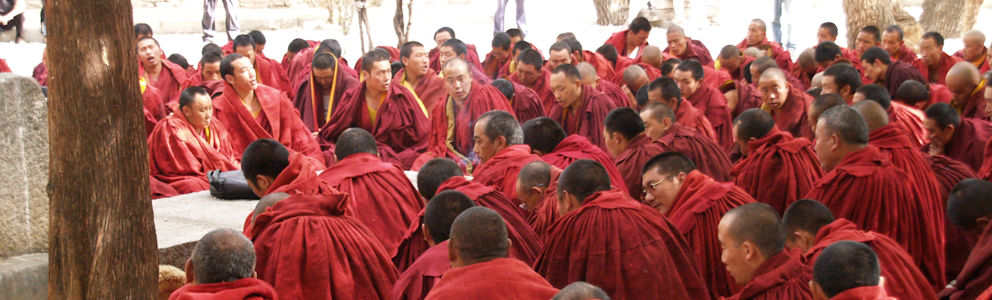
Dag 6 - Thursday, September 20, 2007This morning we drive to the largest monastery complex in Tibet — the Drepung Monastery. Drepung is located about eight kilometers outside the capital, Lhasa. Here, Thasi has more time for explanations since there’s no strict time limit. He takes his time to tell us about the different kings, Buddhas, and Lamas.

Fortunately, he often repeats himself, as there’s far too much information to absorb all at once. There are so many different Buddhas! Drepung is one of the three major Gelugpa monasteries (the other two are Sera and Ganden, which we’ll visit later). It is the largest monastery in Tibet. Before the Chinese occupation, around 15,000 monks lived here; today, only a few hundred are allowed to remain. As we walk through the monastery complex, the impressive rock paintings on the mountain slopes catch our eye. We visit the Dalai Lama’s former living quarters and admire the beautifully decorated Buddha statues. Tashi is enthusiastic and explains a great deal about the faith and the monastery. He gets so caught up in his storytelling that he completely loses track of time. We were supposed to meet at the bus at twelve o’clock for those who wanted to explore the monastery on their own, but at noon, we have only just finished visiting the palace. Quickly, Thasi continues with the rest of the tour. This part is just as beautiful — especially the monks’ large assembly hall, which is truly magnificent. I decide to spend 20 yuan (about two euros) to take photos. In every room, you have to pay separately for photography. Because Thasi is now rushing through his explanations, everything moves quickly. When I step outside, I realize I’ve lost sight of both the guide and the leading group. Together with the others who have fallen behind, we decide to follow the marked route. The signs lead us past beautiful chapels, over the rooftops of the monastery, and along several temples. We expect to catch up with Thasi at some point, but we never see him again. We decide to peek briefly inside each temple as we pass and then move on quickly. The route turns out to be harder to follow than expected, and we end up in an inner courtyard where the monks live. One of them kindly points us back in the right direction. After asking for directions a few more times, we finally reach the bus.

There, we learn that the tour had been cut short and that the others returned via a shorter route — they’ve already been waiting for us for an hour. We quickly get in the bus and drive back to Lhasa. In the afternoon, we walk into the city and start a walking tour from the Lonely Planet around Barkhor Square. At the Gyüme Lower Tantric College, we enter through the gate. It’s a temple similar to Drepung, though much, much smaller. Here, monks receive their first two years of training. A curtain hangs in front of the entrance — usually a sign not to enter — but a monk outside gestures that we may go in. We visit the college, and when we ask if we can take photos, he hesitantly asks for 5 yuan (about fifty euro cents). We climb the stairs to the upper floor. From one of the rooms, we hear chanting — a monk is praying. When he sees us, he beckons us to come inside. He smiles shyly at the attention. When we ask if we can take his picture and then show him the result, he laughs heartily. We also climb to the second floor. Back downstairs, one of the monks asks where we’re from, and soon we’re having a conversation about Buddhism and the temple. Using our digital camera, we show them photos from Drepung. Judging by their reactions, they’ve never been there themselves. They let us take some photos of them as well — even a group photo. A third monk comes over and gestures that he’d like to be in the picture too. We promise to send them the photos, and they give us an address written in both Chinese and English, as well as an email address from one of the monks (though he admits he doesn’t use it much). Tomorrow morning, the monks will gather for prayers, and we’re invited to join them from eight o’clock onward — something we definitely want to do. We thank them and continue our walk.

Just a few meters further on, we find a small hidden monastery. At first, we can’t locate the entrance, but with some hand gestures from passersby, we’re directed to the right spot. Next to the monastery, we visit a small print shop. Through a window, we can see the printing work being done, but when we try to step inside, the supervisor clearly disapproves, so we turn back. We continue the route through the Muslim quarter, where many billiard tables are set up right on the street. Pool seems to be the number one sport in Tibet. We visit a few small temples and walk past Lhasa’s two mosques. Our tour ends back at Barkhor Square, from where we return to the hotel. In the evening, Jozalien gives us a briefing about the next two days. It isn’t necessary to bring all our luggage; we’ll probably take just one bag between the two of us and leave the other behind. Later that evening, I have a tuna pizza on Barkhor Square. The pizza tastes good but is swimming in oil — hopefully, that won’t cause any trouble later. Back at the hotel, we climb up to the fifth floor and step out onto the roof. Between the solar panels and the laundry lines, we walk to the edge to take a beautiful nighttime photo of the Potala Palace.
 Tibet
Tibet 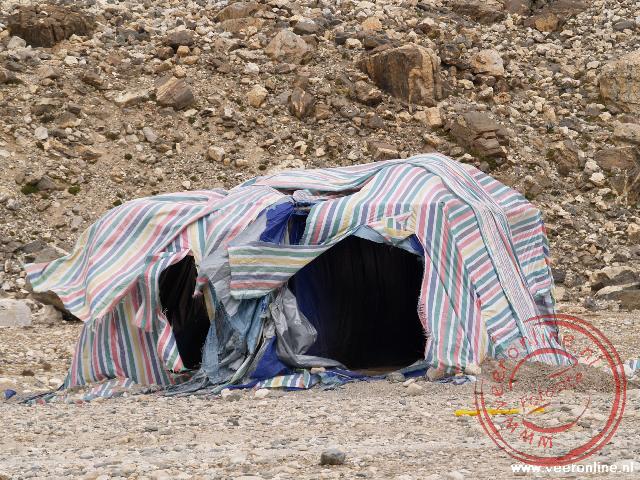 The windy toilet at Mount Everest basecamp at 5028 meters
 The tent camp for the last overnight stay near basecamp
 The tent where we stayed at 5028 meters at the foot of Mount Everest
 Ronald with Mount Everest summit in the background
Travelogue Tour of Nepal and Tibet
Dag 2 | Nepal > First impressions of Kathmandu
Dag 3 | Nepal > Durbar Square in the Thamel district
Dag 4 | Tibet > View of the Himalayan giants
Dag 5 | Tibet > May we enter the Potala Palace
Dag 6 | Tibet > Visit to Drepung monastery
Dag 7 | Tibet > Debating monks at Sera monastery
Dag 8 | Tibet > The oldest monastery of Tibet
Dag 9 | Tibet > Climb to the meditation caves
Dag 10 | Tibet > The photogenic Yumbu Lagang palace
Dag 11 | Tibet > Sky burial at the Drigung Til monastery
Dag 12 | Tibet > Having Tibetan butter tea
Dag 13 | Tibet > The heavily destroyed Ganden monastery
Dag 14 | Tibet > The worship of Buddha
Dag 15 | Tibet > The sacred Yamdrok Lake
Dag 16 | Tibet > The stupa of the Kumbum monastery
Dag 17 | Tibet > Tibetans as slaves in Pana Major
Dag 18 | Tibet > Temple fatigue?
Dag 19 | Tibet > Nobody knows our hotel
Dag 20 | Tibet > Tent camp at five kilometers altitude
Dag 21 | Tibet > Basecamp Mount Everest at 5,280 m
Dag 22 | Tibet > Roadwork or not?
Dag 23 | Nepal > Back in Nepal
Dag 24 | Nepal > The royal city Bhaktapur
Dag 25 | Nepal > In the middle of the night in Doha