
154 countries
(and areas)
 - Azerbaijan
- Bahrain
- Barbados
- Belgium
- Belize
- Benin
- Bhutan
- Bolivia
- Bonaire
- Bosnia and Herzegovina
- Botswana
- Brazil
- British Virgin Islands
- Brunei
- Bulgaria
- Cambodia
- Canada
- Cape Verde
- Chile
- China
- Costa Rica
- Croatia
- Cuba
- Curacao
- Cyprus
- Czech Republic
- Denmark
- Dominica
- Dominican Republic
- Egypt
- El Salvador
- England
- Estonia
- Eswatini (Swaziland)
- Ethiopia
- Fiji
- Finland
- France
- French Guiana
- Georgia
- Germany
- Gibraltar
- Greece
- Grenada
- Guadeloupe
- Guatemala
- Honduras
- Hong Kong
- Hungary
- Iceland
- India
- Indonesia
- Iran
- Ireland
- Israel
- Italy
- Jamaica
- Japan
- Jordan
- Kazakhstan
- Kenya
- Kosovo
- Kuwait
- Kyrgyzstan
- Laos
- Latvia
- Lebanon
- Lesotho
- Liechtenstein
- Lithuania
- Luxembourg
- Macau
- Madagascar
- Malawi
- Malaysia
- Maldives
- Malta
- Martinique
- Mexico
- Moldova
- Monaco
- Mongolia
- Montenegro
- Morocco
- Mozambique
- Namibia
- Nepal
- Netherlands
- New Zealand
- Nicaragua
- North Macedonia
- Northern Ireland
- Norway
- Oman
- Pakistan
- Palestine
- Peru
- Philippines
- Poland
- Portugal
- Qatar
- Republic of Korea
- Romania
- Russia
- Saint Kitts and Nevis
- Saint Lucia
- Saint Martin
- Saint Vincent and the Grenadines
- San Marino
- São Tomé and Principe
- Saudi Arabia
- Scotland
- Senegal
- Serbia
- Singapore
- Sint Maarten
- Slovakia
- Slovenia
- South Africa
- Spain
- Sri Lanka
- Suriname
- Sweden
- Switzerland
- Tajikistan
- Tanzania
- Thailand
- The Gambia
- Tibet
- Togo
- Transnistria
- Trinidad and Tobago
- Tunisia
- Turkey
- Turkmenistan
- Uganda
- United Arab Emirates
- United States
- Uruguay
- Uzbekistan
- Vatican City
- Vietnam
- Wales
- Zambia
- Zanzibar
- Azerbaijan
- Bahrain
- Barbados
- Belgium
- Belize
- Benin
- Bhutan
- Bolivia
- Bonaire
- Bosnia and Herzegovina
- Botswana
- Brazil
- British Virgin Islands
- Brunei
- Bulgaria
- Cambodia
- Canada
- Cape Verde
- Chile
- China
- Costa Rica
- Croatia
- Cuba
- Curacao
- Cyprus
- Czech Republic
- Denmark
- Dominica
- Dominican Republic
- Egypt
- El Salvador
- England
- Estonia
- Eswatini (Swaziland)
- Ethiopia
- Fiji
- Finland
- France
- French Guiana
- Georgia
- Germany
- Gibraltar
- Greece
- Grenada
- Guadeloupe
- Guatemala
- Honduras
- Hong Kong
- Hungary
- Iceland
- India
- Indonesia
- Iran
- Ireland
- Israel
- Italy
- Jamaica
- Japan
- Jordan
- Kazakhstan
- Kenya
- Kosovo
- Kuwait
- Kyrgyzstan
- Laos
- Latvia
- Lebanon
- Lesotho
- Liechtenstein
- Lithuania
- Luxembourg
- Macau
- Madagascar
- Malawi
- Malaysia
- Maldives
- Malta
- Martinique
- Mexico
- Moldova
- Monaco
- Mongolia
- Montenegro
- Morocco
- Mozambique
- Namibia
- Nepal
- Netherlands
- New Zealand
- Nicaragua
- North Macedonia
- Northern Ireland
- Norway
- Oman
- Pakistan
- Palestine
- Peru
- Philippines
- Poland
- Portugal
- Qatar
- Republic of Korea
- Romania
- Russia
- Saint Kitts and Nevis
- Saint Lucia
- Saint Martin
- Saint Vincent and the Grenadines
- San Marino
- São Tomé and Principe
- Saudi Arabia
- Scotland
- Senegal
- Serbia
- Singapore
- Sint Maarten
- Slovakia
- Slovenia
- South Africa
- Spain
- Sri Lanka
- Suriname
- Sweden
- Switzerland
- Tajikistan
- Tanzania
- Thailand
- The Gambia
- Tibet
- Togo
- Transnistria
- Trinidad and Tobago
- Tunisia
- Turkey
- Turkmenistan
- Uganda
- United Arab Emirates
- United States
- Uruguay
- Uzbekistan
- Vatican City
- Vietnam
- Wales
- Zambia
- Zanzibar


Copyright 2004 - 2026
Veeronline.nl Travel Adventures

Home > Dominica > A Caribbean Cruise > Travelogue day 6
Travelogue A Caribbean Cruise
February 29 March 16 2024 (17 days)
Dominica > Still a lot of hurricane damage
Dag 6 - Tuesday, March 5, 2024When I wake up, it turns out the alarm hasn’t gone off. Or did I turn it off in my sleep? That seems unlikely to me. Could the time synchronization on my phone have problems out at sea? Luckily, we still have plenty of time before the excursion on the island of Dominica starts. We even have time to enjoy a relaxed breakfast. Today we’re taking a tour around the island of Dominica. We’ll visit, among other places, the Wotten Waven sulfur springs and the Trafalgar Falls. Dominica is the largest island in this region and is almost entirely volcanic in origin. The extinct volcanoes form a rugged mountainous landscape on Dominica. We are assigned to driver Louis. He enthusiastically begins telling us about the island in English, the official language of Dominica. I don’t know if he realizes that most people in the minibus don’t understand a word of what he says—they’re from Italy and France. Louis explains that Columbus gave the island its name “Dominica” in 1493 because he passed by on a Sunday, as the bus starts climbing into the mountains. The local population strongly resisted the colonists, causing the French to withdraw and hand the island over to the British, who burned the capital Roseau to the ground. Dominica became independent in 1978. The country has had a hard time. As we drive through the capital Roseau, Louis points out damaged buildings. The island was severely hit by Hurricane Maria in 2017. Ninety percent of the buildings in the capital were damaged. The church and library still have no roofs. Many places have containers where temporary shops have been set up. Outside the city, the road winds up into the mountains.

We drive through tropical rainforest. Louis proudly says 65% of the island is covered by rainforest. There are three large national parks, and nature is actively protected. The island calls itself “The Nature Island.” Although the volcanoes no longer erupt, there is still volcanic activity. Hot steam heats some sulfur springs. I see the water boiling in the spring and the hot steam rising. It’s always a remarkable sight. A little further on lie the Trafalgar Falls. These two waterfalls are part of the Roseau River, which flows into the capital. Louis points to a palm-like tree. “This is the Roseau,” he says, the namesake of the river and the city. Through a path in the forest, we reach the waterfall viewpoint in about ten minutes. It’s busy. Everyone on a tour arrives here at the same time. Why don’t they let one minibus go to the springs first and the other to the waterfall? The two waterfalls cascade water down from the mountains. It’s a beautiful sight, but against the sunlight. Some visitors venture onto the rocks beneath the waterfall. I skip this. The third stop is at a small bar. Choices are rum punch, coconut punch, fruit drink, or beer. I choose the coconut punch—a sweet alcoholic drink. By chance, we meet a Dutch couple. The number of Dutch onboard is limited. Besides our dining table companion, we haven’t met other fellow countrymen. On the way back, just outside Roseau, is the Botanical Garden of Dominica. The Botanical Gardens of Dominica were founded in 1891, making them one of the oldest botanical gardens in the Caribbean. The original purpose was as an experimental garden. Today it’s more of a neatly maintained park. Several old trees with many aerial roots and bamboo groves are beautiful to see. In an aviary, the endangered Sisserou Parrot is kept. This colorful parrot is the national bird of Dominica and also appears on the country’s flag. I think I see a parrot through the mesh, but I’m not completely sure. Finally, Louis takes us to the Morne Bruce Viewpoint, overlooking the city.

I see the center of Roseau and behind it the cruise ship Costa Fortuna. Back on the ship, we say goodbye to Louis. We go onboard for lunch. In the afternoon, we stroll through the town of Roseau. The town consists of colorful houses, colonial buildings, and some hurricane-damaged homes. In one of the ruins is the Rock Ruin Café and Bar. The church tower is scaffolding-covered, but the rest of the church is still badly damaged. The site is fenced off with steel plates and the windows boarded up with wood. The second church has no roof at all. The wooden frame shows where the roof once was. It feels a bit strange that the adjacent presidential palace and parliament building are in perfect condition. The Fort Young now houses a luxury hotel. The guard lets us take a quick look inside. We continue wandering through the town until we reach the Roseau River. In a container bar, we order local beer. I pay in dollars and get change in Eastern Caribbean dollars, a currency used on several islands. When I mention I collect banknotes, the waitress gives me a two-dollar bill. “It’s brand new,” she says, “I’d like to give it to you.” I thank her kindly while drinking my beer. We return to the ship well in time. Our cabin is right above the gangway. It’s funny to see people still arriving around half past five. Everyone must be onboard by six. Up to ten minutes after that time, people rush onboard. Meanwhile, all preparations for departure are made. The gangway retracts, the mooring lines are cast off, and the ship pulls away from the quay, heading out to sea toward Saint Lucia. Outside, dusk falls—a perfect moment to go eat. After dinner, we finish with a drink at the bar with live music.
 Dominica
  The cruise ship is docked at the quay for the capital Roseau
 A lizard beside the road
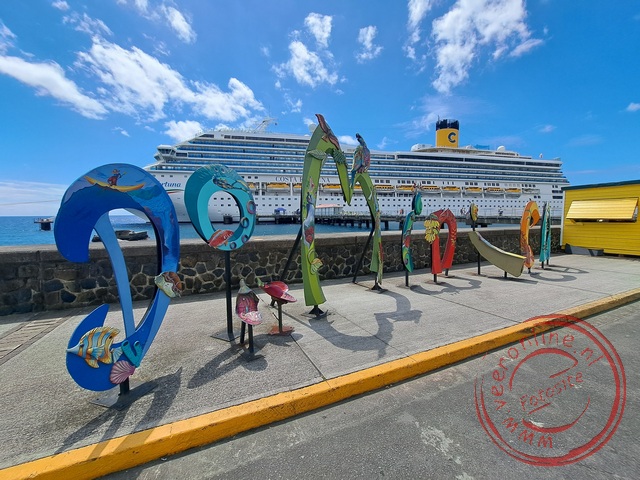 The letters Dominica with the Costa Fortuna behind them
 The small center of the capital of Dominica
Travelogue A Caribbean Cruise
Dag 2 | Guadeloupe > On board the Costa Fortuna
Dag 3 | Trinidad and Tobago > A day on board the cruise ship
Dag 4 | Trinidad and Tobago > The old plantations of Tobago
Dag 5 | Barbados > Snorkeling with turtles on Barbados
Dag 6 | Dominica > Still a lot of hurricane damage
Dag 7 | Saint Lucia > The mud bath on Saint Lucia
Dag 8 | Martinique > On the beach of Martinique
Dag 9 | Guadeloupe > A tour around Guadeloupe
Dag 10 | British Virgin Islands > A relaxing day at sea
Dag 11 | British Virgin Islands > The Bath's National Park on Virgin Gorda
Dag 12 | Sint Maarten > The border between the Netherlands and France
Dag 13 | Antigua and Barbuda > The historic Nelson's Dockyard
Dag 14 | Saint Vincent and the Grenadines > Sailing to one of the Grenadines
Dag 15 | Martinique > Walking through Martinique's rainforest
Dag 16 | Guadeloupe > Farewell to the Costa Fortuna
Dag 17 | Guadeloupe > By train through Paris