
154 countries
(and areas)
 - Azerbaijan
- Bahrain
- Barbados
- Belgium
- Belize
- Benin
- Bhutan
- Bolivia
- Bonaire
- Bosnia and Herzegovina
- Botswana
- Brazil
- British Virgin Islands
- Brunei
- Bulgaria
- Cambodia
- Canada
- Cape Verde
- Chile
- China
- Costa Rica
- Croatia
- Cuba
- Curacao
- Cyprus
- Czech Republic
- Denmark
- Dominica
- Dominican Republic
- Egypt
- El Salvador
- England
- Estonia
- Eswatini (Swaziland)
- Ethiopia
- Fiji
- Finland
- France
- French Guiana
- Georgia
- Germany
- Gibraltar
- Greece
- Grenada
- Guadeloupe
- Guatemala
- Honduras
- Hong Kong
- Hungary
- Iceland
- India
- Indonesia
- Iran
- Ireland
- Israel
- Italy
- Jamaica
- Japan
- Jordan
- Kazakhstan
- Kenya
- Kosovo
- Kuwait
- Kyrgyzstan
- Laos
- Latvia
- Lebanon
- Lesotho
- Liechtenstein
- Lithuania
- Luxembourg
- Macau
- Madagascar
- Malawi
- Malaysia
- Maldives
- Malta
- Martinique
- Mexico
- Moldova
- Monaco
- Mongolia
- Montenegro
- Morocco
- Mozambique
- Namibia
- Nepal
- Netherlands
- New Zealand
- Nicaragua
- North Macedonia
- Northern Ireland
- Norway
- Oman
- Pakistan
- Palestine
- Peru
- Philippines
- Poland
- Portugal
- Qatar
- Republic of Korea
- Romania
- Russia
- Saint Kitts and Nevis
- Saint Lucia
- Saint Martin
- Saint Vincent and the Grenadines
- San Marino
- São Tomé and Principe
- Saudi Arabia
- Scotland
- Senegal
- Serbia
- Singapore
- Sint Maarten
- Slovakia
- Slovenia
- South Africa
- Spain
- Sri Lanka
- Suriname
- Sweden
- Switzerland
- Tajikistan
- Tanzania
- Thailand
- The Gambia
- Tibet
- Togo
- Transnistria
- Trinidad and Tobago
- Tunisia
- Turkey
- Turkmenistan
- Uganda
- United Arab Emirates
- United States
- Uruguay
- Uzbekistan
- Vatican City
- Vietnam
- Wales
- Zambia
- Zanzibar
- Azerbaijan
- Bahrain
- Barbados
- Belgium
- Belize
- Benin
- Bhutan
- Bolivia
- Bonaire
- Bosnia and Herzegovina
- Botswana
- Brazil
- British Virgin Islands
- Brunei
- Bulgaria
- Cambodia
- Canada
- Cape Verde
- Chile
- China
- Costa Rica
- Croatia
- Cuba
- Curacao
- Cyprus
- Czech Republic
- Denmark
- Dominica
- Dominican Republic
- Egypt
- El Salvador
- England
- Estonia
- Eswatini (Swaziland)
- Ethiopia
- Fiji
- Finland
- France
- French Guiana
- Georgia
- Germany
- Gibraltar
- Greece
- Grenada
- Guadeloupe
- Guatemala
- Honduras
- Hong Kong
- Hungary
- Iceland
- India
- Indonesia
- Iran
- Ireland
- Israel
- Italy
- Jamaica
- Japan
- Jordan
- Kazakhstan
- Kenya
- Kosovo
- Kuwait
- Kyrgyzstan
- Laos
- Latvia
- Lebanon
- Lesotho
- Liechtenstein
- Lithuania
- Luxembourg
- Macau
- Madagascar
- Malawi
- Malaysia
- Maldives
- Malta
- Martinique
- Mexico
- Moldova
- Monaco
- Mongolia
- Montenegro
- Morocco
- Mozambique
- Namibia
- Nepal
- Netherlands
- New Zealand
- Nicaragua
- North Macedonia
- Northern Ireland
- Norway
- Oman
- Pakistan
- Palestine
- Peru
- Philippines
- Poland
- Portugal
- Qatar
- Republic of Korea
- Romania
- Russia
- Saint Kitts and Nevis
- Saint Lucia
- Saint Martin
- Saint Vincent and the Grenadines
- San Marino
- São Tomé and Principe
- Saudi Arabia
- Scotland
- Senegal
- Serbia
- Singapore
- Sint Maarten
- Slovakia
- Slovenia
- South Africa
- Spain
- Sri Lanka
- Suriname
- Sweden
- Switzerland
- Tajikistan
- Tanzania
- Thailand
- The Gambia
- Tibet
- Togo
- Transnistria
- Trinidad and Tobago
- Tunisia
- Turkey
- Turkmenistan
- Uganda
- United Arab Emirates
- United States
- Uruguay
- Uzbekistan
- Vatican City
- Vietnam
- Wales
- Zambia
- Zanzibar


Copyright 2004 - 2026
Veeronline.nl Travel Adventures

Home > Saint Lucia > A Caribbean Cruise > Travelogue day 7
Travelogue A Caribbean Cruise
February 29 March 16 2024 (17 days)
Saint Lucia > The mud bath on Saint Lucia
Dag 7 - Wednesday, March 6, 2024When I open the curtains, I see another TUI cruise ship turning in the harbor. I estimate the distance to the stern to be less than twenty meters. People on the balconies are looking at our ship. The rhythm on board is already becoming quite familiar. The alarm goes off at half past six. Shower, get dressed, and have breakfast on deck three. Then we check in for the excursion in the theater. We can go straight to the bus. Today we are making a tour around the island of Saint Lucia, passing fishing villages and banana plantations. We’ll also visit the famous Pitons volcanic peaks and have the opportunity to bathe in a volcanic mud bath. In the port of Castries, three large cruise ships are docked. This means the quay is busy. I follow the guide to bus number two. Delicios is standing by the bus. She explains the program in English. Apart from us, the other travelers are French. Except for one couple, I don’t think her message gets through. Claud is the driver. He drives the minibus from the port area towards the capital. Meanwhile, Delicios talks about the buildings we pass and the country’s history. The capital has been hit by a major fire four times. The last time was in 1948 when a tailor left a candle burning. Three quarters of Castries burned down then. The island is also regularly struck by earthquakes and hurricanes. The last severe hurricane was in 2010. There have been no volcanic eruptions since the 18th century.

Still, they do not want to call the volcano extinct; it is just less active. We follow the coastal road south. The winding mountain road twists through the landscape with hairpin bends. Not one hundred meters is straight. The incline is sometimes as steep as fifteen percent. Claud revs the bus high to get uphill. From the height, I have a view of the capital and the harbor. The three large cruise ships are clearly visible. Further on, we pass Marigot Bay. Marigot Bay is one of the most beautiful bays in the Caribbean. The bay was the setting for several films, including Dr. Dolittle 2. We descend again to the fishing village of Anse la Raye. The program lists this village as a main stop, but we drive right through it. No stop is planned. Delicios’s program and the Costa description do not match. The Costa staff member points this out, but it does not change the itinerary. Fortunately, the journey around the island is beautiful enough. The second fishing village, Canaries, is also mainly a drive-through. Along the roadside are large banana plantations. We also pass mango trees, cashew trees, and coconut palms. Saint Lucia is a green island, mostly covered with tropical rainforest.

Just after ten o’clock, we arrive in Soufrière. The town of Soufrière lies entirely within the volcanic crater. The volcano exploded tens of thousands of years ago. From the crater rim, we can see the Pitons, two huge pointed rock formations. The Pitons themselves are not volcanoes; they were formed by lava flows. The Pitons with Soufrière in the foreground is a magnificent sight. Just outside Soufrière are sulfur springs. A guide takes us along the boiling springs. She looks a bit disappointed that only four people speak English. She promises to speak slowly for the remaining participants. I look out over an area with several hot springs. Boiling water bubbles upward. This is more impressive than the sulfur spring in Dominica. In the past, people could walk closer between the springs, but since a guide fell into a spring, access has been limited to a viewing platform. There are also mud baths near the springs. I put on my swimming trunks and smear myself with the mud. The mud is said to be healthy for the skin. In the bath heated by volcanic water, I rinse off. Or so I thought. The water also contains mud. Black sludge remains. I try to rinse under a stream of water functioning as a shower. When I dry off a little later, my towel shows that this was in vain. Black stains are on my towel. I’ll wash that out at home. We drive back to Castries in about an hour. Just outside Castries, there is roadwork.

Traffic is completely stuck here. It takes at least twenty extra minutes to get past the roundabout under construction. I ask if it’s possible to get off in Castries. This is not allowed. The tour company returns everyone to the cruise ship. Afterwards, we could possibly ride with the bus to the center, but we decide not to. We take our backpacks to the cabin and quickly grab a bite on board. At half past two, we walk to the center of Castries. Because there are several cruise ships docked, we have to walk a bit further. We are on the last ship. In just under half an hour, we reach the Cathedral of the Immaculate Conception in Castries. A hearse stands at the door. The church is busy. From the back of the church, we look at the special building. The church is built on a steel frame with a wooden roof. You don’t see cathedrals like this often. Next to the church is Columbus Square. In the middle of the square stands a 400-year-old tree. The center of Castries is small, and most historical colonial buildings were lost in the 1948 city fire. The cathedral and the old tree have survived all disasters. In a local restaurant, we order a Piton beer, local to Saint Lucia. We order a drink and take it back to our cabin. Here I take a shower first. I still smell the sulfur from this afternoon’s mud bath. After dinner, there is an ABBAmania show in the Atrium on deck three. The dance floor fills up with people dancing to various ABBA songs. Afterwards, we go to the theater for an acrobatic performance of Romeo and Juliet. Fun and impressive.
 Dominica
  Neg Mawon Emancipation Monument in Roseau
 Antigua and Barbuda
  The buildings of Nelsons Dockyard have been restored
 Saint Vincent and the Grenadines
 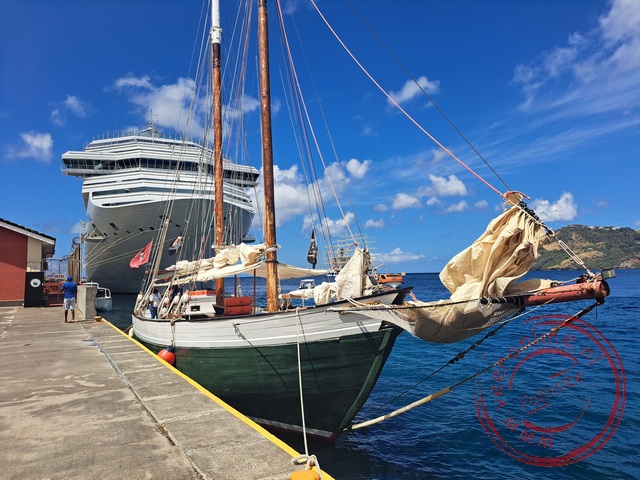 We sail to the island of Bequia on the Scaramouche
 The hot springs of Wotten Waven
Travelogue A Caribbean Cruise
Dag 2 | Guadeloupe > On board the Costa Fortuna
Dag 3 | Trinidad and Tobago > A day on board the cruise ship
Dag 4 | Trinidad and Tobago > The old plantations of Tobago
Dag 5 | Barbados > Snorkeling with turtles on Barbados
Dag 6 | Dominica > Still a lot of hurricane damage
Dag 7 | Saint Lucia > The mud bath on Saint Lucia
Dag 8 | Martinique > On the beach of Martinique
Dag 9 | Guadeloupe > A tour around Guadeloupe
Dag 10 | British Virgin Islands > A relaxing day at sea
Dag 11 | British Virgin Islands > The Bath's National Park on Virgin Gorda
Dag 12 | Sint Maarten > The border between the Netherlands and France
Dag 13 | Antigua and Barbuda > The historic Nelson's Dockyard
Dag 14 | Saint Vincent and the Grenadines > Sailing to one of the Grenadines
Dag 15 | Martinique > Walking through Martinique's rainforest
Dag 16 | Guadeloupe > Farewell to the Costa Fortuna
Dag 17 | Guadeloupe > By train through Paris