
154 countries
(and areas)
 - Belize
- Benin
- Bhutan
- Bolivia
- Bonaire
- Bosnia and Herzegovina
- Botswana
- Brazil
- British Virgin Islands
- Brunei
- Bulgaria
- Cambodia
- Canada
- Cape Verde
- Chile
- China
- Costa Rica
- Croatia
- Cuba
- Curacao
- Cyprus
- Czech Republic
- Denmark
- Dominica
- Dominican Republic
- Egypt
- El Salvador
- England
- Estonia
- Eswatini (Swaziland)
- Ethiopia
- Fiji
- Finland
- France
- French Guiana
- Georgia
- Germany
- Gibraltar
- Greece
- Grenada
- Guadeloupe
- Guatemala
- Honduras
- Hong Kong
- Hungary
- Iceland
- India
- Indonesia
- Iran
- Ireland
- Israel
- Italy
- Jamaica
- Japan
- Jordan
- Kazakhstan
- Kenya
- Kosovo
- Kuwait
- Kyrgyzstan
- Laos
- Latvia
- Lebanon
- Lesotho
- Liechtenstein
- Lithuania
- Luxembourg
- Macau
- Madagascar
- Malawi
- Malaysia
- Maldives
- Malta
- Martinique
- Mexico
- Moldova
- Monaco
- Mongolia
- Montenegro
- Morocco
- Mozambique
- Namibia
- Nepal
- Netherlands
- New Zealand
- Nicaragua
- North Macedonia
- Northern Ireland
- Norway
- Oman
- Pakistan
- Palestine
- Peru
- Philippines
- Poland
- Portugal
- Qatar
- Republic of Korea
- Romania
- Russia
- Saint Kitts and Nevis
- Saint Lucia
- Saint Martin
- Saint Vincent and the Grenadines
- San Marino
- São Tomé and Principe
- Saudi Arabia
- Scotland
- Senegal
- Serbia
- Singapore
- Sint Maarten
- Slovakia
- Slovenia
- South Africa
- Spain
- Sri Lanka
- Suriname
- Sweden
- Switzerland
- Tajikistan
- Tanzania
- Thailand
- The Gambia
- Tibet
- Togo
- Transnistria
- Trinidad and Tobago
- Tunisia
- Turkey
- Turkmenistan
- Uganda
- United Arab Emirates
- United States
- Uruguay
- Uzbekistan
- Vatican City
- Vietnam
- Wales
- Zambia
- Zanzibar
- Belize
- Benin
- Bhutan
- Bolivia
- Bonaire
- Bosnia and Herzegovina
- Botswana
- Brazil
- British Virgin Islands
- Brunei
- Bulgaria
- Cambodia
- Canada
- Cape Verde
- Chile
- China
- Costa Rica
- Croatia
- Cuba
- Curacao
- Cyprus
- Czech Republic
- Denmark
- Dominica
- Dominican Republic
- Egypt
- El Salvador
- England
- Estonia
- Eswatini (Swaziland)
- Ethiopia
- Fiji
- Finland
- France
- French Guiana
- Georgia
- Germany
- Gibraltar
- Greece
- Grenada
- Guadeloupe
- Guatemala
- Honduras
- Hong Kong
- Hungary
- Iceland
- India
- Indonesia
- Iran
- Ireland
- Israel
- Italy
- Jamaica
- Japan
- Jordan
- Kazakhstan
- Kenya
- Kosovo
- Kuwait
- Kyrgyzstan
- Laos
- Latvia
- Lebanon
- Lesotho
- Liechtenstein
- Lithuania
- Luxembourg
- Macau
- Madagascar
- Malawi
- Malaysia
- Maldives
- Malta
- Martinique
- Mexico
- Moldova
- Monaco
- Mongolia
- Montenegro
- Morocco
- Mozambique
- Namibia
- Nepal
- Netherlands
- New Zealand
- Nicaragua
- North Macedonia
- Northern Ireland
- Norway
- Oman
- Pakistan
- Palestine
- Peru
- Philippines
- Poland
- Portugal
- Qatar
- Republic of Korea
- Romania
- Russia
- Saint Kitts and Nevis
- Saint Lucia
- Saint Martin
- Saint Vincent and the Grenadines
- San Marino
- São Tomé and Principe
- Saudi Arabia
- Scotland
- Senegal
- Serbia
- Singapore
- Sint Maarten
- Slovakia
- Slovenia
- South Africa
- Spain
- Sri Lanka
- Suriname
- Sweden
- Switzerland
- Tajikistan
- Tanzania
- Thailand
- The Gambia
- Tibet
- Togo
- Transnistria
- Trinidad and Tobago
- Tunisia
- Turkey
- Turkmenistan
- Uganda
- United Arab Emirates
- United States
- Uruguay
- Uzbekistan
- Vatican City
- Vietnam
- Wales
- Zambia
- Zanzibar


Copyright 2004 - 2026
Veeronline.nl Travel Adventures

Home > Suriname > Travel around Suriname > Travelogue day 10
Travelogue Travel around Suriname
20 sept - 12 oct 2006 (23 days)
Suriname > Encounter with the Shaman
Dag 10 - Friday, September 29, 2006The night was one to quickly forget. Apparently, the meal from the evening before didn’t sit well and caused sharp pains in my stomach and intestines. Perhaps fortunately—or unfortunately—it all came back up during the night. In short, I barely slept, and the prospect of heading into the jungle feeling sick and weak didn’t exactly make me happy. Finally, at six o’clock the alarm went off, though I still didn’t feel well.

We carried the jungle gear and the rest of our luggage downstairs, as we were on the move for eleven days and couldn’t leave our bags in the rooms. After breakfast—just tea for me—we left the hotel at half past seven and drove to Zorg en Hoop Airport in Paramaribo. The name alone inspires confidence. The luggage was weighed and stayed under the limit. Including the bottles of rum for the tribes, we had 92 kilograms with us. We ourselves were also weighed. In groups of five, we stepped on the scale (discreetly), and the total weight was noted. All in all, we stayed under the pre-specified limit. The plane was a small 20-seater. At a quarter to nine, we took off and soon saw Paramaribo disappear beneath us. The Suriname River was clearly visible from the air. The rainforest looked like a vast field of broccoli, with the orange-red road to Brownsberg clearly visible between the treetops. Shortly after half past nine, we landed on the airstrip at Drietabbetje. The luggage was quickly unloaded, and less than ten minutes later, the plane took off again with new passengers for a flight back to Paramaribo. At the airstrip, we met John and his crew. John welcomed us to Drietabbetje and introduced the crew who would accompany us over the next few days. We boarded a ready korjaal. The boat wasn’t big enough for the entire group, so we were ferried across the river in two groups. Here we arrived in the village of Drietabbetje, a Maroon village where time seemed to have stood still.
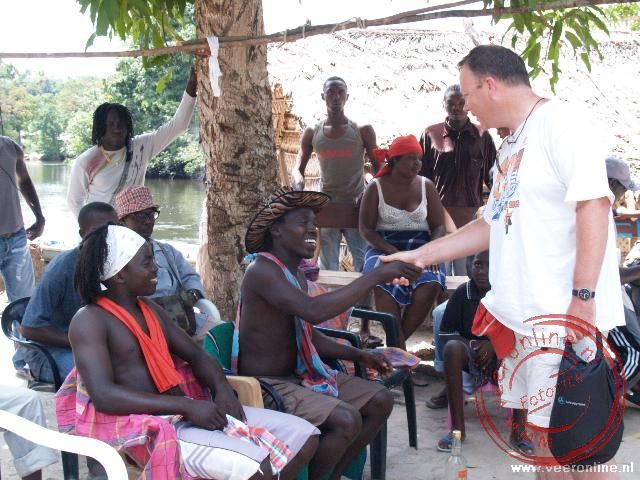
My first impression was like walking through a film set. By around ten o’clock in the morning, everyone was at the riverside lodging. After a mug of lemonade, we quickly got back into the boats. This time, two boats were available, and we traveled a short distance downstream to visit the Shaman. The Shaman is a kind of spiritual priest, connected to the forces of nature and the spirit world. Through rituals, he calls upon these forces to, for example, drive away evil spirits. The Shaman is part of the Winti religion. Upon arriving at the village, the crew first had to request permission for us to visit. At the central area, we saw the Shaman. After permission was granted—a bottle of rum works wonders—we were allowed to meet him and introduced ourselves one by one. The Shaman then stood up and delivered a long speech to John. We could follow very little of it, though we recognized the word “bakra” (strangers), and at times, his tone sounded threatening. John listened carefully and would probably never fully tell us what was said. After the speech, we all received a sip of rum and took a group photo with the Shaman. Then it was time for the Shaman to begin the session. He received women who confessed their concerns. During the exorcism, some were put into a trance. They walked around, shouted, or screamed. Spirits were also driven away by spitting rum over them. The whole spectacle was a fascinating experience to witness, though it felt strange, especially since it wasn’t always clear to us what exactly was happening. After spending about two hours with the Shaman, we returned to Drietabbetje for lunch. We had a few free hours in the program. I decided to catch up on some missed sleep in my hammock from the previous night.

Others followed suit, went for a refreshing swim in the river, or visited the local bar (or whatever passed for one). Late in the afternoon, John led us through Drietabbetje. The village has about 1,500 inhabitants. Most houses stand on stilts to protect against high water. During the high-water period earlier this year, the village center was spared, though the area where we were staying had been underwater. Fortunately, it was now the dry season. During our walk, we attracted a lot of attention, especially from the local youth, who were eager to have their photos taken and see themselves on the digital camera. On the way back, we were alerted to a wild boar near the village. We walked back a short distance and saw the animal on a forest path before it disappeared into the woods. Jan’s attempts to lure it out failed. Back at our accommodation, dinner was ready. By candlelight, we enjoyed a delicious meal and went to our hammocks early to sleep.
 Suriname
  A sula, a rapid in the river
 From the river we see the Teboe Top mountain in the background
 The Goslar shipwreck at the mouth of the Suriname River near Paramaribo
 A walk through the jungle
Travelogue Travel around Suriname
Dag 2 | Suriname > Sailing on the Suriname River
Dag 3 | Suriname > Lightning strike nearby
Dag 4 | Suriname > Morning walk at Overbridge
Dag 5 | Suriname > Taking the birds out on Sunday morning
Dag 6 | Suriname > Cycling to Peperpot
Dag 7 | Suriname > City walk through Paramaribo
Dag 8 | Suriname > A mist of orange dust
Dag 9 | Suriname > Swimming in the Witi Creek
Dag 10 | Suriname > Encounter with the Shaman
Dag 11 | Suriname > Upstream by korjaal
Dag 12 | Suriname > Wild camping in the jungle
Dag 13 | Suriname > Climbing to the Teboe Top
Dag 14 | Suriname > Party in Tutu Kampu
Dag 15 | Suriname > Back again in Drietabbetje
Dag 16 | Suriname > Video camera stolen
Dag 17 | Suriname > Miss Sampson on Stoelmanseiland
Dag 18 | Suriname > Motorcycle breakdown on the way to Albina
Dag 19 | Suriname > On the beach of French Guiana
Dag 20 | Suriname > Papillon prison
Dag 21 | Suriname > Party in the Palmtuin
Dag 22 | Suriname > The large wooden Paulus and Petrus Cathedral
Dag 23 | Suriname > Farewell to Suriname