
154 countries
(and areas)
 - Belize
- Benin
- Bhutan
- Bolivia
- Bonaire
- Bosnia and Herzegovina
- Botswana
- Brazil
- British Virgin Islands
- Brunei
- Bulgaria
- Cambodia
- Canada
- Cape Verde
- Chile
- China
- Costa Rica
- Croatia
- Cuba
- Curacao
- Cyprus
- Czech Republic
- Denmark
- Dominica
- Dominican Republic
- Egypt
- El Salvador
- England
- Estonia
- Eswatini (Swaziland)
- Ethiopia
- Fiji
- Finland
- France
- French Guiana
- Georgia
- Germany
- Gibraltar
- Greece
- Grenada
- Guadeloupe
- Guatemala
- Honduras
- Hong Kong
- Hungary
- Iceland
- India
- Indonesia
- Iran
- Ireland
- Israel
- Italy
- Jamaica
- Japan
- Jordan
- Kazakhstan
- Kenya
- Kosovo
- Kuwait
- Kyrgyzstan
- Laos
- Latvia
- Lebanon
- Lesotho
- Liechtenstein
- Lithuania
- Luxembourg
- Macau
- Madagascar
- Malawi
- Malaysia
- Maldives
- Malta
- Martinique
- Mexico
- Moldova
- Monaco
- Mongolia
- Montenegro
- Morocco
- Mozambique
- Namibia
- Nepal
- Netherlands
- New Zealand
- Nicaragua
- North Macedonia
- Northern Ireland
- Norway
- Oman
- Pakistan
- Palestine
- Peru
- Philippines
- Poland
- Portugal
- Qatar
- Republic of Korea
- Romania
- Russia
- Saint Kitts and Nevis
- Saint Lucia
- Saint Martin
- Saint Vincent and the Grenadines
- San Marino
- São Tomé and Principe
- Saudi Arabia
- Scotland
- Senegal
- Serbia
- Singapore
- Sint Maarten
- Slovakia
- Slovenia
- South Africa
- Spain
- Sri Lanka
- Suriname
- Sweden
- Switzerland
- Tajikistan
- Tanzania
- Thailand
- The Gambia
- Tibet
- Togo
- Transnistria
- Trinidad and Tobago
- Tunisia
- Turkey
- Turkmenistan
- Uganda
- United Arab Emirates
- United States
- Uruguay
- Uzbekistan
- Vatican City
- Vietnam
- Wales
- Zambia
- Zanzibar
- Belize
- Benin
- Bhutan
- Bolivia
- Bonaire
- Bosnia and Herzegovina
- Botswana
- Brazil
- British Virgin Islands
- Brunei
- Bulgaria
- Cambodia
- Canada
- Cape Verde
- Chile
- China
- Costa Rica
- Croatia
- Cuba
- Curacao
- Cyprus
- Czech Republic
- Denmark
- Dominica
- Dominican Republic
- Egypt
- El Salvador
- England
- Estonia
- Eswatini (Swaziland)
- Ethiopia
- Fiji
- Finland
- France
- French Guiana
- Georgia
- Germany
- Gibraltar
- Greece
- Grenada
- Guadeloupe
- Guatemala
- Honduras
- Hong Kong
- Hungary
- Iceland
- India
- Indonesia
- Iran
- Ireland
- Israel
- Italy
- Jamaica
- Japan
- Jordan
- Kazakhstan
- Kenya
- Kosovo
- Kuwait
- Kyrgyzstan
- Laos
- Latvia
- Lebanon
- Lesotho
- Liechtenstein
- Lithuania
- Luxembourg
- Macau
- Madagascar
- Malawi
- Malaysia
- Maldives
- Malta
- Martinique
- Mexico
- Moldova
- Monaco
- Mongolia
- Montenegro
- Morocco
- Mozambique
- Namibia
- Nepal
- Netherlands
- New Zealand
- Nicaragua
- North Macedonia
- Northern Ireland
- Norway
- Oman
- Pakistan
- Palestine
- Peru
- Philippines
- Poland
- Portugal
- Qatar
- Republic of Korea
- Romania
- Russia
- Saint Kitts and Nevis
- Saint Lucia
- Saint Martin
- Saint Vincent and the Grenadines
- San Marino
- São Tomé and Principe
- Saudi Arabia
- Scotland
- Senegal
- Serbia
- Singapore
- Sint Maarten
- Slovakia
- Slovenia
- South Africa
- Spain
- Sri Lanka
- Suriname
- Sweden
- Switzerland
- Tajikistan
- Tanzania
- Thailand
- The Gambia
- Tibet
- Togo
- Transnistria
- Trinidad and Tobago
- Tunisia
- Turkey
- Turkmenistan
- Uganda
- United Arab Emirates
- United States
- Uruguay
- Uzbekistan
- Vatican City
- Vietnam
- Wales
- Zambia
- Zanzibar


Copyright 2004 - 2026
Veeronline.nl Travel Adventures

Home > Suriname > Travel around Suriname > Travelogue day 11
Travelogue Travel around Suriname
20 sept - 12 oct 2006 (23 days)
Suriname > Upstream by korjaal
Dag 11 - Saturday, September 30, 2006During the night, there was quite a commotion. Jan’s hammock came loose in the middle of the night, and he landed on the ground. The hammocks had been hung by the crew for this first evening. Next time, we’ll have to do it ourselves. The hammock was rehung. It was only a quarter past two in the morning, but apparently, for a nearby rooster, it was already time to announce the morning. The signal was quickly picked up by the other roosters in the village — and there were quite a few of them.

After waking up, we took a dip in the river at the bathing spot. Integration wasn’t fully successful yet, as the local forest-dwellers waited on the shore until we were out of the water. After breakfast, we loaded the two korjaals with our gear. All the luggage and six people went into one boat, while the others went in the second. Before setting off, we picked up Helen from a nearby village; she would also join as part of the cooking staff. Then we began our jungle trek, traveling upstream in the korjaals. The boats moved quickly along the river. A crew member at the front gave instructions on where the rocks and shallows were. Occasionally, the boat slid over stones, and the motor had to be lifted quickly. In the rapids, the korjaals moved swiftly against the current. At the last moment, the motor was lifted, allowing the boat to glide over the rocks.

Water splashed everywhere, and we didn’t stay completely dry, but the warm air dried us quickly. At one rapid, things almost went wrong. The first boat entered the current without enough speed. The strong flow pushed the boat back, leaving it sideways in the current — a risky maneuver, as the boat could have taken on water. Everyone quickly got out, and the boat was realigned. From the second boat, we had a great view and took a calmer route around. All in all, it ended well. A little further on, it was our turn. A series of rapids was too strong to simply power through. The boats couldn’t make it on their own. At the start of the sula (the name for these rapids), we got out of the boat. Walking alongside it, we guided it through the rapids. This was challenging — partly because the crew’s instructions were unclear and sometimes contradictory, but also because the strong current and underwater rocks made it hard to stay upright. People slipped left and right. I accidentally struck a rock with my foot, stumbled, and landed on the boat’s edge. Unfortunately, there was a nail there, which caused a deep cut. After a while, we gained experience, and pulling on the rope proved far the most efficient method. After about an hour of struggling, both boats reached the top of the sula, and we toasted with a bottle of warm cola. Back in the boat, we continued along the river. At the village of Granborie, we landed for a short village walk.

This was the last village of the forest-dwelling Maroons along the river. We checked out and informed them that we were entering the Indigenous area. Of course, our visit was accompanied by a bottle of rum for the captain, the village elder. It was nearly three o’clock when we stopped at a small beach for lunch. I noticed that I was already quite red from the rapids — definitely a t-shirt for the upcoming swims. Others in the group had already gotten slightly sunburned. After about another hour of sailing, we arrived at Tutu Kampu, an Indigenous village of only 30 inhabitants. We took up residence in the meeting hall, where the hammocks fit perfectly between the posts. We met the tribal chief, who offered us a drink — a homemade type of beer. Leon also gave him medical advice for his inflamed eye. To close the afternoon, we took a swim in the river. After dinner, we drank tea, coffee, and beer by the water and went to bed around ten o’clock.
 Suriname
 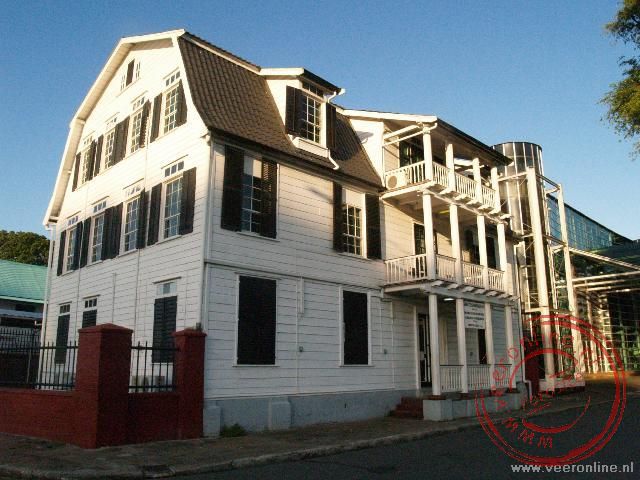 The wooden houses in the center of Paramaribo
 Paramaribo from the air
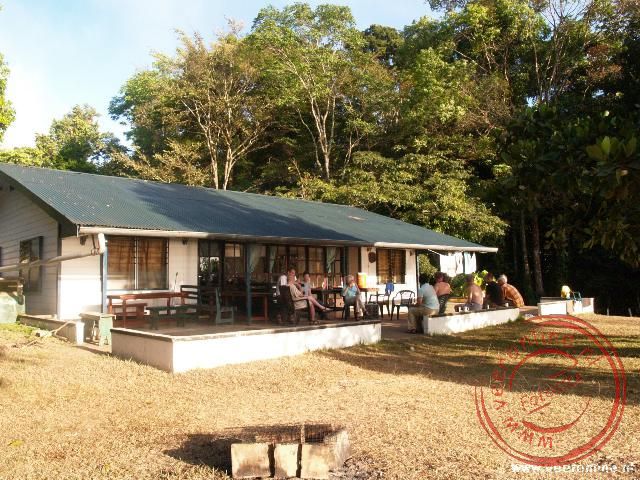 The apartment at Brownsberg
 The bauxite road back to Paramaribo
Travelogue Travel around Suriname
Dag 2 | Suriname > Sailing on the Suriname River
Dag 3 | Suriname > Lightning strike nearby
Dag 4 | Suriname > Morning walk at Overbridge
Dag 5 | Suriname > Taking the birds out on Sunday morning
Dag 6 | Suriname > Cycling to Peperpot
Dag 7 | Suriname > City walk through Paramaribo
Dag 8 | Suriname > A mist of orange dust
Dag 9 | Suriname > Swimming in the Witi Creek
Dag 10 | Suriname > Encounter with the Shaman
Dag 11 | Suriname > Upstream by korjaal
Dag 12 | Suriname > Wild camping in the jungle
Dag 13 | Suriname > Climbing to the Teboe Top
Dag 14 | Suriname > Party in Tutu Kampu
Dag 15 | Suriname > Back again in Drietabbetje
Dag 16 | Suriname > Video camera stolen
Dag 17 | Suriname > Miss Sampson on Stoelmanseiland
Dag 18 | Suriname > Motorcycle breakdown on the way to Albina
Dag 19 | Suriname > On the beach of French Guiana
Dag 20 | Suriname > Papillon prison
Dag 21 | Suriname > Party in the Palmtuin
Dag 22 | Suriname > The large wooden Paulus and Petrus Cathedral
Dag 23 | Suriname > Farewell to Suriname