
154 countries
(and areas)
 - Azerbaijan
- Bahrain
- Barbados
- Belgium
- Belize
- Benin
- Bhutan
- Bolivia
- Bonaire
- Bosnia and Herzegovina
- Botswana
- Brazil
- British Virgin Islands
- Brunei
- Bulgaria
- Cambodia
- Canada
- Cape Verde
- Chile
- China
- Costa Rica
- Croatia
- Cuba
- Curacao
- Cyprus
- Czech Republic
- Denmark
- Dominica
- Dominican Republic
- Egypt
- El Salvador
- England
- Estonia
- Eswatini (Swaziland)
- Ethiopia
- Fiji
- Finland
- France
- French Guiana
- Georgia
- Germany
- Gibraltar
- Greece
- Grenada
- Guadeloupe
- Guatemala
- Honduras
- Hong Kong
- Hungary
- Iceland
- India
- Indonesia
- Iran
- Ireland
- Israel
- Italy
- Jamaica
- Japan
- Jordan
- Kazakhstan
- Kenya
- Kosovo
- Kuwait
- Kyrgyzstan
- Laos
- Latvia
- Lebanon
- Lesotho
- Liechtenstein
- Lithuania
- Luxembourg
- Macau
- Madagascar
- Malawi
- Malaysia
- Maldives
- Malta
- Martinique
- Mexico
- Moldova
- Monaco
- Mongolia
- Montenegro
- Morocco
- Mozambique
- Namibia
- Nepal
- Netherlands
- New Zealand
- Nicaragua
- North Macedonia
- Northern Ireland
- Norway
- Oman
- Pakistan
- Palestine
- Peru
- Philippines
- Poland
- Portugal
- Qatar
- Republic of Korea
- Romania
- Russia
- Saint Kitts and Nevis
- Saint Lucia
- Saint Martin
- Saint Vincent and the Grenadines
- San Marino
- São Tomé and Principe
- Saudi Arabia
- Scotland
- Senegal
- Serbia
- Singapore
- Sint Maarten
- Slovakia
- Slovenia
- South Africa
- Spain
- Sri Lanka
- Suriname
- Sweden
- Switzerland
- Tajikistan
- Tanzania
- Thailand
- The Gambia
- Tibet
- Togo
- Transnistria
- Trinidad and Tobago
- Tunisia
- Turkey
- Turkmenistan
- Uganda
- United Arab Emirates
- United States
- Uruguay
- Uzbekistan
- Vatican City
- Vietnam
- Wales
- Zambia
- Zanzibar
- Azerbaijan
- Bahrain
- Barbados
- Belgium
- Belize
- Benin
- Bhutan
- Bolivia
- Bonaire
- Bosnia and Herzegovina
- Botswana
- Brazil
- British Virgin Islands
- Brunei
- Bulgaria
- Cambodia
- Canada
- Cape Verde
- Chile
- China
- Costa Rica
- Croatia
- Cuba
- Curacao
- Cyprus
- Czech Republic
- Denmark
- Dominica
- Dominican Republic
- Egypt
- El Salvador
- England
- Estonia
- Eswatini (Swaziland)
- Ethiopia
- Fiji
- Finland
- France
- French Guiana
- Georgia
- Germany
- Gibraltar
- Greece
- Grenada
- Guadeloupe
- Guatemala
- Honduras
- Hong Kong
- Hungary
- Iceland
- India
- Indonesia
- Iran
- Ireland
- Israel
- Italy
- Jamaica
- Japan
- Jordan
- Kazakhstan
- Kenya
- Kosovo
- Kuwait
- Kyrgyzstan
- Laos
- Latvia
- Lebanon
- Lesotho
- Liechtenstein
- Lithuania
- Luxembourg
- Macau
- Madagascar
- Malawi
- Malaysia
- Maldives
- Malta
- Martinique
- Mexico
- Moldova
- Monaco
- Mongolia
- Montenegro
- Morocco
- Mozambique
- Namibia
- Nepal
- Netherlands
- New Zealand
- Nicaragua
- North Macedonia
- Northern Ireland
- Norway
- Oman
- Pakistan
- Palestine
- Peru
- Philippines
- Poland
- Portugal
- Qatar
- Republic of Korea
- Romania
- Russia
- Saint Kitts and Nevis
- Saint Lucia
- Saint Martin
- Saint Vincent and the Grenadines
- San Marino
- São Tomé and Principe
- Saudi Arabia
- Scotland
- Senegal
- Serbia
- Singapore
- Sint Maarten
- Slovakia
- Slovenia
- South Africa
- Spain
- Sri Lanka
- Suriname
- Sweden
- Switzerland
- Tajikistan
- Tanzania
- Thailand
- The Gambia
- Tibet
- Togo
- Transnistria
- Trinidad and Tobago
- Tunisia
- Turkey
- Turkmenistan
- Uganda
- United Arab Emirates
- United States
- Uruguay
- Uzbekistan
- Vatican City
- Vietnam
- Wales
- Zambia
- Zanzibar


Copyright 2004 - 2026
Veeronline.nl Travel Adventures

Home > Suriname > Travel around Suriname > Travelogue day 17
Travelogue Travel around Suriname
20 sept - 12 oct 2006 (23 days)
Suriname > Miss Sampson on Stoelmanseiland
Dag 17 - Friday, October 6, 2006
At nine o’clock, we load the luggage back into the boats and say goodbye to Meo. We sail up the Tapanahony River again for our final leg to Stoelmanseiland. We pass several rapids, with water occasionally splashing over the side of the boat. Fortunately, the water is sucked back out at the rear when the engine is running. After about an hour of sailing, we stop at a small gold-mining settlement. Practically no one is there. The only man present tells us that the gold miners are working almost an hour away, which is too far for us to walk. He does show us a small amount of gold—about three grams—and John explains the process of gold extraction. Downstream, we might encounter other places where we could watch the gold being mined. At the end of the Tapanahony River, we reach the junction of the Lana and Marowijne rivers. On the Lana River, we sail five minutes against the current to reach Stoelmanseiland. In the rapids, a large wave splashes over the edge, leaving several people wet. Stoelmanseiland was the base of Ronnie Brunswijk during the civil war in the 1980s. We also plan to file a report here for the broken video camera. Near the airstrip, we dock, where there is also a police post.

It quickly becomes clear that we cannot file a report here either; it must be done in Albina. Walking across Stoelmanseiland from the airstrip, we see that it has now become a quiet and dilapidated village. Currently, only about 200 people live here, compared to over 900 during the civil war. We walk past the hospital and reach the local school, where Miss Sampson immediately approaches. She still has her hairpins in and tells us how she runs the school as best she can with God’s guidance. She explains that the schoolchildren are picked up in surrounding villages by the school boat each morning and brought to Stoelmanseiland. Miss Sampson mentions that it is difficult to obtain good supplies and find qualified teachers. The new school year is starting next week, and she asks for help by sending pens and notebooks addressed to her. We decide to pass around a hat to collect money for her. This allows her to buy supplies herself, since sending items from the Netherlands might be unreliable.

Our donation is greatly appreciated. Back on the boat, we head toward the Marowijne River. At the start of the Marowijne, near the river junction, there is a large sula. Most of us must get out of the boat here, but four people are needed as ballast at the rear. While everyone climbs over the rocks to the other side of the sula, we sit in the boat with life jackets on. The first rapid is easy, and we prepare for the next, which turns out to be nonexistent. We brace for the following one—also nonexistent. Before we know it, we have passed the sula. Was that all? Climbing over the rocks proves much harder. On the other side, a few small boats can carry part of the cargo over the sula for a fee, especially useful after large shopping trips in Paramaribo. We continue sailing on the Marowijne River. The right bank is Suriname and the left bank is French Guiana. Soon, we dock on the Suriname side in the village of Gakaba, a Jehovah’s Witness village. John and Henny’s sister also lives here with a small shop by the bay. Gakaba is much better maintained than Stoelmanseiland. In the shop, we buy cola and yogurt, and eat lunch on the veranda. After lunch, John shows us around the village. We visit the school, which is much tidier than the previous one, and here no donations are needed. We also meet John and Henny’s slightly shy sister.

At three o’clock, we board the boat again and sail to Mi Sa Boo. To our surprise, the overnight stay is on the right bank, in French Guiana. It is nice to spend the night here. We stay with Uncle Leo, who fled to the other side of the river during the civil war and set up accommodations for his family, including facilities to hang hammocks for guests. We set up camp by hanging the hammocks. With some careful arranging, they all fit under the shelter. Afterwards, we cool off in the Marowijne River. A wooden staircase leads into the water because stingrays may be present near the shore, and they can sting dangerously. While swimming, dark clouds gather above the river. We get out just in time as a heavy rainstorm begins. We take shelter under the hammock shelter while the water drains back into the river. The rain pours heavily for about an hour, then it dries up. It has become dusk. Meanwhile, dinner has been prepared in the kitchen. After dinner, we buy a few bottles of beer from Uncle Leo and chat with John in the kitchen about Suriname, tourism, politics, and Desi Bouterse.
 Suriname
 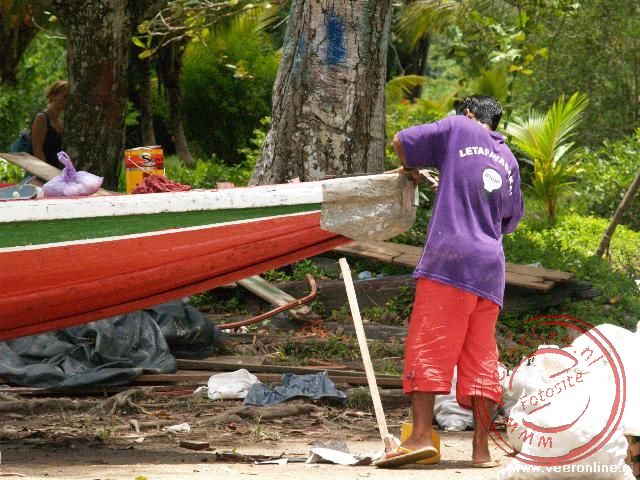 Maintenance of the korjaal, the boat used on the river
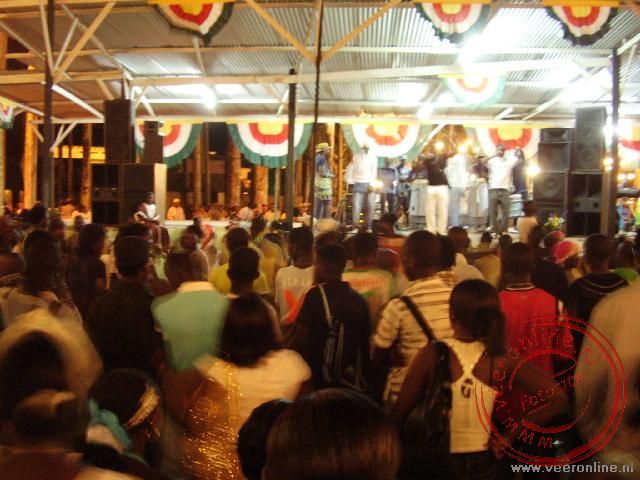 A party night in the palm garden with an open-air performance
 Jan crosses the stream over a narrow tree trunk
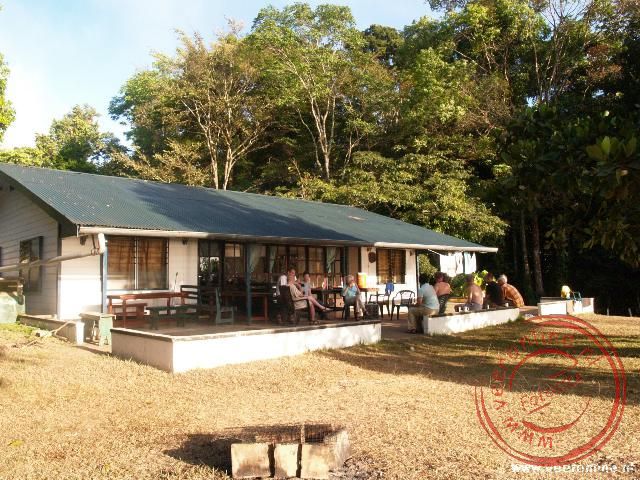 The apartment at Brownsberg
Travelogue Travel around Suriname
Dag 2 | Suriname > Sailing on the Suriname River
Dag 3 | Suriname > Lightning strike nearby
Dag 4 | Suriname > Morning walk at Overbridge
Dag 5 | Suriname > Taking the birds out on Sunday morning
Dag 6 | Suriname > Cycling to Peperpot
Dag 7 | Suriname > City walk through Paramaribo
Dag 8 | Suriname > A mist of orange dust
Dag 9 | Suriname > Swimming in the Witi Creek
Dag 10 | Suriname > Encounter with the Shaman
Dag 11 | Suriname > Upstream by korjaal
Dag 12 | Suriname > Wild camping in the jungle
Dag 13 | Suriname > Climbing to the Teboe Top
Dag 14 | Suriname > Party in Tutu Kampu
Dag 15 | Suriname > Back again in Drietabbetje
Dag 16 | Suriname > Video camera stolen
Dag 17 | Suriname > Miss Sampson on Stoelmanseiland
Dag 18 | Suriname > Motorcycle breakdown on the way to Albina
Dag 19 | Suriname > On the beach of French Guiana
Dag 20 | Suriname > Papillon prison
Dag 21 | Suriname > Party in the Palmtuin
Dag 22 | Suriname > The large wooden Paulus and Petrus Cathedral
Dag 23 | Suriname > Farewell to Suriname