
154 countries
(and areas)
 - Azerbaijan
- Bahrain
- Barbados
- Belgium
- Belize
- Benin
- Bhutan
- Bolivia
- Bonaire
- Bosnia and Herzegovina
- Botswana
- Brazil
- British Virgin Islands
- Brunei
- Bulgaria
- Cambodia
- Canada
- Cape Verde
- Chile
- China
- Costa Rica
- Croatia
- Cuba
- Curacao
- Cyprus
- Czech Republic
- Denmark
- Dominica
- Dominican Republic
- Egypt
- El Salvador
- England
- Estonia
- Eswatini (Swaziland)
- Ethiopia
- Fiji
- Finland
- France
- French Guiana
- Georgia
- Germany
- Gibraltar
- Greece
- Grenada
- Guadeloupe
- Guatemala
- Honduras
- Hong Kong
- Hungary
- Iceland
- India
- Indonesia
- Iran
- Ireland
- Israel
- Italy
- Jamaica
- Japan
- Jordan
- Kazakhstan
- Kenya
- Kosovo
- Kuwait
- Kyrgyzstan
- Laos
- Latvia
- Lebanon
- Lesotho
- Liechtenstein
- Lithuania
- Luxembourg
- Macau
- Madagascar
- Malawi
- Malaysia
- Maldives
- Malta
- Martinique
- Mexico
- Moldova
- Monaco
- Mongolia
- Montenegro
- Morocco
- Mozambique
- Namibia
- Nepal
- Netherlands
- New Zealand
- Nicaragua
- North Macedonia
- Northern Ireland
- Norway
- Oman
- Pakistan
- Palestine
- Peru
- Philippines
- Poland
- Portugal
- Qatar
- Republic of Korea
- Romania
- Russia
- Saint Kitts and Nevis
- Saint Lucia
- Saint Martin
- Saint Vincent and the Grenadines
- San Marino
- São Tomé and Principe
- Saudi Arabia
- Scotland
- Senegal
- Serbia
- Singapore
- Sint Maarten
- Slovakia
- Slovenia
- South Africa
- Spain
- Sri Lanka
- Suriname
- Sweden
- Switzerland
- Tajikistan
- Tanzania
- Thailand
- The Gambia
- Tibet
- Togo
- Transnistria
- Trinidad and Tobago
- Tunisia
- Turkey
- Turkmenistan
- Uganda
- United Arab Emirates
- United States
- Uruguay
- Uzbekistan
- Vatican City
- Vietnam
- Wales
- Zambia
- Zanzibar
- Azerbaijan
- Bahrain
- Barbados
- Belgium
- Belize
- Benin
- Bhutan
- Bolivia
- Bonaire
- Bosnia and Herzegovina
- Botswana
- Brazil
- British Virgin Islands
- Brunei
- Bulgaria
- Cambodia
- Canada
- Cape Verde
- Chile
- China
- Costa Rica
- Croatia
- Cuba
- Curacao
- Cyprus
- Czech Republic
- Denmark
- Dominica
- Dominican Republic
- Egypt
- El Salvador
- England
- Estonia
- Eswatini (Swaziland)
- Ethiopia
- Fiji
- Finland
- France
- French Guiana
- Georgia
- Germany
- Gibraltar
- Greece
- Grenada
- Guadeloupe
- Guatemala
- Honduras
- Hong Kong
- Hungary
- Iceland
- India
- Indonesia
- Iran
- Ireland
- Israel
- Italy
- Jamaica
- Japan
- Jordan
- Kazakhstan
- Kenya
- Kosovo
- Kuwait
- Kyrgyzstan
- Laos
- Latvia
- Lebanon
- Lesotho
- Liechtenstein
- Lithuania
- Luxembourg
- Macau
- Madagascar
- Malawi
- Malaysia
- Maldives
- Malta
- Martinique
- Mexico
- Moldova
- Monaco
- Mongolia
- Montenegro
- Morocco
- Mozambique
- Namibia
- Nepal
- Netherlands
- New Zealand
- Nicaragua
- North Macedonia
- Northern Ireland
- Norway
- Oman
- Pakistan
- Palestine
- Peru
- Philippines
- Poland
- Portugal
- Qatar
- Republic of Korea
- Romania
- Russia
- Saint Kitts and Nevis
- Saint Lucia
- Saint Martin
- Saint Vincent and the Grenadines
- San Marino
- São Tomé and Principe
- Saudi Arabia
- Scotland
- Senegal
- Serbia
- Singapore
- Sint Maarten
- Slovakia
- Slovenia
- South Africa
- Spain
- Sri Lanka
- Suriname
- Sweden
- Switzerland
- Tajikistan
- Tanzania
- Thailand
- The Gambia
- Tibet
- Togo
- Transnistria
- Trinidad and Tobago
- Tunisia
- Turkey
- Turkmenistan
- Uganda
- United Arab Emirates
- United States
- Uruguay
- Uzbekistan
- Vatican City
- Vietnam
- Wales
- Zambia
- Zanzibar


Copyright 2004 - 2026
Veeronline.nl Travel Adventures
Home > Switzerland > Road Trip Germany and Switzerland > Travelogue day 4
Travelogue Road Trip Germany and Switzerland
August 1530 2020 (16 days)
Switzerland > The St. Gallen Library
Dag 4 - Tuesday 18 August 2020Did we sleep well? That’s how the owner greets us at breakfast. Absolutely! His wife also comes by, curious about how we found the room. We hadn’t met her yesterday—she was still working. The couple wants to know all about our next travel destinations. Usually, they get guests from the Netherlands cycling around Lake Constance. Guests for the monastery of St. Gallen are less frequent. At nine o’clock, we get back in the car and say goodbye to the friendly couple. It’s still a bit early to drive to the monastery of St. Gallen, which is only a twenty-minute drive away. The monastery opens at ten. We drive through Rorschach and along the shore of Lake Constance. The weather doesn’t cooperate; a heavy shower breaks out. We decide to skip the little walk along the lake. Fortunately, the shower is short-lived, and blue skies appear again. After a few kilometers, we pass an eye-catching building: the monastery of Tubbach. We turn onto the narrow driveway. The church is open to visitors, but the monastery itself is closed due to the risk of coronavirus infection among the sisters. The information board gives good news—all sisters have recently been tested and none were infected. The monastery of St. Gallen lies in the middle of the city of the same name. The city developed around the monastery complex. We park in one of the garages in the “Klosterviertel” district. The cathedral towers rise high above the houses. A guardian advises us to visit the monastery library first. It’s still quiet, she explains, and the library just opened. We follow her advice.
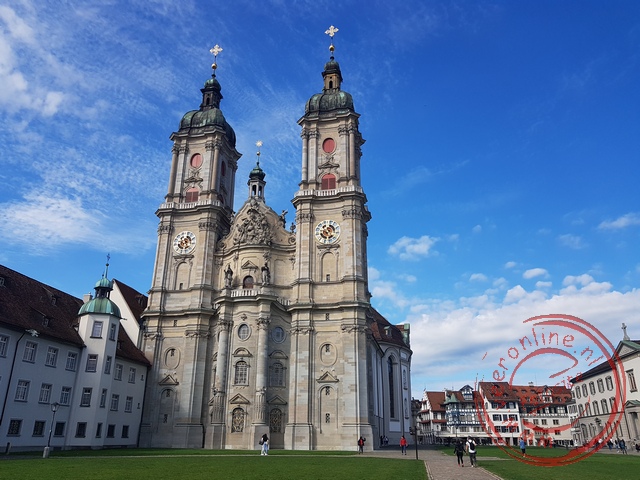
The monastery of St. Gallen already had a special book collection in the 8th century. The baroque monastery library is one of the oldest in the world. To enter, we first put the camera in a locker. Cameras are not allowed inside. At the entrance, there are felt overshoes to put over your shoes to protect the floor. Entering the library, I am speechless. What a beautiful hall. The teak wooden bookcases, spread over two floors, house fifty thousand old books. Together with the baroque decorations and splendid ceiling paintings, the library is a true masterpiece. What a pity this cannot be captured in a photo. In the monastery’s cellar, sculptures and old ornaments are displayed. Next to the monastery stands the cathedral of St. Gallen. The church in its current form was built in the 18th century. The baroque interior is magnificent. Unwittingly, we compare it to the cathedral of Ottobeuren. The baroque decorations of this church focus around the altar and are, compared to the cathedral we visited yesterday, finished more uniformly in one style. Actually, no comparison is fair—both churches are incredibly beautiful. Finally, from the monastery complex, we visit the exhibition about the origin of St. Gallen. In 612, the Irish monk Gallus founded a Christian cell at this spot. Later, the monastery was built here. Old drawings from 820 were discovered with construction plans of the monastery.

It is assumed that this manuscript formed the basis for the monastery of St. Gallen. A video explains the history. At the end, the original drawing is shown for a maximum of twenty seconds. By not exposing the old document to too much light, it is better preserved. Around the monastery are several terraces in the sun. At the first terrace, we are not welcome since we only want a drink. It’s lunchtime and the tables are reserved for guests who also want to eat. At a nearby terrace, however, we can just have a drink. Around one o’clock, we leave St. Gallen. We partially retrace the road to Rorschach and then continue toward Liechtenstein. From the Swiss highway, we can already see the small principality across the Rhine river. At Gamprin, we cross the border. It’s little more than a bridge with the two national flags. It’s remarkable that right after the bridge, most cars have the black license plate of Liechtenstein. In Switzerland, we hadn’t noticed these plates. Through Schaan, we drive to the capital Vaduz. Liechtenstein is a small country wedged between Switzerland and Austria. The capital has only about five thousand inhabitants. Actually, there is just one main road running north to south through the country.
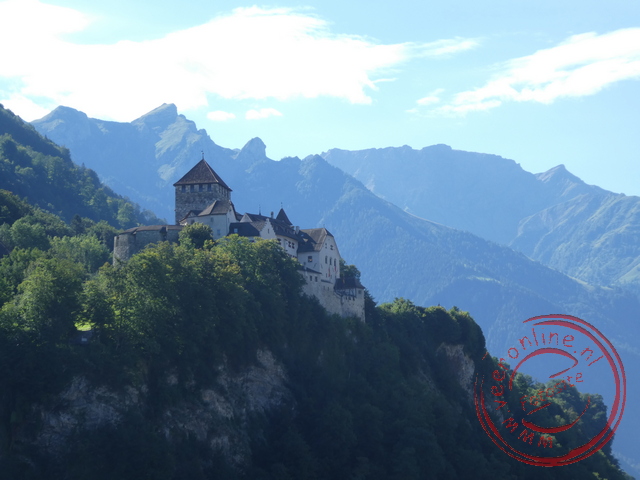
We stay overnight in Triesen, a village just south of Vaduz. At the hotel, we can use the check-in machine. After entering all details, we receive our room number and key from the machine. The two-and-a-half kilometers to the capital are just too far to walk. Also, the main road is not a nice place to walk alongside. We drive back to Vaduz. In the center, in the pedestrian zone, we order drinks and food. From here, the walk to Schloss Vaduz begins. The 12th-century castle sits on the rocks above the city. Over the centuries, the castle has been frequently modified and expanded. Since 1712, it has belonged to the princes of Liechtenstein. Since 1938, the castle is the permanent residence of the royal family. The castle is not open for visits, but from the height, we have a beautiful view of the capital. At the end of the afternoon, we have a beer on a terrace. We consider eating in Vaduz but decide to drive back to Triesen to look for a restaurant. Before heading to the car, we buy bread and cheese for tomorrow at the supermarket. Tomorrow we want to do a mountain hike. In the evening, the choice of restaurants in Triesen proves limited. We avoid places where dishes cost over forty euros. In the end, we choose a small Italian restaurant with pizzas. There is still a table available. A nice choice.
 Switzerland
  The monastery of Tubach
 The decorated houses and shops in Rorschach
 The rocks have been deeply carved out by the power of the water
 The St Lawrence Church in St Gallen
Travelogue Road Trip Germany and Switzerland
Dag 2 | Germany > Medieval Rothenburg
Dag 3 | Germany > Harburg and Ottobeuren
Dag 4 | Switzerland > The St. Gallen Library
Dag 5 | Liechtenstein > Fürstensteig Mountain Hike
Dag 6 | Switzerland > Around the Davos Lake
Dag 7 | Switzerland > Through the Mountains to Lucerne
Dag 8 | Switzerland > The Dying Lion
Dag 9 | Switzerland > The Oeschinen Mountain Lake
Dag 10 | Switzerland > On Top of the Gornergrat
Dag 11 | Switzerland > The Great St. Bernard Pass
Dag 12 | Switzerland > The Castle of Chillon
Dag 13 | Germany > The Basel Minster
Dag 14 | Germany > The Cologne Cathedral
Dag 15 | Germany > Historic Monschau
Dag 16 | Germany > Farewell Monschau