
154 countries
(and areas)
 - Azerbaijan
- Bahrain
- Barbados
- Belgium
- Belize
- Benin
- Bhutan
- Bolivia
- Bonaire
- Bosnia and Herzegovina
- Botswana
- Brazil
- British Virgin Islands
- Brunei
- Bulgaria
- Cambodia
- Canada
- Cape Verde
- Chile
- China
- Costa Rica
- Croatia
- Cuba
- Curacao
- Cyprus
- Czech Republic
- Denmark
- Dominica
- Dominican Republic
- Egypt
- El Salvador
- England
- Estonia
- Eswatini (Swaziland)
- Ethiopia
- Fiji
- Finland
- France
- French Guiana
- Georgia
- Germany
- Gibraltar
- Greece
- Grenada
- Guadeloupe
- Guatemala
- Honduras
- Hong Kong
- Hungary
- Iceland
- India
- Indonesia
- Iran
- Ireland
- Israel
- Italy
- Jamaica
- Japan
- Jordan
- Kazakhstan
- Kenya
- Kosovo
- Kuwait
- Kyrgyzstan
- Laos
- Latvia
- Lebanon
- Lesotho
- Liechtenstein
- Lithuania
- Luxembourg
- Macau
- Madagascar
- Malawi
- Malaysia
- Maldives
- Malta
- Martinique
- Mexico
- Moldova
- Monaco
- Mongolia
- Montenegro
- Morocco
- Mozambique
- Namibia
- Nepal
- Netherlands
- New Zealand
- Nicaragua
- North Macedonia
- Northern Ireland
- Norway
- Oman
- Pakistan
- Palestine
- Peru
- Philippines
- Poland
- Portugal
- Qatar
- Republic of Korea
- Romania
- Russia
- Saint Kitts and Nevis
- Saint Lucia
- Saint Martin
- Saint Vincent and the Grenadines
- San Marino
- São Tomé and Principe
- Saudi Arabia
- Scotland
- Senegal
- Serbia
- Singapore
- Sint Maarten
- Slovakia
- Slovenia
- South Africa
- Spain
- Sri Lanka
- Suriname
- Sweden
- Switzerland
- Tajikistan
- Tanzania
- Thailand
- The Gambia
- Tibet
- Togo
- Transnistria
- Trinidad and Tobago
- Tunisia
- Turkey
- Turkmenistan
- Uganda
- United Arab Emirates
- United States
- Uruguay
- Uzbekistan
- Vatican City
- Vietnam
- Wales
- Zambia
- Zanzibar
- Azerbaijan
- Bahrain
- Barbados
- Belgium
- Belize
- Benin
- Bhutan
- Bolivia
- Bonaire
- Bosnia and Herzegovina
- Botswana
- Brazil
- British Virgin Islands
- Brunei
- Bulgaria
- Cambodia
- Canada
- Cape Verde
- Chile
- China
- Costa Rica
- Croatia
- Cuba
- Curacao
- Cyprus
- Czech Republic
- Denmark
- Dominica
- Dominican Republic
- Egypt
- El Salvador
- England
- Estonia
- Eswatini (Swaziland)
- Ethiopia
- Fiji
- Finland
- France
- French Guiana
- Georgia
- Germany
- Gibraltar
- Greece
- Grenada
- Guadeloupe
- Guatemala
- Honduras
- Hong Kong
- Hungary
- Iceland
- India
- Indonesia
- Iran
- Ireland
- Israel
- Italy
- Jamaica
- Japan
- Jordan
- Kazakhstan
- Kenya
- Kosovo
- Kuwait
- Kyrgyzstan
- Laos
- Latvia
- Lebanon
- Lesotho
- Liechtenstein
- Lithuania
- Luxembourg
- Macau
- Madagascar
- Malawi
- Malaysia
- Maldives
- Malta
- Martinique
- Mexico
- Moldova
- Monaco
- Mongolia
- Montenegro
- Morocco
- Mozambique
- Namibia
- Nepal
- Netherlands
- New Zealand
- Nicaragua
- North Macedonia
- Northern Ireland
- Norway
- Oman
- Pakistan
- Palestine
- Peru
- Philippines
- Poland
- Portugal
- Qatar
- Republic of Korea
- Romania
- Russia
- Saint Kitts and Nevis
- Saint Lucia
- Saint Martin
- Saint Vincent and the Grenadines
- San Marino
- São Tomé and Principe
- Saudi Arabia
- Scotland
- Senegal
- Serbia
- Singapore
- Sint Maarten
- Slovakia
- Slovenia
- South Africa
- Spain
- Sri Lanka
- Suriname
- Sweden
- Switzerland
- Tajikistan
- Tanzania
- Thailand
- The Gambia
- Tibet
- Togo
- Transnistria
- Trinidad and Tobago
- Tunisia
- Turkey
- Turkmenistan
- Uganda
- United Arab Emirates
- United States
- Uruguay
- Uzbekistan
- Vatican City
- Vietnam
- Wales
- Zambia
- Zanzibar


Copyright 2004 - 2026
Veeronline.nl Travel Adventures

Home > Germany > Cruise 2025 Caribbean > Travelogue day 2
Travelogue Cruise 2025 Caribbean
January 21 February 7 2025 (18 days)
Germany > The old town of Düsseldorf
Dag 2 - Wednesday, January 22, 2025Breakfast is not included at the hotel.That’s why we brought our own currant bun, coffee, and a boiled egg. Around nine o’clock, we head to the U-Bahn station. The U-Bahn is a cross between a tram and a metro. Outside the city center, it runs above ground. Only in Düsseldorf’s Altstadt does the tram go underground like a subway. We don’t have to wait long—there’s a tram every ten minutes. At the machine on the tram, we purchase two tickets for the ride. In about twenty minutes, we arrive in the center of Düsseldorf. We get off at the Heinrich-Heine-Allee stop. It turns out we’ve exited one stop too early. We walk a bit to the intersection of Königsallee and Steinstrasse, where the luxury stores of the high-end brands are located. The Königsallee is the city’s most luxurious shopping street. We wander past the window displays and through a shopping arcade.From here, a walking tour through the old town begins. We follow the signs toward Carlsplatz, the square where a market is held daily. A little further on stands the St. Maximilian Church. The Maxkirche is a beautiful example of late Baroque architecture. We cross over and enter the pedestrian zone. At this early hour, the streets are still quiet. The Wilhelm-Marx-Haus was once Düsseldorf’s first high-rise building. The brick structure was completed in 1924 and stands 57 meters tall. Today, it is under renovation, and scaffolding blocks our view of this historic site. We look for a café to have some coffee. We turn into Schneider Wibbel Gasse, a small street full of eateries. It looks like this is the evening entertainment district. In the only café that’s already open, we order drinks and warm up a bit. It’s just above freezing outside, and a chilly wind is blowing. My hat and gloves are very useful.Passing the city hostel, we reach the old town hall. The oldest part of the town hall dates back to 1570.
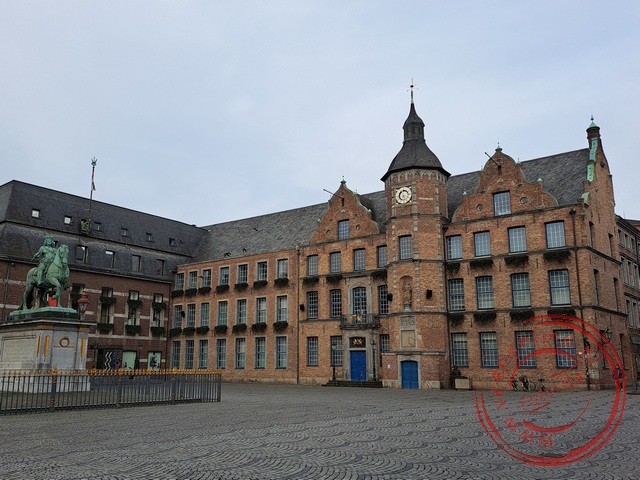
On Burgplatz, a castle once stood; today, only the Schlossturm remains. The square borders the Rhine River. Boats sail across the wide waters. We continue on to the St. Lambertus Basilica, which originated in the 13th century and was expanded in later centuries. The distinctively crooked tower resulted from reconstruction after a fire in 1815. It's striking that nativity scenes are still displayed in all the churches—even in this one.From the basilica, we walk to the Hofgarten, one of six city parks around the center. The Hofgarten is the largest park in the city. We stroll through the greenery to the Rhine, where, among other things, the art museum is located. Back in the old town, we pass the Kunsthalle and X20, a war museum. We visit the Dominican St. Andrew’s Church and eventually arrive in the more modern district, where the opera house and glass office buildings are located. Through a modern shopping arcade, we return to the starting point of our walk. The route was a nice introduction to the city of Düsseldorf.It’s only 1:30 p.m.—we still have time. We decide to take the metro to Neuss, where the Quirinus Münster Basilica is located. When we try to buy a metro ticket, it’s unclear whether Neuss falls within the same fare zone or if we need a different ticket. We can’t figure it out at the machine, so we opt for a standard one-way ticket. We pass our hotel and get off a few stops later at Neuss Hauptbahnhof. It turns out this is indeed a different zone, so we probably traveled without a valid ticket for the last three stops.From the station, we enter Neuss’s shopping area. On the left, we see the St. Mary’s Church, a rather simple Russian Orthodox church. On one of the side streets, we spot a terrace, indicating a café.
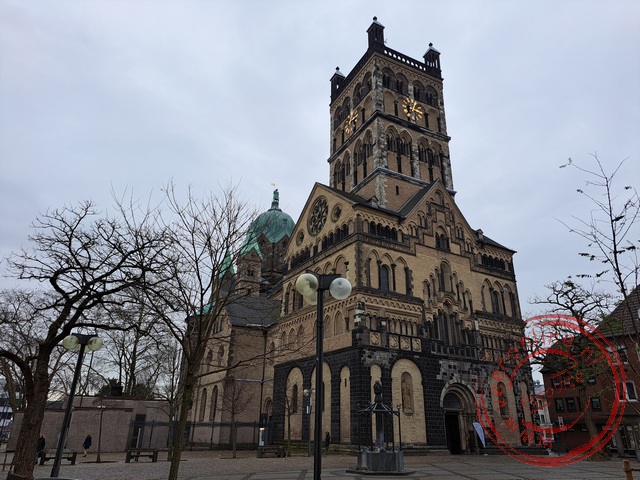
We head inside and order a drink. Closer to the center lies the Quirinus Münster. The Basilica of Saint Quirinus is a late Romanesque church built between 1209 and 1230. It became an important pilgrimage site after the relics of Saint Quirinus, a Roman martyr, were brought here. In 1741, lightning struck the church, causing its 100-meter tower to collapse. The tower was never rebuilt. In 2009, the church was designated a basilica by the then Pope. The interior is less impressive; restoration work is underway, and visitors can only view the church from the rear.We decide to have an early dinner before walking back to the hotel. The alternative—first returning to the hotel—has the drawback that there are few nice restaurants near it, unlike in Neuss. On the main square, we enter a small restaurant and are still able to order from the lunch menu. I go for schnitzel with fries and a beer. Outside, it has started to rain. We’ve been lucky with the weather today: cold but dry. By late afternoon, the rain stops, and we walk back to the hotel—a 45-minute walk. The route runs alongside a canal, where there’s lots of activity. Ships are being loaded and unloaded. Due to industrial sites, we can’t stay by the water the whole way, so we follow the busy main road. At intersections, we cross at traffic lights for safety. Around 5:15 p.m., we’re back at the hotel.In the lobby, there’s a vending machine for drinks. It only accepts coins. I exchange some money to get a small bottle of red wine. Then we retreat to our room. Tomorrow, we won’t need our winter clothes for the trip. I sort the clothing—what stays in the car and what comes with us. Around nine o’clock, we turn off the lights and go to sleep. We need to get up early tomorrow.
 Saint Vincent and the Grenadines
  The rugged coast of Saint Vincent and the Grenadines
 Aruba
Aruba  The rugged coast of Aruba
 Curacao
  An iguana in the trees at the Hato Caves
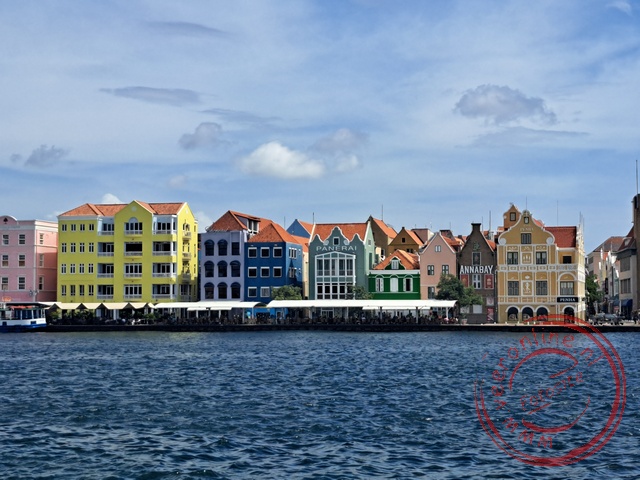 The colourful houses of Willemstad
Travelogue Cruise 2025 Caribbean
Dag 2 | Germany > The old town of Düsseldorf
Dag 3 | Barbados > Flight to Barbados
Dag 4 | Saint Vincent and the Grenadines > Black Point Tunnel of Saint Vincent
Dag 5 | Saint Lucia > Sailing Around Saint Lucia
Dag 6 | Dominica > The Emerald Pool on Dominica
Dag 7 | Saint Kitts and Nevis > Touring the Island of Saint Kitts
Dag 8 | Antigua and Barbuda > St. John's Cathedral on Antigua
Dag 9 | Dominican Republic > A Day at Sea
Dag 10 | Dominican Republic > The Cathedral of Santo Domingo
Dag 11 | Aruba > A Bit More Swell at Sea
Dag 12 | Aruba > Aruba, One Happy Island
Dag 13 | Curaçao > The Anna Bay of Curaçao
Dag 14 | Bonaire > The Lago Lake of Bonaire
Dag 15 | Grenada > On the Way to Grenada
Dag 16 | Grenada > Fort Frederick on Grenada
Dag 17 | Barbados > Back on Barbados
Dag 18 | Germany > From Düsseldorf Back Home