
154 countries
(and areas)
 - Belize
- Benin
- Bhutan
- Bolivia
- Bonaire
- Bosnia and Herzegovina
- Botswana
- Brazil
- British Virgin Islands
- Brunei
- Bulgaria
- Cambodia
- Canada
- Cape Verde
- Chile
- China
- Costa Rica
- Croatia
- Cuba
- Curacao
- Cyprus
- Czech Republic
- Denmark
- Dominica
- Dominican Republic
- Egypt
- El Salvador
- England
- Estonia
- Eswatini (Swaziland)
- Ethiopia
- Fiji
- Finland
- France
- French Guiana
- Georgia
- Germany
- Gibraltar
- Greece
- Grenada
- Guadeloupe
- Guatemala
- Honduras
- Hong Kong
- Hungary
- Iceland
- India
- Indonesia
- Iran
- Ireland
- Israel
- Italy
- Jamaica
- Japan
- Jordan
- Kazakhstan
- Kenya
- Kosovo
- Kuwait
- Kyrgyzstan
- Laos
- Latvia
- Lebanon
- Lesotho
- Liechtenstein
- Lithuania
- Luxembourg
- Macau
- Madagascar
- Malawi
- Malaysia
- Maldives
- Malta
- Martinique
- Mexico
- Moldova
- Monaco
- Mongolia
- Montenegro
- Morocco
- Mozambique
- Namibia
- Nepal
- Netherlands
- New Zealand
- Nicaragua
- North Macedonia
- Northern Ireland
- Norway
- Oman
- Pakistan
- Palestine
- Peru
- Philippines
- Poland
- Portugal
- Qatar
- Republic of Korea
- Romania
- Russia
- Saint Kitts and Nevis
- Saint Lucia
- Saint Martin
- Saint Vincent and the Grenadines
- San Marino
- São Tomé and Principe
- Saudi Arabia
- Scotland
- Senegal
- Serbia
- Singapore
- Sint Maarten
- Slovakia
- Slovenia
- South Africa
- Spain
- Sri Lanka
- Suriname
- Sweden
- Switzerland
- Tajikistan
- Tanzania
- Thailand
- The Gambia
- Tibet
- Togo
- Transnistria
- Trinidad and Tobago
- Tunisia
- Turkey
- Turkmenistan
- Uganda
- United Arab Emirates
- United States
- Uruguay
- Uzbekistan
- Vatican City
- Vietnam
- Wales
- Zambia
- Zanzibar
- Belize
- Benin
- Bhutan
- Bolivia
- Bonaire
- Bosnia and Herzegovina
- Botswana
- Brazil
- British Virgin Islands
- Brunei
- Bulgaria
- Cambodia
- Canada
- Cape Verde
- Chile
- China
- Costa Rica
- Croatia
- Cuba
- Curacao
- Cyprus
- Czech Republic
- Denmark
- Dominica
- Dominican Republic
- Egypt
- El Salvador
- England
- Estonia
- Eswatini (Swaziland)
- Ethiopia
- Fiji
- Finland
- France
- French Guiana
- Georgia
- Germany
- Gibraltar
- Greece
- Grenada
- Guadeloupe
- Guatemala
- Honduras
- Hong Kong
- Hungary
- Iceland
- India
- Indonesia
- Iran
- Ireland
- Israel
- Italy
- Jamaica
- Japan
- Jordan
- Kazakhstan
- Kenya
- Kosovo
- Kuwait
- Kyrgyzstan
- Laos
- Latvia
- Lebanon
- Lesotho
- Liechtenstein
- Lithuania
- Luxembourg
- Macau
- Madagascar
- Malawi
- Malaysia
- Maldives
- Malta
- Martinique
- Mexico
- Moldova
- Monaco
- Mongolia
- Montenegro
- Morocco
- Mozambique
- Namibia
- Nepal
- Netherlands
- New Zealand
- Nicaragua
- North Macedonia
- Northern Ireland
- Norway
- Oman
- Pakistan
- Palestine
- Peru
- Philippines
- Poland
- Portugal
- Qatar
- Republic of Korea
- Romania
- Russia
- Saint Kitts and Nevis
- Saint Lucia
- Saint Martin
- Saint Vincent and the Grenadines
- San Marino
- São Tomé and Principe
- Saudi Arabia
- Scotland
- Senegal
- Serbia
- Singapore
- Sint Maarten
- Slovakia
- Slovenia
- South Africa
- Spain
- Sri Lanka
- Suriname
- Sweden
- Switzerland
- Tajikistan
- Tanzania
- Thailand
- The Gambia
- Tibet
- Togo
- Transnistria
- Trinidad and Tobago
- Tunisia
- Turkey
- Turkmenistan
- Uganda
- United Arab Emirates
- United States
- Uruguay
- Uzbekistan
- Vatican City
- Vietnam
- Wales
- Zambia
- Zanzibar


Copyright 2004 - 2026
Veeronline.nl Travel Adventures

Home > Ethiopia > Tour through Mythical Ethiopia > Travelogue day 12
Travelogue Tour through Mythical Ethiopia
September 19 October 6 2012 (18 days)
Ethiopia > Heavy rainfall near Aragash
Dag 12 - Sunday, September 30, 2012It is Sunday morning, but it is already noticeably busy as I leave the city. Just south of Addis Ababa, there is a kind of religious festival. Numerous people walk along the road in neat clothing. Groups of men run in unison toward the festival. Jonas doesn’t know exactly what the gathering means. Once the procession of people turns off, we can pick up speed and continue south. It was decided not to visit the ancient excavations of Melka Kunture. This allows us to take the main road directly, saving several hours on an already long travel day.

The coffee stop takes on a different character. The hotel has no electricity, so no coffee can be made. I order a cola instead. Around noon, I reach Ziway. On a courtyard under grapevines, I order a vegetable soup. The region we are driving through lies in the Rift Valley—a wide gorge created by the eastward movement of the East African plate away from the continent. In this valley are several lakes with beautiful natural areas. The road runs between the lakes. I notice that the landscape here has a much more African feel: open grasslands with the occasional acacia tree. Only the giraffes and impalas are missing. I only see herds of cows and goats being driven along the road by young boys. Shashemene is an important crossroads between east and west, and north and south. It is also known for its Rastafari community, closely linked to Jamaica. Ras Tafari Makonnen, their leader, was crowned Emperor Haile Selassie of Ethiopia at the beginning of the 20th century. He called on Rastafari followers from Jamaica to return to their origins in Ethiopia. He provided land in Shashemene, and he is still regarded as their spiritual leader. In the decades after his death, many Rastafari returned under the Communist regime. Today, the Rastafari community has declined. I see several small houses painted red, green, and yellow—the reggae colors. A young Rasta boy approaches me: “Ah, Holland, where marijuana is legal!” He offers me a joint. I politely decline. Another boy invites me to visit the Black Lion Museum about Haile Selassie’s life, but unfortunately, there’s no time. It is still a two-hour drive to the Aragash Lodge near Yirga Alem. As soon as Jonas turns onto the road, it starts to rain—a heavy downpour.

Rainwater streams down the roadside in torrents. I see children playing in the rushing water. The scene outside immediately looks different. Boys walk with a plastic bag over them as a raincoat; others use the leaves of the inset—a type of banana leaf—as umbrellas. In this area, the inset is used for food: the trunk is scraped, the mixture buried for several months to ferment, and then baked into a sort of bread. It is still raining when I arrive at the Aragash Lodge, built in the style of the Sidama tribe. The huts are round and made of bamboo. The rain and thunder are too strong to visit the Sidama village nearby. Just as I take shelter from the rain at the reception, lightning strikes. The reception goes dark immediately—probably one of the solar panels was hit. Since the walk to the village is canceled, I am invited into the restaurant. The owner is celebrating her birthday and treats me, the fellow travelers, and the staff to a coffee ceremony with cake. Despite the rain, I still want to go for a short walk. Wearing a raincoat and carrying an umbrella, I walk into the forest near the lodge. I follow some muddy paths across the grounds. A lodge staff member comes after me, asking if I want to see the coffee plantation. The rain intensifies, and we walk together through the forest with umbrellas. I reach the coffee plants. The staff member explains that the lodge tries to produce as much as possible itself. The coffee from the plantation is used in the restaurant. A little further on is a large vegetable garden. He points out the avocados, poppy, and mangoes—every fruit and vegetable is grown there. I return just in time to see the hyenas being fed. These shy animals cautiously approach the meat left out each evening. A clap of thunder sends them scurrying away. When I open my travel bag in my Sidama hut, I find it has gotten wet. The bag had been on top of the bus, and the plastic probably leaked. Fortunately, it’s mostly just my dirty laundry. I hang everything up to dry.
 Ethiopia
  A shepherd leads his cattle along the mountain path
 The waterfall in the Blue Nile near Bahir Dar
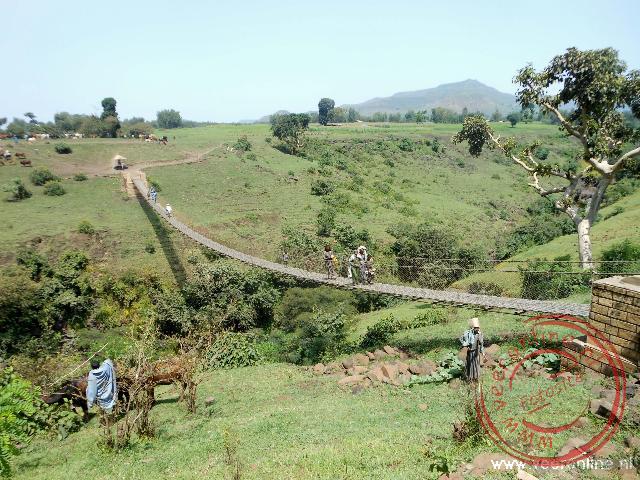 A suspension bridge at the waterfall over the Blue Nile
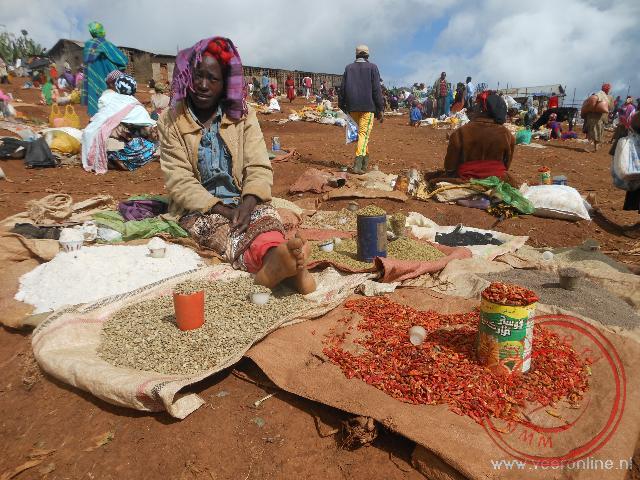 The spice seller at the market in Chencha
Travelogue Tour through Mythical Ethiopia
Dag 2 | Ethiopia > City tour through Addis Ababa
Dag 3 | Ethiopia > Traveling through green Ethiopia
Dag 4 | Ethiopia > The Nile Falls and Lake Tana
Dag 5 | Ethiopia > The palaces of Gondar
Dag 6 | Ethiopia > Hiking in the Semien Mountains
Dag 7 | Ethiopia > Visit to Grace Village orphanage
Dag 8 | Ethiopia > The stelae of Axum
Dag 9 | Ethiopia > 'Happy Meskel!”
Dag 10 | Ethiopia > The rock churches of Lalibela
Dag 11 | Ethiopia > Flight back to Addis Ababa
Dag 12 | Ethiopia > Heavy rainfall near Aragash
Dag 13 | Ethiopia > Delivering a gift in Arba Minch
Dag 14 | Ethiopia > Visiting the Dorze tribe
Dag 15 | Ethiopia > On the way to Lake Langano
Dag 16 | Ethiopia > Langano Vacation Club Resort
Dag 17 | Ethiopia > Back to Addis, back home
Dag 18 | Ethiopia > Farewell to Ethiopia