
154 countries
(and areas)
 - Belize
- Benin
- Bhutan
- Bolivia
- Bonaire
- Bosnia and Herzegovina
- Botswana
- Brazil
- British Virgin Islands
- Brunei
- Bulgaria
- Cambodia
- Canada
- Cape Verde
- Chile
- China
- Costa Rica
- Croatia
- Cuba
- Curacao
- Cyprus
- Czech Republic
- Denmark
- Dominica
- Dominican Republic
- Egypt
- El Salvador
- England
- Estonia
- Eswatini (Swaziland)
- Ethiopia
- Fiji
- Finland
- France
- French Guiana
- Georgia
- Germany
- Gibraltar
- Greece
- Grenada
- Guadeloupe
- Guatemala
- Honduras
- Hong Kong
- Hungary
- Iceland
- India
- Indonesia
- Iran
- Ireland
- Israel
- Italy
- Jamaica
- Japan
- Jordan
- Kazakhstan
- Kenya
- Kosovo
- Kuwait
- Kyrgyzstan
- Laos
- Latvia
- Lebanon
- Lesotho
- Liechtenstein
- Lithuania
- Luxembourg
- Macau
- Madagascar
- Malawi
- Malaysia
- Maldives
- Malta
- Martinique
- Mexico
- Moldova
- Monaco
- Mongolia
- Montenegro
- Morocco
- Mozambique
- Namibia
- Nepal
- Netherlands
- New Zealand
- Nicaragua
- North Macedonia
- Northern Ireland
- Norway
- Oman
- Pakistan
- Palestine
- Peru
- Philippines
- Poland
- Portugal
- Qatar
- Republic of Korea
- Romania
- Russia
- Saint Kitts and Nevis
- Saint Lucia
- Saint Martin
- Saint Vincent and the Grenadines
- San Marino
- São Tomé and Principe
- Saudi Arabia
- Scotland
- Senegal
- Serbia
- Singapore
- Sint Maarten
- Slovakia
- Slovenia
- South Africa
- Spain
- Sri Lanka
- Suriname
- Sweden
- Switzerland
- Tajikistan
- Tanzania
- Thailand
- The Gambia
- Tibet
- Togo
- Transnistria
- Trinidad and Tobago
- Tunisia
- Turkey
- Turkmenistan
- Uganda
- United Arab Emirates
- United States
- Uruguay
- Uzbekistan
- Vatican City
- Vietnam
- Wales
- Zambia
- Zanzibar
- Belize
- Benin
- Bhutan
- Bolivia
- Bonaire
- Bosnia and Herzegovina
- Botswana
- Brazil
- British Virgin Islands
- Brunei
- Bulgaria
- Cambodia
- Canada
- Cape Verde
- Chile
- China
- Costa Rica
- Croatia
- Cuba
- Curacao
- Cyprus
- Czech Republic
- Denmark
- Dominica
- Dominican Republic
- Egypt
- El Salvador
- England
- Estonia
- Eswatini (Swaziland)
- Ethiopia
- Fiji
- Finland
- France
- French Guiana
- Georgia
- Germany
- Gibraltar
- Greece
- Grenada
- Guadeloupe
- Guatemala
- Honduras
- Hong Kong
- Hungary
- Iceland
- India
- Indonesia
- Iran
- Ireland
- Israel
- Italy
- Jamaica
- Japan
- Jordan
- Kazakhstan
- Kenya
- Kosovo
- Kuwait
- Kyrgyzstan
- Laos
- Latvia
- Lebanon
- Lesotho
- Liechtenstein
- Lithuania
- Luxembourg
- Macau
- Madagascar
- Malawi
- Malaysia
- Maldives
- Malta
- Martinique
- Mexico
- Moldova
- Monaco
- Mongolia
- Montenegro
- Morocco
- Mozambique
- Namibia
- Nepal
- Netherlands
- New Zealand
- Nicaragua
- North Macedonia
- Northern Ireland
- Norway
- Oman
- Pakistan
- Palestine
- Peru
- Philippines
- Poland
- Portugal
- Qatar
- Republic of Korea
- Romania
- Russia
- Saint Kitts and Nevis
- Saint Lucia
- Saint Martin
- Saint Vincent and the Grenadines
- San Marino
- São Tomé and Principe
- Saudi Arabia
- Scotland
- Senegal
- Serbia
- Singapore
- Sint Maarten
- Slovakia
- Slovenia
- South Africa
- Spain
- Sri Lanka
- Suriname
- Sweden
- Switzerland
- Tajikistan
- Tanzania
- Thailand
- The Gambia
- Tibet
- Togo
- Transnistria
- Trinidad and Tobago
- Tunisia
- Turkey
- Turkmenistan
- Uganda
- United Arab Emirates
- United States
- Uruguay
- Uzbekistan
- Vatican City
- Vietnam
- Wales
- Zambia
- Zanzibar


Copyright 2004 - 2026
Veeronline.nl Travel Adventures

Home > Ethiopia > Tour through Mythical Ethiopia > Travelogue day 6
Travelogue Tour through Mythical Ethiopia
September 19 October 6 2012 (18 days)
Ethiopia > Hiking in the Semien Mountains
Dag 6 - Monday, September 24, 2012I leave Gondar in the direction of Debark, a distance of just one hundred kilometers. Part of the route has recently been improved, but it is unclear how far the work has progressed. Previously, the trip to Debark took five hours. Just outside Gondar I get off the bus to visit the former Jewish village. Decades ago, through a government program, the Jewish population was more or less forced to return to Israel.

Officially it was called voluntary. Now the current residents cleverly use the Jewish village to attract tourists. As soon as I get off, I am surrounded mainly by children wanting me to buy things. Even as I walk into the village, everyone tries to sell me something. Children point me toward the Old Synagogue, but soon it turns out this is only a way to ask for money. A pity, really. I return to the bus with a group of sellers following me. On the way to Debark I see how people work the land. With sickles, tall grass is cut by hand. I look at it with admiration. The fields are plowed with a wooden plough pulled by two oxen. Jonas, the driver, often has to brake to avoid free-roaming livestock. In the past, when the road was not paved, everyone shared the road. The speed difference between cattle and motorized traffic was not so large. With the asphalt, traffic races by at much higher speeds, sometimes creating dangerous situations. Outside the villages it is quieter and less risky, so Jonas can drive on more smoothly. We pass through green mountains, dotted everywhere with the yellow blossoms of the Meskel flower. In three days, the Meskel Festival will be held. After the rainy season, at the end of September, the landscape quickly dries up. It is hard to imagine that these lush hills will wither so soon. At half past eleven I arrive in Debark. The town is larger than I expected, still home to about 200,000 people.
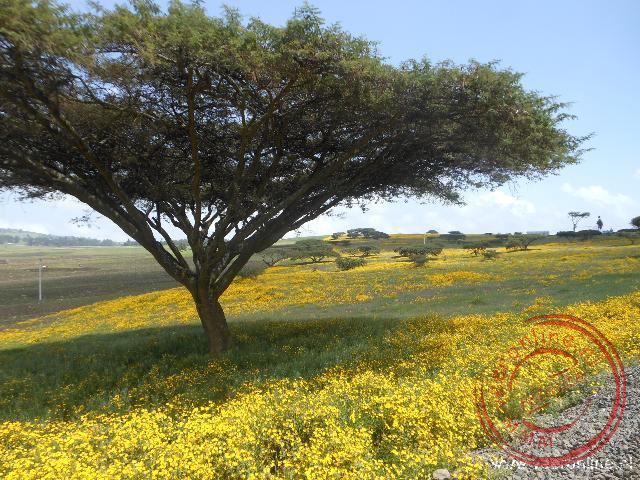
Yet the streetscape looks more primitive than, for example, Gondar. Debark lies at an altitude of 2,800 meters, and it can get quite chilly at night. I spend the night in the best hotel in town, though even this is simple and sober. In the afternoon I head to the Simien Mountains for a nature walk. Specially for this, guide Ababa comes along. She explains that the national park has the highest mountains in Ethiopia, with the tallest peak over four thousand meters. For safety, two armed soldiers accompany us, one in front and one behind. Ababa explains this is for protection, as wild animals could appear here. She herself once saw a leopard, she says, but in the area where we will walk, the chance of seeing wild animals is almost nil. On a multi-day trek, the chance is greater. Still, the guards have a pleasant assignment. With the bus we drive to the entrance of the Simien Mountains Reserve, a beautiful ride ever higher into the mountains. When I get out, I stand at 3,250 meters, right in the middle of the clouds, leaving me with little view. A pity, since the scenery should be stunning here. Ababa and one guard lead the way along the edge of the valley.
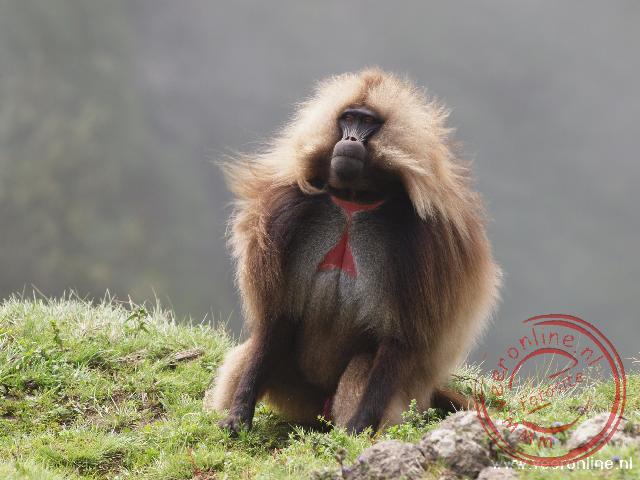
Soon I come across a large troop of Gelada baboons. These monkeys are found only in this region. Remarkably, they are vegetarian and feed mainly on grass. Another special feature is the red heart-shaped patch on their chest, which grows brighter during mating. I can approach the troop easily, within ten meters. They clearly do not see me as a threat. Still, they turn their backs when I get too close, or move away from me. The males are especially impressive, with their large manes. The troop consists of several males, each with a group of females, as well as bachelor groups. These attempt to challenge the dominant males to take over power. I cannot get enough of watching them and take numerous photos. The valley is also beautiful. Now and then the clouds break, revealing the deep gorge—a breathtaking sight. The constantly shifting clouds make the walk along the steep valley edge always different. After two hours of walking I return to the bus and encounter another group of male baboons grooming each other in pairs. As I watch this amusing scene, a male from a nearby troop approaches provocatively, passing right by me. Ababa assures me I am not in danger. The grooming males immediately stop and growl at the intruder before chasing him off together. A clear power struggle has just played out right before me. Remarkable! Back in Debark I get off at the edge of the town center and walk down the street.
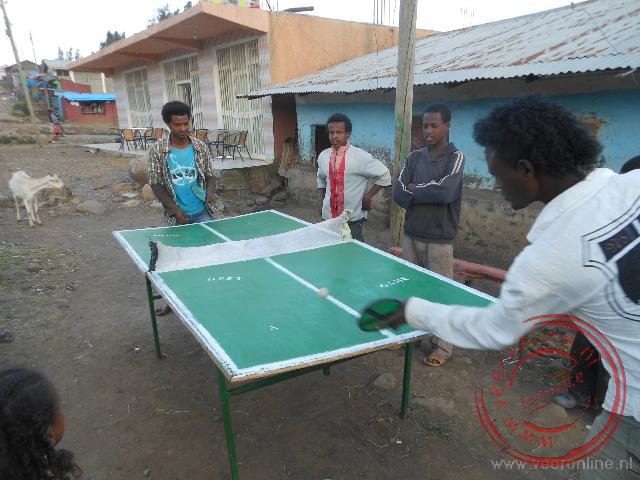
Immediately children run up from all directions, asking for money, pens, or my water bottle. Fortunately, some only want to say hello or shake hands. The guards also walk along, keeping the children at a distance—a pity that this is necessary. The street is lively: clothes are being repaired on old Singer sewing machines, young people play table tennis in the street or foosball. I join a game of table tennis but lose badly; with the wind behind me I cannot keep the ball on the table. I step into a small room where boys are playing billiards. They invite me to join; with some luck my ball goes into a pocket, and everyone laughs. Further on, I wander through the market. Clothes hang in wooden stalls, spices are sold from large sacks, and a woman proudly shows me the red peppers. I end the day with a buffet dinner in a restaurant next to the hotel. A musician provides the Ethiopian atmosphere with his string instrument and singing.
 Ethiopia
  A woodland kingfisher or Senegal kingfisher
 A pied kingfisher
 View from the Semien Mountains
 Hiking in the mist at 3250 metres in the Simien Mountains
Travelogue Tour through Mythical Ethiopia
Dag 2 | Ethiopia > City tour through Addis Ababa
Dag 3 | Ethiopia > Traveling through green Ethiopia
Dag 4 | Ethiopia > The Nile Falls and Lake Tana
Dag 5 | Ethiopia > The palaces of Gondar
Dag 6 | Ethiopia > Hiking in the Semien Mountains
Dag 7 | Ethiopia > Visit to Grace Village orphanage
Dag 8 | Ethiopia > The stelae of Axum
Dag 9 | Ethiopia > 'Happy Meskel!”
Dag 10 | Ethiopia > The rock churches of Lalibela
Dag 11 | Ethiopia > Flight back to Addis Ababa
Dag 12 | Ethiopia > Heavy rainfall near Aragash
Dag 13 | Ethiopia > Delivering a gift in Arba Minch
Dag 14 | Ethiopia > Visiting the Dorze tribe
Dag 15 | Ethiopia > On the way to Lake Langano
Dag 16 | Ethiopia > Langano Vacation Club Resort
Dag 17 | Ethiopia > Back to Addis, back home
Dag 18 | Ethiopia > Farewell to Ethiopia