
154 countries
(and areas)
 - Azerbaijan
- Bahrain
- Barbados
- Belgium
- Belize
- Benin
- Bhutan
- Bolivia
- Bonaire
- Bosnia and Herzegovina
- Botswana
- Brazil
- British Virgin Islands
- Brunei
- Bulgaria
- Cambodia
- Canada
- Cape Verde
- Chile
- China
- Costa Rica
- Croatia
- Cuba
- Curacao
- Cyprus
- Czech Republic
- Denmark
- Dominica
- Dominican Republic
- Egypt
- El Salvador
- England
- Estonia
- Eswatini (Swaziland)
- Ethiopia
- Fiji
- Finland
- France
- French Guiana
- Georgia
- Germany
- Gibraltar
- Greece
- Grenada
- Guadeloupe
- Guatemala
- Honduras
- Hong Kong
- Hungary
- Iceland
- India
- Indonesia
- Iran
- Ireland
- Israel
- Italy
- Jamaica
- Japan
- Jordan
- Kazakhstan
- Kenya
- Kosovo
- Kuwait
- Kyrgyzstan
- Laos
- Latvia
- Lebanon
- Lesotho
- Liechtenstein
- Lithuania
- Luxembourg
- Macau
- Madagascar
- Malawi
- Malaysia
- Maldives
- Malta
- Martinique
- Mexico
- Moldova
- Monaco
- Mongolia
- Montenegro
- Morocco
- Mozambique
- Namibia
- Nepal
- Netherlands
- New Zealand
- Nicaragua
- North Macedonia
- Northern Ireland
- Norway
- Oman
- Pakistan
- Palestine
- Peru
- Philippines
- Poland
- Portugal
- Qatar
- Republic of Korea
- Romania
- Russia
- Saint Kitts and Nevis
- Saint Lucia
- Saint Martin
- Saint Vincent and the Grenadines
- San Marino
- São Tomé and Principe
- Saudi Arabia
- Scotland
- Senegal
- Serbia
- Singapore
- Sint Maarten
- Slovakia
- Slovenia
- South Africa
- Spain
- Sri Lanka
- Suriname
- Sweden
- Switzerland
- Tajikistan
- Tanzania
- Thailand
- The Gambia
- Tibet
- Togo
- Transnistria
- Trinidad and Tobago
- Tunisia
- Turkey
- Turkmenistan
- Uganda
- United Arab Emirates
- United States
- Uruguay
- Uzbekistan
- Vatican City
- Vietnam
- Wales
- Zambia
- Zanzibar
- Azerbaijan
- Bahrain
- Barbados
- Belgium
- Belize
- Benin
- Bhutan
- Bolivia
- Bonaire
- Bosnia and Herzegovina
- Botswana
- Brazil
- British Virgin Islands
- Brunei
- Bulgaria
- Cambodia
- Canada
- Cape Verde
- Chile
- China
- Costa Rica
- Croatia
- Cuba
- Curacao
- Cyprus
- Czech Republic
- Denmark
- Dominica
- Dominican Republic
- Egypt
- El Salvador
- England
- Estonia
- Eswatini (Swaziland)
- Ethiopia
- Fiji
- Finland
- France
- French Guiana
- Georgia
- Germany
- Gibraltar
- Greece
- Grenada
- Guadeloupe
- Guatemala
- Honduras
- Hong Kong
- Hungary
- Iceland
- India
- Indonesia
- Iran
- Ireland
- Israel
- Italy
- Jamaica
- Japan
- Jordan
- Kazakhstan
- Kenya
- Kosovo
- Kuwait
- Kyrgyzstan
- Laos
- Latvia
- Lebanon
- Lesotho
- Liechtenstein
- Lithuania
- Luxembourg
- Macau
- Madagascar
- Malawi
- Malaysia
- Maldives
- Malta
- Martinique
- Mexico
- Moldova
- Monaco
- Mongolia
- Montenegro
- Morocco
- Mozambique
- Namibia
- Nepal
- Netherlands
- New Zealand
- Nicaragua
- North Macedonia
- Northern Ireland
- Norway
- Oman
- Pakistan
- Palestine
- Peru
- Philippines
- Poland
- Portugal
- Qatar
- Republic of Korea
- Romania
- Russia
- Saint Kitts and Nevis
- Saint Lucia
- Saint Martin
- Saint Vincent and the Grenadines
- San Marino
- São Tomé and Principe
- Saudi Arabia
- Scotland
- Senegal
- Serbia
- Singapore
- Sint Maarten
- Slovakia
- Slovenia
- South Africa
- Spain
- Sri Lanka
- Suriname
- Sweden
- Switzerland
- Tajikistan
- Tanzania
- Thailand
- The Gambia
- Tibet
- Togo
- Transnistria
- Trinidad and Tobago
- Tunisia
- Turkey
- Turkmenistan
- Uganda
- United Arab Emirates
- United States
- Uruguay
- Uzbekistan
- Vatican City
- Vietnam
- Wales
- Zambia
- Zanzibar


Copyright 2004 - 2026
Veeronline.nl Travel Adventures

Home > Ethiopia > Tour through Mythical Ethiopia > Travelogue day 8
Travelogue Tour through Mythical Ethiopia
September 19 October 6 2012 (18 days)
Ethiopia > The stelae of Axum
Dag 8 - Wednesday, September 26, 2012Today, Mook takes me on a tour of Axum. The tour visits a large number of archaeological sites in and around the city. Axum was a powerful kingdom from the 4th to the 11th century. The Axumite kingdom extended far into Yemen. In the 11th century, the kingdom declined, and power shifted to Lalibela. First, I visit the Bath of Queen Sheba. This large bath, carved from the rock, likely served more as a water reservoir than as an actual swimming pool.

In one corner, a few men are bathing in the reservoir. Next, I go to King Ezana’s inscriptions. A large stone here is the Ethiopian Rosetta Stone. The story of King Ezana is engraved in three languages, including Greek. Next to the tomb of King Kaleb of Axum lies an ancient deep water well in the shape of a cross. Believers were baptized here. King Kaleb ruled around 520 AD. I descend a staircase to explore the five underground tomb chambers. It is impressive that such a construction could be made in the 4th century. The stones fit perfectly together, reminding me of the skills of the Inca in South America. Back in the center of Axum, Mook shows me the stelae—tall pillars that served as grave monuments. The tallest stele is 24 meters high. There was once a 33-meter stele, but it toppled over. You can walk under the rubble. I am amazed at the colossal blocks of the pillars. Seeing the simple and small foundation, it is no surprise that the tower fell. Another pillar leans so much it needs support. The recently placed 24-meter stele stands perfectly upright. In 1936, during the Italian occupation, this tower was taken to Rome. After lengthy negotiations, it was returned to Axum in 2004—a real asset. The mausoleum under the stelae is closed for restoration this week. Mook tries in vain to find someone with a key. However, he can show me another underground tomb. In a small room lies a gravestone. No opening has been found, so human remains may still lie inside.
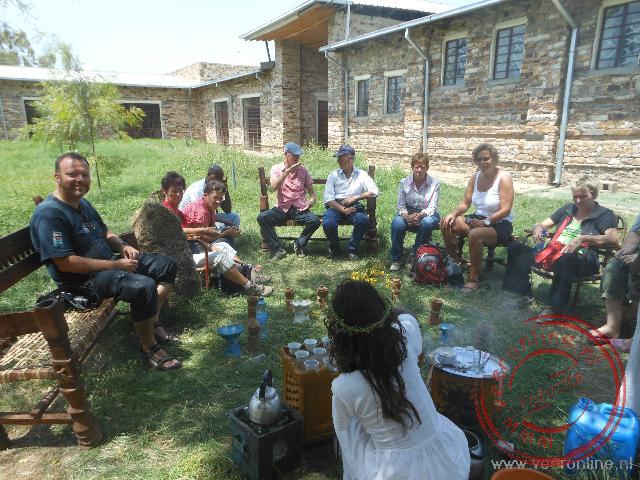
Recently, a second chamber has been discovered here. It is possible that many more undiscovered chambers remain in this field of stelae. I am quickly done in the associated museum. At the exit, I order coffee, which is prepared with a traditional coffee ceremony. The coffee is roasted, finely ground, and brewed with incense. Unsurprisingly, the coffee tastes wonderfully smooth. After lunch, I want to visit the Church of Our Lady Mary of Zion. However, because of preparations for tomorrow’s Meskel Festival, a service is still ongoing. I therefore stroll through the center of Axum. I walk along the main street, look at the small shops, and greet the friendly people. At a terrace, I strike up a conversation with an Ethiopian. He tells me about the Meskel Festival: this afternoon there will be a procession from the Church of Our Lady Mary of Zion. Tomorrow morning, there will be a festival on the square by the stelae. The bonfire, already prepared, will be lit at the end of the festival. I explain that I will already be on the plane to Lalibela by then. Perhaps I can still witness the beginning of the festival tomorrow morning. When I arrive at the Church of Our Lady Mary of Zion, the service has just ended.
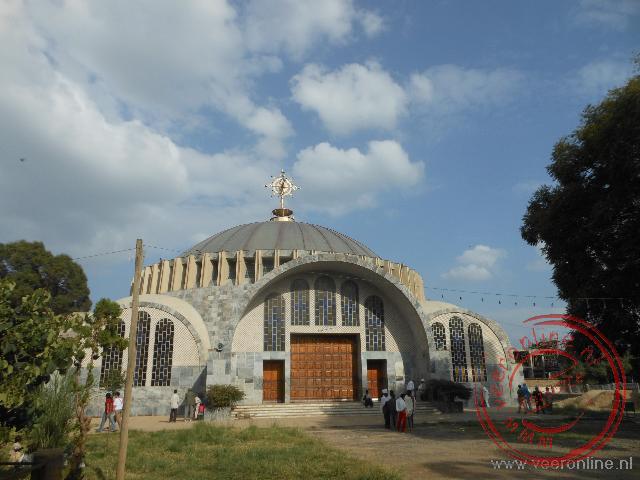
Mook first takes me to the back of the church. Here once stood a 5th-century church from the time of Ezana. This church was completely destroyed during an Islamic attack in the 16th century. Only the foundations remain. Emperor Fasiladas built a new church next to the ruins in 1635. According to Orthodox tradition, this church is accessible only to men. Next to this church, the Ark of the Covenant is said to be kept. The Ark was allegedly transported from Israel to Axum during the reign of King Solomon. No one may see the Ark. Once a year, during the Timkat Festival, it is carried in the procession but carefully covered. I doubt anything remains. Historically, it seems likely that the Ark was lost when the church was destroyed in the 16th century. Next to the old church, Emperor Haile Selassie built a modern cathedral in 1950, accessible to both men and women. I remove my shoes and enter the church. A clergyman welcomes me into this large round church. Inside, the space is surprisingly empty. A large red carpet fills the interior. The clergyman points out various depictions of the life of Jesus on the walls. At the back of the church lies the holy book, which is shown to me specially. The 15-kilogram book contains illustrations and texts. It is carefully leafed through. The clergyman gestures for me to follow him. Only men are allowed to follow him to the old church. A clerk opens the door and lets me in. Behind tall curtains hang old murals. “To protect them from the sun,” the dean explains. The clerk holds the curtains aside so I can see the story of Mary and Jesus. I thank the clergyman and return to the group. I enter the museum. A larger new museum is under construction, which is certainly needed. The current collection is crowded and disorganized. I see old crosses, special crowns, and garments from the Axumite era. It is now almost four o’clock, the time the procession begins

. I position myself along the route. Clergy emerge from the old church in a procession. Some carry colorful, decorated parasols to shield themselves from the sun. It is a lively, colorful procession. The clergy are followed by numerous townspeople. The women cheer rhythmically as they pass. It is wonderful to witness this procession. In the evening, after dark, I walk down the main street. I have dinner at the Johnson Restaurant. Children regularly appear in the doorway, singing songs. The owner sometimes gives them money. One group after another passes by, performing in honor of the Meskel Festival. The festival is celebrated widely on the streets. As I walk to my hotel, a group of boys invites me to join the Meskel celebrations. They hand me a beer and explain that the ceremony will take place on the square tomorrow. We exchange email addresses, and I promise to send them the photos I take. Lying in bed, I can still hear groups of people celebrating in the streets late into the night.
 Ethiopia
  Bamboo houses of the Dorze tribe
 A collection of Ethiopian food on an injera pancake
 A fish eagle at Arba Minch
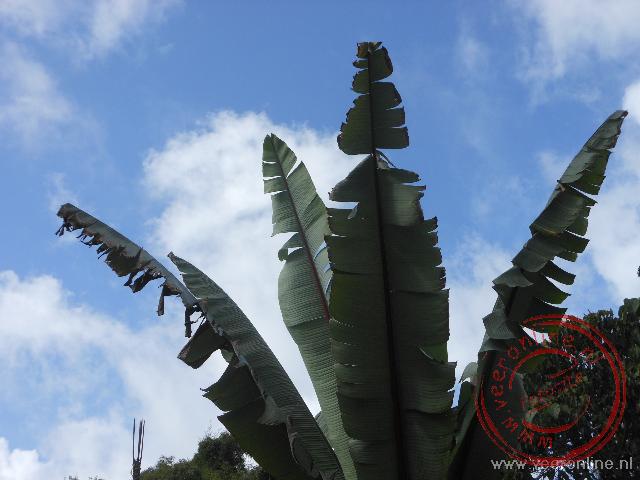 The enset tree also called the false banana
Travelogue Tour through Mythical Ethiopia
Dag 2 | Ethiopia > City tour through Addis Ababa
Dag 3 | Ethiopia > Traveling through green Ethiopia
Dag 4 | Ethiopia > The Nile Falls and Lake Tana
Dag 5 | Ethiopia > The palaces of Gondar
Dag 6 | Ethiopia > Hiking in the Semien Mountains
Dag 7 | Ethiopia > Visit to Grace Village orphanage
Dag 8 | Ethiopia > The stelae of Axum
Dag 9 | Ethiopia > 'Happy Meskel!”
Dag 10 | Ethiopia > The rock churches of Lalibela
Dag 11 | Ethiopia > Flight back to Addis Ababa
Dag 12 | Ethiopia > Heavy rainfall near Aragash
Dag 13 | Ethiopia > Delivering a gift in Arba Minch
Dag 14 | Ethiopia > Visiting the Dorze tribe
Dag 15 | Ethiopia > On the way to Lake Langano
Dag 16 | Ethiopia > Langano Vacation Club Resort
Dag 17 | Ethiopia > Back to Addis, back home
Dag 18 | Ethiopia > Farewell to Ethiopia