
154 countries
(and areas)
 - Belize
- Benin
- Bhutan
- Bolivia
- Bonaire
- Bosnia and Herzegovina
- Botswana
- Brazil
- British Virgin Islands
- Brunei
- Bulgaria
- Cambodia
- Canada
- Cape Verde
- Chile
- China
- Costa Rica
- Croatia
- Cuba
- Curacao
- Cyprus
- Czech Republic
- Denmark
- Dominica
- Dominican Republic
- Egypt
- El Salvador
- England
- Estonia
- Eswatini (Swaziland)
- Ethiopia
- Fiji
- Finland
- France
- French Guiana
- Georgia
- Germany
- Gibraltar
- Greece
- Grenada
- Guadeloupe
- Guatemala
- Honduras
- Hong Kong
- Hungary
- Iceland
- India
- Indonesia
- Iran
- Ireland
- Israel
- Italy
- Jamaica
- Japan
- Jordan
- Kazakhstan
- Kenya
- Kosovo
- Kuwait
- Kyrgyzstan
- Laos
- Latvia
- Lebanon
- Lesotho
- Liechtenstein
- Lithuania
- Luxembourg
- Macau
- Madagascar
- Malawi
- Malaysia
- Maldives
- Malta
- Martinique
- Mexico
- Moldova
- Monaco
- Mongolia
- Montenegro
- Morocco
- Mozambique
- Namibia
- Nepal
- Netherlands
- New Zealand
- Nicaragua
- North Macedonia
- Northern Ireland
- Norway
- Oman
- Pakistan
- Palestine
- Peru
- Philippines
- Poland
- Portugal
- Qatar
- Republic of Korea
- Romania
- Russia
- Saint Kitts and Nevis
- Saint Lucia
- Saint Martin
- Saint Vincent and the Grenadines
- San Marino
- São Tomé and Principe
- Saudi Arabia
- Scotland
- Senegal
- Serbia
- Singapore
- Sint Maarten
- Slovakia
- Slovenia
- South Africa
- Spain
- Sri Lanka
- Suriname
- Sweden
- Switzerland
- Tajikistan
- Tanzania
- Thailand
- The Gambia
- Tibet
- Togo
- Transnistria
- Trinidad and Tobago
- Tunisia
- Turkey
- Turkmenistan
- Uganda
- United Arab Emirates
- United States
- Uruguay
- Uzbekistan
- Vatican City
- Vietnam
- Wales
- Zambia
- Zanzibar
- Belize
- Benin
- Bhutan
- Bolivia
- Bonaire
- Bosnia and Herzegovina
- Botswana
- Brazil
- British Virgin Islands
- Brunei
- Bulgaria
- Cambodia
- Canada
- Cape Verde
- Chile
- China
- Costa Rica
- Croatia
- Cuba
- Curacao
- Cyprus
- Czech Republic
- Denmark
- Dominica
- Dominican Republic
- Egypt
- El Salvador
- England
- Estonia
- Eswatini (Swaziland)
- Ethiopia
- Fiji
- Finland
- France
- French Guiana
- Georgia
- Germany
- Gibraltar
- Greece
- Grenada
- Guadeloupe
- Guatemala
- Honduras
- Hong Kong
- Hungary
- Iceland
- India
- Indonesia
- Iran
- Ireland
- Israel
- Italy
- Jamaica
- Japan
- Jordan
- Kazakhstan
- Kenya
- Kosovo
- Kuwait
- Kyrgyzstan
- Laos
- Latvia
- Lebanon
- Lesotho
- Liechtenstein
- Lithuania
- Luxembourg
- Macau
- Madagascar
- Malawi
- Malaysia
- Maldives
- Malta
- Martinique
- Mexico
- Moldova
- Monaco
- Mongolia
- Montenegro
- Morocco
- Mozambique
- Namibia
- Nepal
- Netherlands
- New Zealand
- Nicaragua
- North Macedonia
- Northern Ireland
- Norway
- Oman
- Pakistan
- Palestine
- Peru
- Philippines
- Poland
- Portugal
- Qatar
- Republic of Korea
- Romania
- Russia
- Saint Kitts and Nevis
- Saint Lucia
- Saint Martin
- Saint Vincent and the Grenadines
- San Marino
- São Tomé and Principe
- Saudi Arabia
- Scotland
- Senegal
- Serbia
- Singapore
- Sint Maarten
- Slovakia
- Slovenia
- South Africa
- Spain
- Sri Lanka
- Suriname
- Sweden
- Switzerland
- Tajikistan
- Tanzania
- Thailand
- The Gambia
- Tibet
- Togo
- Transnistria
- Trinidad and Tobago
- Tunisia
- Turkey
- Turkmenistan
- Uganda
- United Arab Emirates
- United States
- Uruguay
- Uzbekistan
- Vatican City
- Vietnam
- Wales
- Zambia
- Zanzibar


Copyright 2004 - 2026
Veeronline.nl Travel Adventures

Home > Ethiopia > Tour through Mythical Ethiopia > Travelogue day 9
Travelogue Tour through Mythical Ethiopia
September 19 October 6 2012 (18 days)
Ethiopia > 'Happy Meskel!”
Dag 9 - Thursday, September 27, 2012On September 27, the Meskel Festival is celebrated. The festival is named after the abundantly blooming yellow flowers. Entire mountainsides turn yellow at the end of September. The festival coincides with the end of the rainy season. Without the rain, the landscape quickly becomes dry and parched. The Meskel flower soon disappears from the landscape. The square with the bonfire is already busy early in the morning.

Clergy members stand in a row under their parasols. Hundreds of people gather around the square to witness the festival. I notice that men form the first row while women stand in the second. There is singing and praying around the bonfire. It is a remarkable sight. After about half an hour, I have to return to the bus. The fire has not yet been lit, but I must head to the airport. At eleven o’clock, I fly toward Lalibela. In the departure hall of the small airport, I check in my luggage. There are no assigned seats on the plane. I walk to the propeller plane, and shortly after, I watch the landscape shrink beneath me. The flight to Lalibela takes less than forty-five minutes.

At Lalibela Airport, the baggage carousel is broken. I retrieve my travel bag myself from the trolley. I meet Asschef at the exit; he will be my guide for the coming days. On the way from the airport to Lalibela, he explains the program for the next two days. I want to visit the Yemrehanna Kristo Church, 42 kilometers outside the city. This church is said to be very special. Along with two other interested travelers, I decide to go to this cave church by minibus tomorrow morning. Lalibela is famous for its eleven rock-hewn churches, carved out of the rock on the orders of King Lalibela. He wanted these churches to form a replica of Jerusalem. The churches are divided into two groups. Today, I will see the first group. First, Asschef shows me the small museum. Compared to the museum in Axum yesterday, there is little new to see here. This collection also deserves a better presentation; the display cases look rather cluttered. Asschef notices my limited interest and fortunately keeps the pace moving.

Behind the museum, I discover the location of the rock churches. Two enormous protective canopies mark the site. These covers were installed by UNESCO to shield the churches from the elements. However, the pillars stand right next to the churches, which takes away much of their charm. I descend to the Bet Medhane Alem Church, the first rock-hewn church. Asschef tells me this is the largest church in Lalibela. The church has a total of 72 pillars—a sacred number, he says. The church is about fifteen meters high and is entirely carved from the surrounding rock. It is impressive how all the details have been executed. The interior is also carved from the rock. I remove my shoes to enter. Since fleas are present in the churches, I spray my socks with flea repellent. Inside, the church is perhaps even more spectacular. A small amount of sunlight filters through the latticed windows onto the red carpet. I walk between the wide pillars and examine the frescoes on the east side of the church. All the churches are oriented to the east, Asschef explains, where the sun rises. Directly behind this church lie three churches side by side: two smaller ones flanking the rocks and a free-standing rock-hewn church in the center, the Bet Maryam Church.
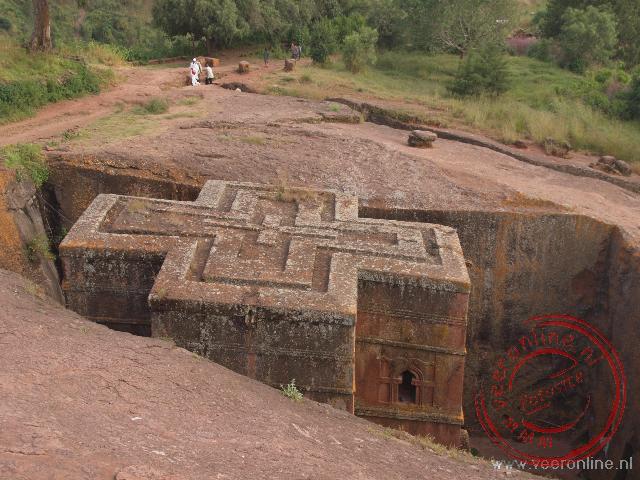
I take off my shoes again and enter the churches. Mulu watches my shoes outside so they are not taken. She ensures my shoes are ready on the other side when I exit the church and helps me put my sandals back on. She is very helpful, and after the first church, she already knows which shoes belong to me. I wander through the narrow passages of the churches. What a remarkable location to explore. I am impressed by all the splendor. After visiting all six churches, I walk a short distance through the village to the only free-standing rock church. This Church of Saint George is also the most famous. The cruciform rock-hewn church is often depicted in travel guides. To my relief, this church is not yet covered by a canopy. This allows a beautiful view of the underground rock church in relation to the surrounding landscape—a truly stunning sight. I descend via a narrow staircase into the fifteen-meter-deep pit to enter the church. Inside, the Saint George Church is relatively small and simply constructed. At five o’clock, it is time to return to the hotel.
 Ethiopia
  The interior of the Our Lady Mary of Zion Church
 The procession on the eve of the Meskel festival in Axum
 View from the Semien Mountains
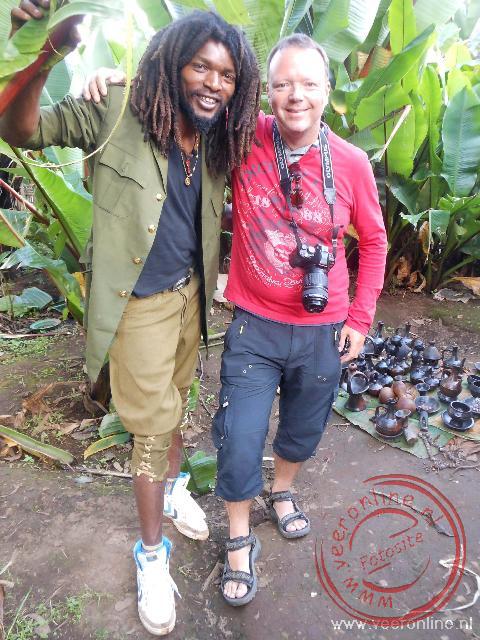 Posing with tribal chief Makonnen
Travelogue Tour through Mythical Ethiopia
Dag 2 | Ethiopia > City tour through Addis Ababa
Dag 3 | Ethiopia > Traveling through green Ethiopia
Dag 4 | Ethiopia > The Nile Falls and Lake Tana
Dag 5 | Ethiopia > The palaces of Gondar
Dag 6 | Ethiopia > Hiking in the Semien Mountains
Dag 7 | Ethiopia > Visit to Grace Village orphanage
Dag 8 | Ethiopia > The stelae of Axum
Dag 9 | Ethiopia > 'Happy Meskel!”
Dag 10 | Ethiopia > The rock churches of Lalibela
Dag 11 | Ethiopia > Flight back to Addis Ababa
Dag 12 | Ethiopia > Heavy rainfall near Aragash
Dag 13 | Ethiopia > Delivering a gift in Arba Minch
Dag 14 | Ethiopia > Visiting the Dorze tribe
Dag 15 | Ethiopia > On the way to Lake Langano
Dag 16 | Ethiopia > Langano Vacation Club Resort
Dag 17 | Ethiopia > Back to Addis, back home
Dag 18 | Ethiopia > Farewell to Ethiopia