
154 countries
(and areas)
 - Belize
- Benin
- Bhutan
- Bolivia
- Bonaire
- Bosnia and Herzegovina
- Botswana
- Brazil
- British Virgin Islands
- Brunei
- Bulgaria
- Cambodia
- Canada
- Cape Verde
- Chile
- China
- Costa Rica
- Croatia
- Cuba
- Curacao
- Cyprus
- Czech Republic
- Denmark
- Dominica
- Dominican Republic
- Egypt
- El Salvador
- England
- Estonia
- Eswatini (Swaziland)
- Ethiopia
- Fiji
- Finland
- France
- French Guiana
- Georgia
- Germany
- Gibraltar
- Greece
- Grenada
- Guadeloupe
- Guatemala
- Honduras
- Hong Kong
- Hungary
- Iceland
- India
- Indonesia
- Iran
- Ireland
- Israel
- Italy
- Jamaica
- Japan
- Jordan
- Kazakhstan
- Kenya
- Kosovo
- Kuwait
- Kyrgyzstan
- Laos
- Latvia
- Lebanon
- Lesotho
- Liechtenstein
- Lithuania
- Luxembourg
- Macau
- Madagascar
- Malawi
- Malaysia
- Maldives
- Malta
- Martinique
- Mexico
- Moldova
- Monaco
- Mongolia
- Montenegro
- Morocco
- Mozambique
- Namibia
- Nepal
- Netherlands
- New Zealand
- Nicaragua
- North Macedonia
- Northern Ireland
- Norway
- Oman
- Pakistan
- Palestine
- Peru
- Philippines
- Poland
- Portugal
- Qatar
- Republic of Korea
- Romania
- Russia
- Saint Kitts and Nevis
- Saint Lucia
- Saint Martin
- Saint Vincent and the Grenadines
- San Marino
- São Tomé and Principe
- Saudi Arabia
- Scotland
- Senegal
- Serbia
- Singapore
- Sint Maarten
- Slovakia
- Slovenia
- South Africa
- Spain
- Sri Lanka
- Suriname
- Sweden
- Switzerland
- Tajikistan
- Tanzania
- Thailand
- The Gambia
- Tibet
- Togo
- Transnistria
- Trinidad and Tobago
- Tunisia
- Turkey
- Turkmenistan
- Uganda
- United Arab Emirates
- United States
- Uruguay
- Uzbekistan
- Vatican City
- Vietnam
- Wales
- Zambia
- Zanzibar
- Belize
- Benin
- Bhutan
- Bolivia
- Bonaire
- Bosnia and Herzegovina
- Botswana
- Brazil
- British Virgin Islands
- Brunei
- Bulgaria
- Cambodia
- Canada
- Cape Verde
- Chile
- China
- Costa Rica
- Croatia
- Cuba
- Curacao
- Cyprus
- Czech Republic
- Denmark
- Dominica
- Dominican Republic
- Egypt
- El Salvador
- England
- Estonia
- Eswatini (Swaziland)
- Ethiopia
- Fiji
- Finland
- France
- French Guiana
- Georgia
- Germany
- Gibraltar
- Greece
- Grenada
- Guadeloupe
- Guatemala
- Honduras
- Hong Kong
- Hungary
- Iceland
- India
- Indonesia
- Iran
- Ireland
- Israel
- Italy
- Jamaica
- Japan
- Jordan
- Kazakhstan
- Kenya
- Kosovo
- Kuwait
- Kyrgyzstan
- Laos
- Latvia
- Lebanon
- Lesotho
- Liechtenstein
- Lithuania
- Luxembourg
- Macau
- Madagascar
- Malawi
- Malaysia
- Maldives
- Malta
- Martinique
- Mexico
- Moldova
- Monaco
- Mongolia
- Montenegro
- Morocco
- Mozambique
- Namibia
- Nepal
- Netherlands
- New Zealand
- Nicaragua
- North Macedonia
- Northern Ireland
- Norway
- Oman
- Pakistan
- Palestine
- Peru
- Philippines
- Poland
- Portugal
- Qatar
- Republic of Korea
- Romania
- Russia
- Saint Kitts and Nevis
- Saint Lucia
- Saint Martin
- Saint Vincent and the Grenadines
- San Marino
- São Tomé and Principe
- Saudi Arabia
- Scotland
- Senegal
- Serbia
- Singapore
- Sint Maarten
- Slovakia
- Slovenia
- South Africa
- Spain
- Sri Lanka
- Suriname
- Sweden
- Switzerland
- Tajikistan
- Tanzania
- Thailand
- The Gambia
- Tibet
- Togo
- Transnistria
- Trinidad and Tobago
- Tunisia
- Turkey
- Turkmenistan
- Uganda
- United Arab Emirates
- United States
- Uruguay
- Uzbekistan
- Vatican City
- Vietnam
- Wales
- Zambia
- Zanzibar


Copyright 2004 - 2026
Veeronline.nl Travel Adventures

Home > Armenia > Caucasus Tour > Travelogue day 17
Travelogue Caucasus Tour
September 13th - October 3th 2025 (21 days)
Armenia > To Lake Sevan
Dag 17 - Monday, September 29, 2025At half past nine, we leave the hotel in Goris. Mateos, our driver, has a bit of a cold. This isn’t surprising, as there has been a lot of coughing and hacking on the bus. He sneezes and sighs at the same time. It is mainly annoying for him, as we have a long drive ahead today. First, we drive back over the Vorotan Pass. This morning, we start again in the mist. Soon, we drive out of the clouds and the sun shines. I am sitting at the front today, giving me a beautiful view of the mountain pass. The road isn’t very busy; we only occasionally pass other vehicles. Once we have descended on the other side of the pass, we arrive at the food court we visited two days ago. It is still a bit early for lunch. I order a type of meat wrap and have it packed to eat later. I also order a coffee. After leaving the food court, we turn off and head toward Lake Sevan. For this, we have to cross a second mountain pass, the Vardenyats Pass. The road is rough. Carefully, Mateos tries to avoid the potholes, often driving on the opposite side of the road. With sharp hairpin bends, we climb higher and higher. The view is magnificent. Near the top of the pass lies the old Orbelian Caravanserai. This former inn and shelter dates from 1332 and now looks somewhat abandoned.
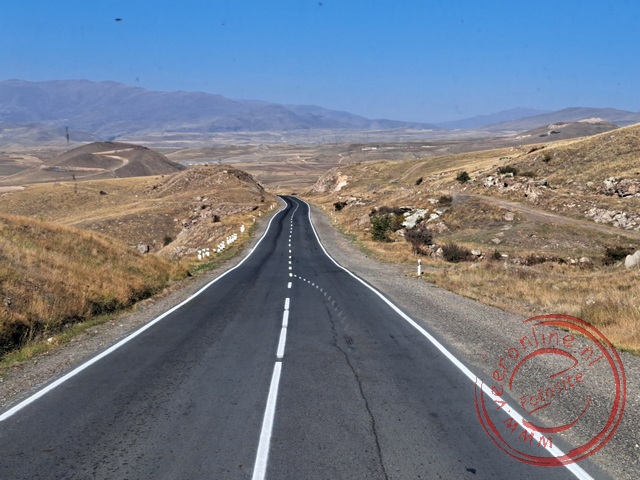
I sit on a stone and look out over the deep valley, watching the road winding its way upward while I eat my wrap. A dog comes over and lies down on the ground at a respectful distance—a polite form of begging. I give him the last piece of my wrap, and he repeats the trick with the other travelers. Once we cross the pass, Lake Sevan comes into view. The mountain lake, at an altitude of 1,914 meters, is one of the largest and highest lakes in the world. The lake was likely formed during a volcanic eruption in the Gegham Mountains. I see the clear blue water reflecting the sunlight. We descend to the lakeshore, arriving in the village of Noratus. On the village cemetery stand ancient gravestones dating from the ninth century. These “Khachkars” are upright Armenian memorial stones with a cross at the center. The cemetery also contains the grave of the monk Karapet Hovhanesi, who had himself buried at the age of 90 to show that death is not to be feared.

His grave has become a pilgrimage site. Visitors drink at his grave and then smash the glass. Shards lie scattered everywhere around the grave. I continue walking through the cemetery, which contains thousands of graves—both historic and very recent. From Noratus, we drive a short distance to our hotel on Lake Sevan. The summer season here is brief, and we are in the tail end of it. Many hotels are already closed. Upon arrival, we find that the power has gone out in the area around the hotel. Hopefully, it will be restored soon. We have a full apartment on the fourth floor with two bedrooms, a living room, and a small kitchen. The lakeshore is windy, creating significant waves on the water. At the end of the afternoon, a boat trip on the lake is planned. When we board, the plastic side screens are down, reducing our view of the lake and the ride.
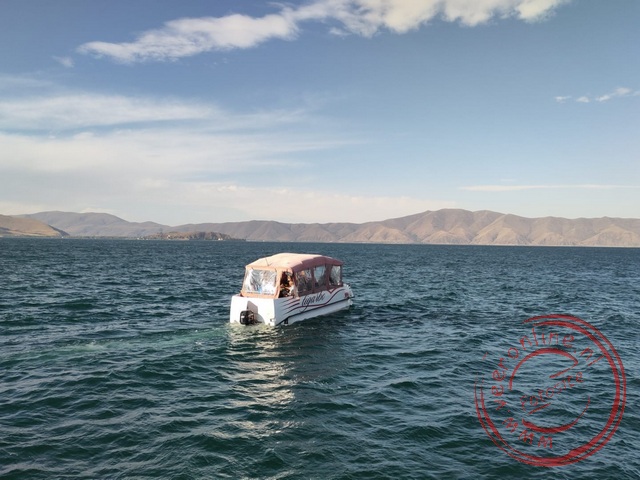
Soon, we start chatting among ourselves while the captain takes us on a tour of Lake Sevan. After about an hour, we are back. In the bar, we order a glass of wine. Meanwhile, the table for dinner is being set. A spread of salads, vegetables, meat, and fish appears on the table. Everything tastes absolutely delicious.
 Armenia
  The Amenaprkich Cathedral in the center of Gyumri
 Georgia
  The ancient dwellings carved into the cliffs of Vardzia
 Azerbaijan
  The balconies reflect the social status of the homeowners
 The ancient khachkar tombstones in the cemetery of Noratus
Travelogue Caucasus Tour
Dag 2 | Azerbaijan > The Burning Mountains of Baku
Dag 3 | Azerbaijan > The Rock Engravings of Gobustan
Dag 4 | Azerbaijan > Crossing the Border into Georgia
Dag 5 | Georgia > Saint Nino in Bodbe
Dag 6 | Georgia > A Walking Tour of Tbilisi
Dag 7 | Georgia > The Church of Kazbegi
Dag 8 | Georgia > The Stalin Museum in Gori
Dag 9 | Georgia > The Modern Seaside Resort Batumi
Dag 10 | Georgia > From Batumi to Akhaltsikhe
Dag 11 | Georgia > The Cave City of Vardzia
Dag 12 | Georgia > Via Gyumri to Yerevan
Dag 13 | Armenia > The Cathedral of Etchmiadzin
Dag 14 | Armenia > The Spear of the Geghard Monastery
Dag 15 | Armenia > In Gregory's Cellar
Dag 16 | Armenia > By Cable Car to Tatev
Dag 17 | Armenia > To Lake Sevan
Dag 18 | Armenia > Three Monasteries in One Day
Dag 19 | Armenia > Back to Tbilisi
Dag 20 | Georgia > The Davit Gareja Monastery
Dag 21 | Georgia > Flight to the Netherlands