
154 countries
(and areas)
 - Belize
- Benin
- Bhutan
- Bolivia
- Bonaire
- Bosnia and Herzegovina
- Botswana
- Brazil
- British Virgin Islands
- Brunei
- Bulgaria
- Cambodia
- Canada
- Cape Verde
- Chile
- China
- Costa Rica
- Croatia
- Cuba
- Curacao
- Cyprus
- Czech Republic
- Denmark
- Dominica
- Dominican Republic
- Egypt
- El Salvador
- England
- Estonia
- Eswatini (Swaziland)
- Ethiopia
- Fiji
- Finland
- France
- French Guiana
- Georgia
- Germany
- Gibraltar
- Greece
- Grenada
- Guadeloupe
- Guatemala
- Honduras
- Hong Kong
- Hungary
- Iceland
- India
- Indonesia
- Iran
- Ireland
- Israel
- Italy
- Jamaica
- Japan
- Jordan
- Kazakhstan
- Kenya
- Kosovo
- Kuwait
- Kyrgyzstan
- Laos
- Latvia
- Lebanon
- Lesotho
- Liechtenstein
- Lithuania
- Luxembourg
- Macau
- Madagascar
- Malawi
- Malaysia
- Maldives
- Malta
- Martinique
- Mexico
- Moldova
- Monaco
- Mongolia
- Montenegro
- Morocco
- Mozambique
- Namibia
- Nepal
- Netherlands
- New Zealand
- Nicaragua
- North Macedonia
- Northern Ireland
- Norway
- Oman
- Pakistan
- Palestine
- Peru
- Philippines
- Poland
- Portugal
- Qatar
- Republic of Korea
- Romania
- Russia
- Saint Kitts and Nevis
- Saint Lucia
- Saint Martin
- Saint Vincent and the Grenadines
- San Marino
- São Tomé and Principe
- Saudi Arabia
- Scotland
- Senegal
- Serbia
- Singapore
- Sint Maarten
- Slovakia
- Slovenia
- South Africa
- Spain
- Sri Lanka
- Suriname
- Sweden
- Switzerland
- Tajikistan
- Tanzania
- Thailand
- The Gambia
- Tibet
- Togo
- Transnistria
- Trinidad and Tobago
- Tunisia
- Turkey
- Turkmenistan
- Uganda
- United Arab Emirates
- United States
- Uruguay
- Uzbekistan
- Vatican City
- Vietnam
- Wales
- Zambia
- Zanzibar
- Belize
- Benin
- Bhutan
- Bolivia
- Bonaire
- Bosnia and Herzegovina
- Botswana
- Brazil
- British Virgin Islands
- Brunei
- Bulgaria
- Cambodia
- Canada
- Cape Verde
- Chile
- China
- Costa Rica
- Croatia
- Cuba
- Curacao
- Cyprus
- Czech Republic
- Denmark
- Dominica
- Dominican Republic
- Egypt
- El Salvador
- England
- Estonia
- Eswatini (Swaziland)
- Ethiopia
- Fiji
- Finland
- France
- French Guiana
- Georgia
- Germany
- Gibraltar
- Greece
- Grenada
- Guadeloupe
- Guatemala
- Honduras
- Hong Kong
- Hungary
- Iceland
- India
- Indonesia
- Iran
- Ireland
- Israel
- Italy
- Jamaica
- Japan
- Jordan
- Kazakhstan
- Kenya
- Kosovo
- Kuwait
- Kyrgyzstan
- Laos
- Latvia
- Lebanon
- Lesotho
- Liechtenstein
- Lithuania
- Luxembourg
- Macau
- Madagascar
- Malawi
- Malaysia
- Maldives
- Malta
- Martinique
- Mexico
- Moldova
- Monaco
- Mongolia
- Montenegro
- Morocco
- Mozambique
- Namibia
- Nepal
- Netherlands
- New Zealand
- Nicaragua
- North Macedonia
- Northern Ireland
- Norway
- Oman
- Pakistan
- Palestine
- Peru
- Philippines
- Poland
- Portugal
- Qatar
- Republic of Korea
- Romania
- Russia
- Saint Kitts and Nevis
- Saint Lucia
- Saint Martin
- Saint Vincent and the Grenadines
- San Marino
- São Tomé and Principe
- Saudi Arabia
- Scotland
- Senegal
- Serbia
- Singapore
- Sint Maarten
- Slovakia
- Slovenia
- South Africa
- Spain
- Sri Lanka
- Suriname
- Sweden
- Switzerland
- Tajikistan
- Tanzania
- Thailand
- The Gambia
- Tibet
- Togo
- Transnistria
- Trinidad and Tobago
- Tunisia
- Turkey
- Turkmenistan
- Uganda
- United Arab Emirates
- United States
- Uruguay
- Uzbekistan
- Vatican City
- Vietnam
- Wales
- Zambia
- Zanzibar


Copyright 2004 - 2026
Veeronline.nl Travel Adventures

Home > Azerbaijan > Caucasus Tour > Travelogue day 3
Travelogue Caucasus Tour
September 13th - October 3th 2025 (21 days)
Azerbaijan > The Rock Engravings of Gobustan
Dag 3 - Monday, September 15, 2025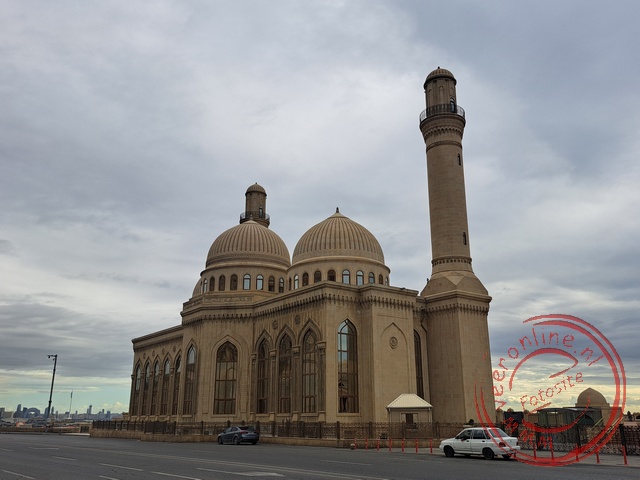
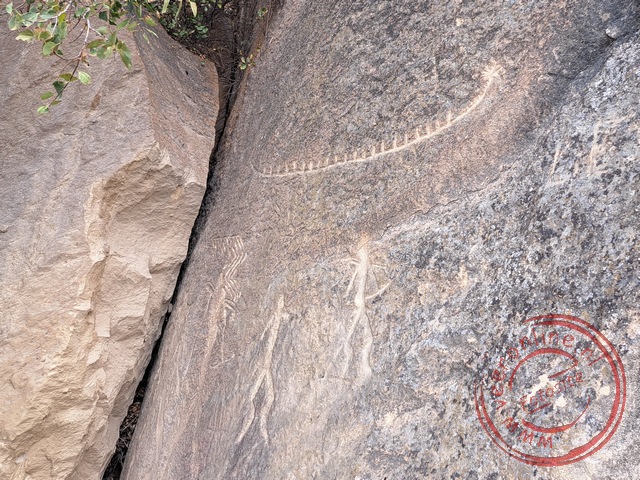
Today we leave Baku, which means I have to pack my suitcase again. The view from the breakfast buffet on the eleventh floor is much clearer. I can now see the Caspian Sea clearly. The weather forecast for today is much better—no rain is expected. That doesn’t matter too much, though, as we are traveling by bus to western Azerbaijan today. Tomorrow we will cross the border into Georgia. By quarter to nine, all the luggage is loaded onto the bus, and we leave the hotel. On the outskirts of the city, we visit the Bibi-Heybat Mosque. The current mosque is a reconstruction from the 1990s of an original 13th-century mosque that was destroyed by the Soviets in 1936. It is an important pilgrimage site and houses the tomb of Ukeyma Khanum, a descendant of the Prophet Muhammad. From the mosque’s terrace, I look out over the harbor and the city of Baku. Just south of Baku lies Gobustan National Park, home to historic rock carvings. Some of these images are over seven thousand years old. Upon arriving at the park, I follow Mehmet along a stone path between the rocks. The view of the wide landscape and the Caspian Sea alone is already stunning. Mehmet points out some of the historic carvings etched into the rocks: bulls, horses, and human figures. It is remarkable that these images have withstood erosion from wind and rain. Through a narrow passage, we enter a sort of cave. Numerous rock carvings are found here as well. In the region, over six thousand images have been discovered on rocks—but fortunately, we do not see them all. The associated museum disappoints me somewhat; perhaps we should have visited it first. There is some explanation about the carvings and the region’s ancient inhabitants. I recognize a few images I had just seen. We drive on quickly. Today we cover over three hundred kilometers across Azerbaijan. Along the way, the landscape changes from flat to gently rolling hills.
It is barren and dry, with little construction along the route. As I look out the window, I try to spot anything uniquely Azerbaijani that isn’t seen in other countries. I quickly notice that all trucks and vans display the letters and numbers of their license plates prominently on the back of the vehicle—likely a legal requirement for easier checks. Along the road, there are frequent police checkpoints, and vehicles are randomly pulled over. Our bus does not need to stop. Around half past one, we approach Shamakhi, a medium-sized city in the country’s center. We stop at a kind of supermarket to eat. Inside, there are several counters where you can order food. I choose a plate of chicken in sauce with rice. It costs just three euros, including a cola.
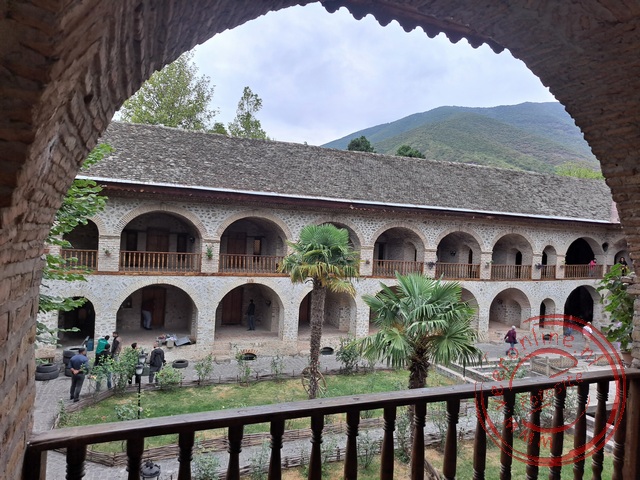
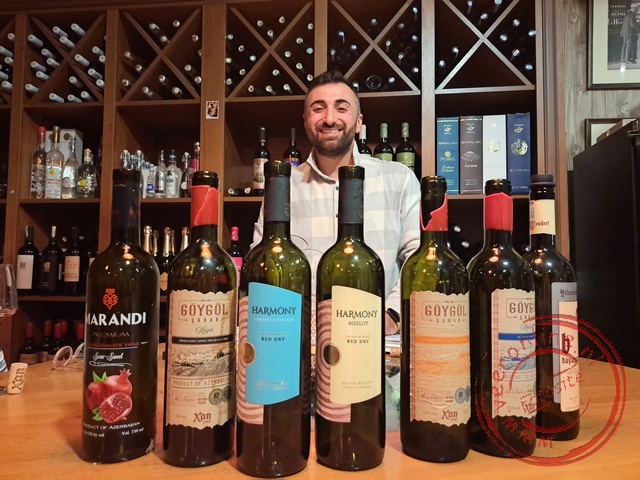
After lunch, we prepare to continue toward Sheki. Just outside the city, we visit Yeddi Gumbaz—the seven tombs of the Khans. Only three tombs remain standing; the rest collapsed during earthquakes. It is still about a three-hour drive to Sheki. The road winds through the mountains, offering magnificent views. Late in the afternoon, we arrive in Sheki, a city in northwestern Azerbaijan. On the northern side of the city is the Khan’s Palace, which we will visit tomorrow. Today we stay in an old caravanserai. Our room is on the first floor of the 300-year-old complex. A stone staircase with high steps leads up to the gallery. The room is simple and located under the brick vaults of the caravanserai. We don’t have much time to look around. Opposite the hotel, we can taste Azerbaijani wine. Mohammed lets us try several white and red wines, explaining the types and the regions where the grapes grow. Each time, we are poured a small amount from a total of eight different bottles. Everyone has their preference. After the wine tasting, we eat in the caravanserai’s garden. Dinner is served outdoors. I’m glad I put on my sweater. I order piti, a local stew of lamb, chickpeas, and vegetables served in an earthenware pot. The waiter pours the broth onto my plate and mashes the remaining meat and vegetables. He explains that I should dip the bread in the broth and eat it together with the piti. It tastes delicious.
 Georgia
 Armenia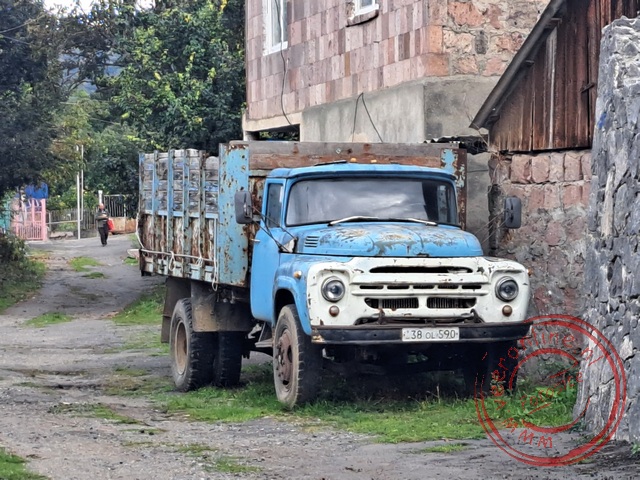


Travelogue Caucasus Tour
Dag 2 | Azerbaijan > The Burning Mountains of Baku
Dag 3 | Azerbaijan > The Rock Engravings of Gobustan
Dag 4 | Azerbaijan > Crossing the Border into Georgia
Dag 5 | Georgia > Saint Nino in Bodbe
Dag 6 | Georgia > A Walking Tour of Tbilisi
Dag 7 | Georgia > The Church of Kazbegi
Dag 8 | Georgia > The Stalin Museum in Gori
Dag 9 | Georgia > The Modern Seaside Resort Batumi
Dag 10 | Georgia > From Batumi to Akhaltsikhe
Dag 11 | Georgia > The Cave City of Vardzia
Dag 12 | Georgia > Via Gyumri to Yerevan
Dag 13 | Armenia > The Cathedral of Etchmiadzin
Dag 14 | Armenia > The Spear of the Geghard Monastery
Dag 15 | Armenia > In Gregory's Cellar
Dag 16 | Armenia > By Cable Car to Tatev
Dag 17 | Armenia > To Lake Sevan
Dag 18 | Armenia > Three Monasteries in One Day
Dag 19 | Armenia > Back to Tbilisi
Dag 20 | Georgia > The Davit Gareja Monastery
Dag 21 | Georgia > Flight to the Netherlands