
154 countries
(and areas)
 - Belize
- Benin
- Bhutan
- Bolivia
- Bonaire
- Bosnia and Herzegovina
- Botswana
- Brazil
- British Virgin Islands
- Brunei
- Bulgaria
- Cambodia
- Canada
- Cape Verde
- Chile
- China
- Costa Rica
- Croatia
- Cuba
- Curacao
- Cyprus
- Czech Republic
- Denmark
- Dominica
- Dominican Republic
- Egypt
- El Salvador
- England
- Estonia
- Eswatini (Swaziland)
- Ethiopia
- Fiji
- Finland
- France
- French Guiana
- Georgia
- Germany
- Gibraltar
- Greece
- Grenada
- Guadeloupe
- Guatemala
- Honduras
- Hong Kong
- Hungary
- Iceland
- India
- Indonesia
- Iran
- Ireland
- Israel
- Italy
- Jamaica
- Japan
- Jordan
- Kazakhstan
- Kenya
- Kosovo
- Kuwait
- Kyrgyzstan
- Laos
- Latvia
- Lebanon
- Lesotho
- Liechtenstein
- Lithuania
- Luxembourg
- Macau
- Madagascar
- Malawi
- Malaysia
- Maldives
- Malta
- Martinique
- Mexico
- Moldova
- Monaco
- Mongolia
- Montenegro
- Morocco
- Mozambique
- Namibia
- Nepal
- Netherlands
- New Zealand
- Nicaragua
- North Macedonia
- Northern Ireland
- Norway
- Oman
- Pakistan
- Palestine
- Peru
- Philippines
- Poland
- Portugal
- Qatar
- Republic of Korea
- Romania
- Russia
- Saint Kitts and Nevis
- Saint Lucia
- Saint Martin
- Saint Vincent and the Grenadines
- San Marino
- São Tomé and Principe
- Saudi Arabia
- Scotland
- Senegal
- Serbia
- Singapore
- Sint Maarten
- Slovakia
- Slovenia
- South Africa
- Spain
- Sri Lanka
- Suriname
- Sweden
- Switzerland
- Tajikistan
- Tanzania
- Thailand
- The Gambia
- Tibet
- Togo
- Transnistria
- Trinidad and Tobago
- Tunisia
- Turkey
- Turkmenistan
- Uganda
- United Arab Emirates
- United States
- Uruguay
- Uzbekistan
- Vatican City
- Vietnam
- Wales
- Zambia
- Zanzibar
- Belize
- Benin
- Bhutan
- Bolivia
- Bonaire
- Bosnia and Herzegovina
- Botswana
- Brazil
- British Virgin Islands
- Brunei
- Bulgaria
- Cambodia
- Canada
- Cape Verde
- Chile
- China
- Costa Rica
- Croatia
- Cuba
- Curacao
- Cyprus
- Czech Republic
- Denmark
- Dominica
- Dominican Republic
- Egypt
- El Salvador
- England
- Estonia
- Eswatini (Swaziland)
- Ethiopia
- Fiji
- Finland
- France
- French Guiana
- Georgia
- Germany
- Gibraltar
- Greece
- Grenada
- Guadeloupe
- Guatemala
- Honduras
- Hong Kong
- Hungary
- Iceland
- India
- Indonesia
- Iran
- Ireland
- Israel
- Italy
- Jamaica
- Japan
- Jordan
- Kazakhstan
- Kenya
- Kosovo
- Kuwait
- Kyrgyzstan
- Laos
- Latvia
- Lebanon
- Lesotho
- Liechtenstein
- Lithuania
- Luxembourg
- Macau
- Madagascar
- Malawi
- Malaysia
- Maldives
- Malta
- Martinique
- Mexico
- Moldova
- Monaco
- Mongolia
- Montenegro
- Morocco
- Mozambique
- Namibia
- Nepal
- Netherlands
- New Zealand
- Nicaragua
- North Macedonia
- Northern Ireland
- Norway
- Oman
- Pakistan
- Palestine
- Peru
- Philippines
- Poland
- Portugal
- Qatar
- Republic of Korea
- Romania
- Russia
- Saint Kitts and Nevis
- Saint Lucia
- Saint Martin
- Saint Vincent and the Grenadines
- San Marino
- São Tomé and Principe
- Saudi Arabia
- Scotland
- Senegal
- Serbia
- Singapore
- Sint Maarten
- Slovakia
- Slovenia
- South Africa
- Spain
- Sri Lanka
- Suriname
- Sweden
- Switzerland
- Tajikistan
- Tanzania
- Thailand
- The Gambia
- Tibet
- Togo
- Transnistria
- Trinidad and Tobago
- Tunisia
- Turkey
- Turkmenistan
- Uganda
- United Arab Emirates
- United States
- Uruguay
- Uzbekistan
- Vatican City
- Vietnam
- Wales
- Zambia
- Zanzibar


Copyright 2004 - 2026
Veeronline.nl Travel Adventures

Home > Uganda > Encounter with the Gorilla > Travelogue day 5
Travelogue Encounter with the Gorilla
July 24 August 15 2011 (23 days)
Uganda > 'Jambo, Jambo!'
Dag 5 - Thursday, July 28, 2011I get up early. Today I’m traveling onward to Namwenda. Once the minibuses are packed, I say goodbye to the beautiful view. Frank asks me to hand over the tip for the staff from the tip jar. Each time he asks someone different to do it. It’s nicer if I give it than if he does it himself. I drive the bus out of the mountains again toward Mbale, where I make a short stop to do some shopping.

This afternoon, I’ll be visiting a small school. Instead of just giving money, our group wants to donate beans and rice. The children always eat lunch at school, so by giving actual goods, I know it will reach them directly. I continue driving with a 30-kilo bag of rice and a 30-kilo bag of beans strapped to the roof. At Iganga, I turn right onto the red dirt road. The minibus starts to shake violently. There are large potholes that we carefully avoid. Along the roadside, there is a lot of trade in the villages. Tomatoes are stacked in small pyramids, and fruit is neatly displayed. The landscape is continuously green, with every bit of land used for agriculture: sugar fields, cornfields, tea plantations, and coffee trees. The villages are brightened up with colorful houses featuring advertisements. In exchange for advertising, for example, for cola or telecom providers, people have their houses painted—something they usually cannot afford.
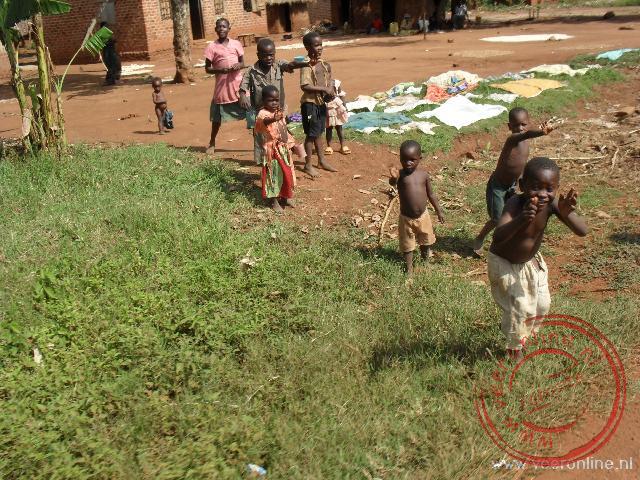
Despite the bright colors, a painted house looks much more cared for. Around lunchtime, I arrive at the farm where I’ll be staying. On the way there, I am greeted enthusiastically with “Jambo, Jambo!” (hello, hello). Children run to the road to wave at me. I wave back cheerfully. The campsite is arranged around the house of Patrick, the farm owner. There is a simple toilet, and for washing there is a jerrycan and a small basin. There is no shower. Frank shows us how to set up the tents. I assume everyone has at least once set up a dome tent before, so the camp is quickly arranged. Meanwhile, an extensive lunch is prepared, featuring several Ugandan dishes—today even more platters than yesterday. In the afternoon, I cycle into the village. Along the route, all the children come out. “Jambo, Jambo” is heard constantly. Children are ready to give high fives as I ride past. Admittedly, it’s not very practical, but it’s fun. I stop at the school for a visit. All 350 children are already waiting outside. They have practiced songs especially for us. A teacher gives me a tour of the school. I struggle to follow the math teacher’s English but understand that he mainly wants to show me what is lacking: no proper blackboards, insufficient books, and not enough sleeping spaces for children who come from far away. Back with the children, several more songs are sung. The headteacher thanks the group for our visit. As a group, we hand over the rice and beans, along with some small toys we brought for the school.

We conclude with a Dutch song. When the children start doing the gestures for “head-shoulders-knees-and-toes,” we join in, to their great delight. It’s clear that multiple Dutch travel groups have visited here. I continue cycling through the village and stop to watch grain being milled. There is a line of people waiting to have their grain ground by the machine—probably the only one in the village. Due to the crowd, I move on quickly, not wanting to be in the way. My cycling tour ends at a small terrace in the village. The afternoon is coming to a close, and it’s time for a Nile Special beer. In the evening, Patrick comes by during dinner. He joins the group around the campfire and introduces himself. He recently retired, and his sons now run the large farm. He proudly tells us that the president visited his farm last year during election season. Around the campfire, I enjoy the drinks I bought in the afternoon. As the fire slowly dies down, I decide it’s a good time to go to bed. Guided by an impressive starry sky, I walk back to my tent.
 Uganda
  Uganda kobs during sunset
 A group of female waterbucks in Elizabeth National Park
 A female lion resting in the grass
 A local market on the shore of Lake Bunyonyi
Travelogue Encounter with the Gorilla
Dag 2 | Uganda > Visit to the chimpanzees
Dag 3 | Uganda > On the way to Sipi Falls
Dag 4 | Uganda > Climbing along the waterfalls
Dag 5 | Uganda > 'Jambo, Jambo!'
Dag 6 | Uganda > The origin of the Nile
Dag 7 | Uganda > Rafting: 'Heavy 5' or 'Light 5'
Dag 8 | Uganda > Colossal rhinos
Dag 9 | Uganda > Lost in Murchison Falls NP
Dag 10 | Uganda > A leopard!
Dag 11 | Uganda > Digestive problems...
Dag 12 | Uganda > To Chimps Nest
Dag 13 | Uganda > Visiting the chimpanzees
Dag 14 | Uganda > Queen Elizabeth National Park
Dag 15 | Uganda > Boating on the Kazinga Channel
Dag 16 | Uganda > Tree-climbing lions
Dag 17 | Uganda > Dusty road to Bwindi
Dag 18 | Uganda > Rest day at Lake Matanda
Dag 19 | Uganda > Eye to eye with the gorillas
Dag 20 | Uganda > Lake Bunyonyi
Dag 21 | Uganda > The Disco in Masaka
Dag 22 | Uganda > Rare Shoebill