
154 countries
(and areas)
 - Azerbaijan
- Bahrain
- Barbados
- Belgium
- Belize
- Benin
- Bhutan
- Bolivia
- Bonaire
- Bosnia and Herzegovina
- Botswana
- Brazil
- British Virgin Islands
- Brunei
- Bulgaria
- Cambodia
- Canada
- Cape Verde
- Chile
- China
- Costa Rica
- Croatia
- Cuba
- Curacao
- Cyprus
- Czech Republic
- Denmark
- Dominica
- Dominican Republic
- Egypt
- El Salvador
- England
- Estonia
- Eswatini (Swaziland)
- Ethiopia
- Fiji
- Finland
- France
- French Guiana
- Georgia
- Germany
- Gibraltar
- Greece
- Grenada
- Guadeloupe
- Guatemala
- Honduras
- Hong Kong
- Hungary
- Iceland
- India
- Indonesia
- Iran
- Ireland
- Israel
- Italy
- Jamaica
- Japan
- Jordan
- Kazakhstan
- Kenya
- Kosovo
- Kuwait
- Kyrgyzstan
- Laos
- Latvia
- Lebanon
- Lesotho
- Liechtenstein
- Lithuania
- Luxembourg
- Macau
- Madagascar
- Malawi
- Malaysia
- Maldives
- Malta
- Martinique
- Mexico
- Moldova
- Monaco
- Mongolia
- Montenegro
- Morocco
- Mozambique
- Namibia
- Nepal
- Netherlands
- New Zealand
- Nicaragua
- North Macedonia
- Northern Ireland
- Norway
- Oman
- Pakistan
- Palestine
- Peru
- Philippines
- Poland
- Portugal
- Qatar
- Republic of Korea
- Romania
- Russia
- Saint Kitts and Nevis
- Saint Lucia
- Saint Martin
- Saint Vincent and the Grenadines
- San Marino
- São Tomé and Principe
- Saudi Arabia
- Scotland
- Senegal
- Serbia
- Singapore
- Sint Maarten
- Slovakia
- Slovenia
- South Africa
- Spain
- Sri Lanka
- Suriname
- Sweden
- Switzerland
- Tajikistan
- Tanzania
- Thailand
- The Gambia
- Tibet
- Togo
- Transnistria
- Trinidad and Tobago
- Tunisia
- Turkey
- Turkmenistan
- Uganda
- United Arab Emirates
- United States
- Uruguay
- Uzbekistan
- Vatican City
- Vietnam
- Wales
- Zambia
- Zanzibar
- Azerbaijan
- Bahrain
- Barbados
- Belgium
- Belize
- Benin
- Bhutan
- Bolivia
- Bonaire
- Bosnia and Herzegovina
- Botswana
- Brazil
- British Virgin Islands
- Brunei
- Bulgaria
- Cambodia
- Canada
- Cape Verde
- Chile
- China
- Costa Rica
- Croatia
- Cuba
- Curacao
- Cyprus
- Czech Republic
- Denmark
- Dominica
- Dominican Republic
- Egypt
- El Salvador
- England
- Estonia
- Eswatini (Swaziland)
- Ethiopia
- Fiji
- Finland
- France
- French Guiana
- Georgia
- Germany
- Gibraltar
- Greece
- Grenada
- Guadeloupe
- Guatemala
- Honduras
- Hong Kong
- Hungary
- Iceland
- India
- Indonesia
- Iran
- Ireland
- Israel
- Italy
- Jamaica
- Japan
- Jordan
- Kazakhstan
- Kenya
- Kosovo
- Kuwait
- Kyrgyzstan
- Laos
- Latvia
- Lebanon
- Lesotho
- Liechtenstein
- Lithuania
- Luxembourg
- Macau
- Madagascar
- Malawi
- Malaysia
- Maldives
- Malta
- Martinique
- Mexico
- Moldova
- Monaco
- Mongolia
- Montenegro
- Morocco
- Mozambique
- Namibia
- Nepal
- Netherlands
- New Zealand
- Nicaragua
- North Macedonia
- Northern Ireland
- Norway
- Oman
- Pakistan
- Palestine
- Peru
- Philippines
- Poland
- Portugal
- Qatar
- Republic of Korea
- Romania
- Russia
- Saint Kitts and Nevis
- Saint Lucia
- Saint Martin
- Saint Vincent and the Grenadines
- San Marino
- São Tomé and Principe
- Saudi Arabia
- Scotland
- Senegal
- Serbia
- Singapore
- Sint Maarten
- Slovakia
- Slovenia
- South Africa
- Spain
- Sri Lanka
- Suriname
- Sweden
- Switzerland
- Tajikistan
- Tanzania
- Thailand
- The Gambia
- Tibet
- Togo
- Transnistria
- Trinidad and Tobago
- Tunisia
- Turkey
- Turkmenistan
- Uganda
- United Arab Emirates
- United States
- Uruguay
- Uzbekistan
- Vatican City
- Vietnam
- Wales
- Zambia
- Zanzibar


Copyright 2004 - 2026
Veeronline.nl Travel Adventures

Home > New Zealand > Fiji and New Zealand > Travelogue day 17
Travelogue Fiji and New Zealand
December 28 2018 February 2 2019 (39 days)
New Zealand > Tongariro Alpine Crossing
Dag 17 - Friday, January 11, 2019When I open the curtains, it’s cloudy. Just today, we are going to hike the Tongariro Alpine Crossing—a beautiful mountain trek of nearly twenty kilometres through Tongariro National Park. This hike is considered one of the most beautiful in New Zealand, but only in good weather. Still, we get in the car and drive for about forty-five minutes to the other side of the national park. Around the start and finish points of the trek, strict parking rules apply: nowhere may you park for longer than four hours, to prevent chaos in the parking areas. That’s why we booked a private parking spot near the endpoint, including a bus transfer to the start. At exactly half past seven, we drive onto the grassy field. Several people are already waiting for the eight o’clock bus. The ride to the starting point takes another 25 minutes. Along the way, the driver tells us that it is cloudy today and that at the top near the Red Crater, wind gusts can reach up to 100 km/h. Due to the wind, the wind chill can feel around or even below freezing. “Be careful,” he says as I step out. The first kilometre of the trail climbs gradually. It’s not too hard yet. The route is perfectly marked, and every two to three kilometres there are toilet facilities. At Soda Springs, after four kilometres of walking, the warning appears again: do you have enough clothing with you, is the weather okay, and can you handle it physically? If not, consider turning back. The same warning even hangs inside the toilet.
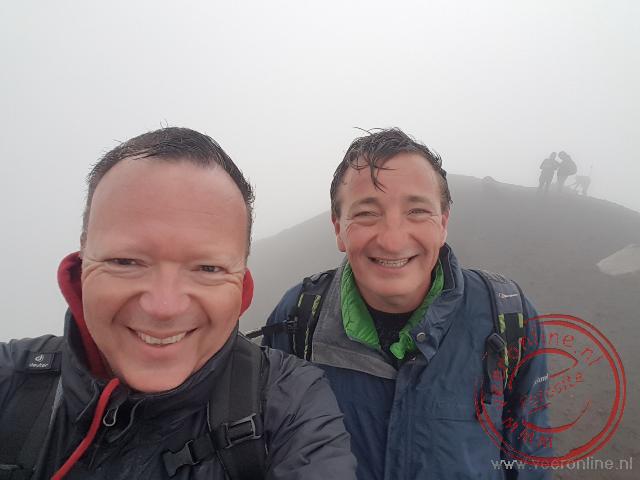
Up to this point, it was easy, but now the steep section begins. Only continue if you’re certain. What lies ahead of us? After Soda Springs, the trail climbs more steeply. The higher I get, the thicker the cloud becomes. I’m walking in the clouds now, with visibility at most fifty metres. The hikers ahead of me quickly fade away like shadows on the mountain. The clouds also block the view of Mount Ngauruhoe, which served as Mount Doom in the Lord of the Rings films. A pity. All I see is an information board explaining the area around the volcano. The wind is picking up, and I have to brace myself at times to avoid being blown over. I suspect there are deep drops to the left and right of the ascending path, but the mist hides them from view. I keep climbing. The biting wind makes it cold. I think some hikers regret their choice of clothing this morning, wearing shorts. I had considered it but thankfully decided against it. I reach the top of the Tongariro volcano. To my right, I must have passed the Red Crater. Ahead of me should be the Emerald Lakes—a trio of alpine lakes formed after the eruption of the Tongariro volcano in 1926. Will I see them at all? The descent is more spectacular. Because of the loose volcanic scree combined with strong wind gusts, hikers regularly slip on the way down.
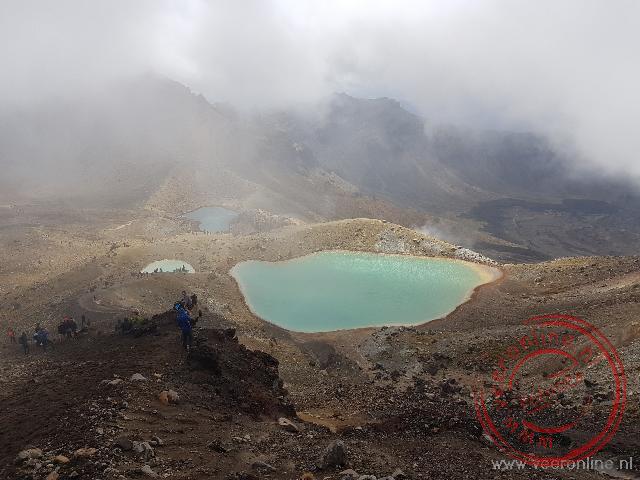
I try to keep my balance along the ridge. Suddenly, the cloud lifts. Below me, I see one of the Emerald Lakes. A collective “ohhh” rises from the hikers on the mountain. I quickly grab my camera, as the clouds could return any moment. It clears a bit more, and for a moment I see all three lakes. The sun even peeks through. At the lakes, I sit on a rock and take out my packed lunch. A shame about the missing view of Mount Doom, but the Emerald Lakes more than make up for it. I can now also see the entire trail through the valley towards the Blue Lake. The summit of the Tongariro volcano lies at 1,900 metres; the endpoint is at 700 metres. This means we still have several hours of descent ahead. Here too, the path is well marked. To prevent sand erosion, a plastic grid has been laid everywhere, holding sand and stones in place. At exactly three o’clock, after six and a half hours of hiking, we are back at the car. Will I be sore tomorrow? As we drive back to Ohakune, the sun is still shining. From the road, we see Mount Ngauruhoe, although its summit is still shrouded in clouds. The nearby Mount Ruapehu is clearly visible. In the late afternoon, we take a walk into Ohakune. The village isn’t very big. On a terrace, we order a drink. Across the street is an Italian restaurant—a perfect choice for tonight’s dinner.
 Fiji
Fiji  The beach at the resort
 New Zealand
  The unique surroundings of WaiOTapu
 Crew members playing music on board the sailing ship
 A seagull on the statue of Abel Tasman
Travelogue Fiji and New Zealand
Dag 2 | Fiji > The airport of Guangzhou
Dag 3 | Fiji > The hotel is closed
Dag 4 | Fiji > Shopping in Sigatoka
Dag 5 | Fiji > The Viti Levu highlands
Dag 6 | Fiji > New Year's Eve in Fiji
Dag 7 | Fiji > Deep sea fishing
Dag 8 | New Zealand > To New Zealand
Dag 9 | New Zealand > The apartment is already occupied
Dag 10 | New Zealand > Dolphin spotting
Dag 11 | New Zealand > To Cape Reinga
Dag 12 | New Zealand > The Cathedral Cove
Dag 13 | New Zealand > Coromandel Coastal Walkway
Dag 14 | New Zealand > Hot Water Beach
Dag 15 | New Zealand > White Island Volcano
Dag 16 | New Zealand > Thermal park Wai-O-Tapu
Dag 17 | New Zealand > Tongariro Alpine Crossing
Dag 18 | New Zealand > To Wellington
Dag 19 | New Zealand > The Te Papa museum
Dag 20 | New Zealand > Ferry to South Island
Dag 21 | New Zealand > No whale watching trip
Dag 22 | New Zealand > The Marlborough Sounds
Dag 23 | New Zealand > Abel Tasman in Nelson
Dag 24 | New Zealand > Kayaking in Abel Tasman N.P.
Dag 25 | New Zealand > To the Pancake Rocks
Dag 26 | New Zealand > Can we go on the glacier?
Dag 27 | New Zealand > To Queenstown
Dag 28 | New Zealand > Funyak on the Dart River
Dag 29 | New Zealand > Te Anau in Fjordland
Dag 30 | New Zealand > Boat trip Milford Sound
Dag 31 | New Zealand > Waterfalls in the Catlins
Dag 32 | New Zealand > To Dunedin
Dag 33 | New Zealand > Otago Peninsula
Dag 34 | New Zealand > Moeraki Boulders
Dag 35 | New Zealand > Helicopter hike on the glacier
Dag 36 | New Zealand > Lake Tekapo
Dag 37 | New Zealand > Christchurch after the earthquake
Dag 38 | New Zealand > Departure Auckland
Dag 39 | New Zealand > From China to Home