
154 countries
(and areas)
 - Belize
- Benin
- Bhutan
- Bolivia
- Bonaire
- Bosnia and Herzegovina
- Botswana
- Brazil
- British Virgin Islands
- Brunei
- Bulgaria
- Cambodia
- Canada
- Cape Verde
- Chile
- China
- Costa Rica
- Croatia
- Cuba
- Curacao
- Cyprus
- Czech Republic
- Denmark
- Dominica
- Dominican Republic
- Egypt
- El Salvador
- England
- Estonia
- Eswatini (Swaziland)
- Ethiopia
- Fiji
- Finland
- France
- French Guiana
- Georgia
- Germany
- Gibraltar
- Greece
- Grenada
- Guadeloupe
- Guatemala
- Honduras
- Hong Kong
- Hungary
- Iceland
- India
- Indonesia
- Iran
- Ireland
- Israel
- Italy
- Jamaica
- Japan
- Jordan
- Kazakhstan
- Kenya
- Kosovo
- Kuwait
- Kyrgyzstan
- Laos
- Latvia
- Lebanon
- Lesotho
- Liechtenstein
- Lithuania
- Luxembourg
- Macau
- Madagascar
- Malawi
- Malaysia
- Maldives
- Malta
- Martinique
- Mexico
- Moldova
- Monaco
- Mongolia
- Montenegro
- Morocco
- Mozambique
- Namibia
- Nepal
- Netherlands
- New Zealand
- Nicaragua
- North Macedonia
- Northern Ireland
- Norway
- Oman
- Pakistan
- Palestine
- Peru
- Philippines
- Poland
- Portugal
- Qatar
- Republic of Korea
- Romania
- Russia
- Saint Kitts and Nevis
- Saint Lucia
- Saint Martin
- Saint Vincent and the Grenadines
- San Marino
- São Tomé and Principe
- Saudi Arabia
- Scotland
- Senegal
- Serbia
- Singapore
- Sint Maarten
- Slovakia
- Slovenia
- South Africa
- Spain
- Sri Lanka
- Suriname
- Sweden
- Switzerland
- Tajikistan
- Tanzania
- Thailand
- The Gambia
- Tibet
- Togo
- Transnistria
- Trinidad and Tobago
- Tunisia
- Turkey
- Turkmenistan
- Uganda
- United Arab Emirates
- United States
- Uruguay
- Uzbekistan
- Vatican City
- Vietnam
- Wales
- Zambia
- Zanzibar
- Belize
- Benin
- Bhutan
- Bolivia
- Bonaire
- Bosnia and Herzegovina
- Botswana
- Brazil
- British Virgin Islands
- Brunei
- Bulgaria
- Cambodia
- Canada
- Cape Verde
- Chile
- China
- Costa Rica
- Croatia
- Cuba
- Curacao
- Cyprus
- Czech Republic
- Denmark
- Dominica
- Dominican Republic
- Egypt
- El Salvador
- England
- Estonia
- Eswatini (Swaziland)
- Ethiopia
- Fiji
- Finland
- France
- French Guiana
- Georgia
- Germany
- Gibraltar
- Greece
- Grenada
- Guadeloupe
- Guatemala
- Honduras
- Hong Kong
- Hungary
- Iceland
- India
- Indonesia
- Iran
- Ireland
- Israel
- Italy
- Jamaica
- Japan
- Jordan
- Kazakhstan
- Kenya
- Kosovo
- Kuwait
- Kyrgyzstan
- Laos
- Latvia
- Lebanon
- Lesotho
- Liechtenstein
- Lithuania
- Luxembourg
- Macau
- Madagascar
- Malawi
- Malaysia
- Maldives
- Malta
- Martinique
- Mexico
- Moldova
- Monaco
- Mongolia
- Montenegro
- Morocco
- Mozambique
- Namibia
- Nepal
- Netherlands
- New Zealand
- Nicaragua
- North Macedonia
- Northern Ireland
- Norway
- Oman
- Pakistan
- Palestine
- Peru
- Philippines
- Poland
- Portugal
- Qatar
- Republic of Korea
- Romania
- Russia
- Saint Kitts and Nevis
- Saint Lucia
- Saint Martin
- Saint Vincent and the Grenadines
- San Marino
- São Tomé and Principe
- Saudi Arabia
- Scotland
- Senegal
- Serbia
- Singapore
- Sint Maarten
- Slovakia
- Slovenia
- South Africa
- Spain
- Sri Lanka
- Suriname
- Sweden
- Switzerland
- Tajikistan
- Tanzania
- Thailand
- The Gambia
- Tibet
- Togo
- Transnistria
- Trinidad and Tobago
- Tunisia
- Turkey
- Turkmenistan
- Uganda
- United Arab Emirates
- United States
- Uruguay
- Uzbekistan
- Vatican City
- Vietnam
- Wales
- Zambia
- Zanzibar


Copyright 2004 - 2026
Veeronline.nl Travel Adventures

Home > New Zealand > Fiji and New Zealand > Travelogue day 36
Travelogue Fiji and New Zealand
December 28 2018 February 2 2019 (39 days)
New Zealand > Lake Tekapo
Dag 36 - Wednesday, January 30, 2019Today we’re going on a half-day mountain hike. We have the choice between the Hooker Valley Track and the Sealy Tarns Track. The Hooker Valley Track is a walk of about three hours round-trip to a viewpoint at Hooker Lake. The trail is flat and fairly easy. The Sealy Tarns, on the other hand, is a more challenging hike. The path rises about six hundred meters via stairs with 2,200 steps. At the top are several small mountain lakes, called Tarns. The weather looks good, so we decide to take the Sealy Tarns Track. We drive again to Mount Cook Village. From the parking lot, we start the hike. The first part follows the same route as the walk to Kea Point that we did the day before yesterday. After a few minutes, our path turns off. Immediately the trail ascends, and soon we reach the first steps. The stairs help us gain elevation quickly. Steps are installed all along the route—sometimes made of stone, but mostly of wood. Because of the steps, the hike becomes a strenuous climb. The effort is rewarded with a stunning view of the Hooker Glacier and Mount Cook behind it.

After about an hour and a half of climbing, we reach the top. Here lie two small mountain lakes. We leave them be, as the view of the surroundings is much more spectacular. Like the Tasman Glacier, the Hooker Glacier is also covered under a layer of rocks, which gives it a black appearance. The glacier flows into Hooker Lake. Below us, we can see the parking lot, Mount Cook Village, the walking trail to Kea Point, and the Hooker Valley Track winding through the valley. We descend via the stairs. Although the hike is listed as three to four hours, we are back at the car in under three hours. We haven’t even walked very fast. We were overtaken by several hikers along the way. The time estimate is probably generous. We also saw people who probably really need the full four hours. We head to the only restaurant in Mount Cook Village for lunch. After lunch, we leave the mountain area. As we drive past the helicopter company, we see three helicopters on the ground. Probably too much wind on the glacier. We realize we were lucky yesterday. Strangely enough, the weather now is much sunnier. The cloud cover that hung over the mountains this morning has completely cleared. We see Mount Cook and the surrounding giant peaks beautifully reflected in Lake Pukaki. Like Lake Pukaki, Lake Tekapo is bright blue due to the minerals from the glaciers.

At our accommodation in Tekapo, it turns out we have an upstairs apartment. The door is open, and a note is left for us. Should anything be needed, the manager is at a nearby Bed & Breakfast. On our way to the lake, we pass by it and can settle the payment with her. By the lake stands the small Church of the Good Shepherd. Its unique location on the shores of Lake Tekapo makes the church a true tourist attraction. From the altar, you look out over the lake. Across the pedestrian bridge, we reach the town center. The village resembles Twizel. Normally, only a handful of people live here, but in the high season, everything revolves around tourists. The manager of our accommodation recommended a restaurant. On the terrace behind the restaurant, we order a drink. For the next order, we also decide to have dinner there. Due to minimal light pollution, the area around Lake Tekapo is known for its spectacular night sky. From the veranda, we see the stars light up as it gets darker. During a nighttime bathroom stop, I step outside again. The starry sky is truly breathtaking. The Milky Way is clearly visible. Stars are everywhere—thousands of them.
 New Zealand
 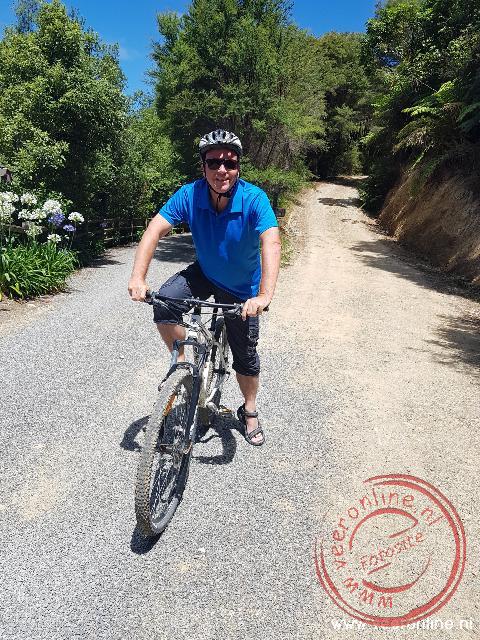 Cycling around the Marlborough Sounds
 The spectacular Cathedral Cove near Hahei
 Fiji
Fiji  The beautiful sunset in Fiji
 Feet in the warm water at Hot Water Beach
Travelogue Fiji and New Zealand
Dag 2 | Fiji > The airport of Guangzhou
Dag 3 | Fiji > The hotel is closed
Dag 4 | Fiji > Shopping in Sigatoka
Dag 5 | Fiji > The Viti Levu highlands
Dag 6 | Fiji > New Year's Eve in Fiji
Dag 7 | Fiji > Deep sea fishing
Dag 8 | New Zealand > To New Zealand
Dag 9 | New Zealand > The apartment is already occupied
Dag 10 | New Zealand > Dolphin spotting
Dag 11 | New Zealand > To Cape Reinga
Dag 12 | New Zealand > The Cathedral Cove
Dag 13 | New Zealand > Coromandel Coastal Walkway
Dag 14 | New Zealand > Hot Water Beach
Dag 15 | New Zealand > White Island Volcano
Dag 16 | New Zealand > Thermal park Wai-O-Tapu
Dag 17 | New Zealand > Tongariro Alpine Crossing
Dag 18 | New Zealand > To Wellington
Dag 19 | New Zealand > The Te Papa museum
Dag 20 | New Zealand > Ferry to South Island
Dag 21 | New Zealand > No whale watching trip
Dag 22 | New Zealand > The Marlborough Sounds
Dag 23 | New Zealand > Abel Tasman in Nelson
Dag 24 | New Zealand > Kayaking in Abel Tasman N.P.
Dag 25 | New Zealand > To the Pancake Rocks
Dag 26 | New Zealand > Can we go on the glacier?
Dag 27 | New Zealand > To Queenstown
Dag 28 | New Zealand > Funyak on the Dart River
Dag 29 | New Zealand > Te Anau in Fjordland
Dag 30 | New Zealand > Boat trip Milford Sound
Dag 31 | New Zealand > Waterfalls in the Catlins
Dag 32 | New Zealand > To Dunedin
Dag 33 | New Zealand > Otago Peninsula
Dag 34 | New Zealand > Moeraki Boulders
Dag 35 | New Zealand > Helicopter hike on the glacier
Dag 36 | New Zealand > Lake Tekapo
Dag 37 | New Zealand > Christchurch after the earthquake
Dag 38 | New Zealand > Departure Auckland
Dag 39 | New Zealand > From China to Home