
154 countries
(and areas)
 - Azerbaijan
- Bahrain
- Barbados
- Belgium
- Belize
- Benin
- Bhutan
- Bolivia
- Bonaire
- Bosnia and Herzegovina
- Botswana
- Brazil
- British Virgin Islands
- Brunei
- Bulgaria
- Cambodia
- Canada
- Cape Verde
- Chile
- China
- Costa Rica
- Croatia
- Cuba
- Curacao
- Cyprus
- Czech Republic
- Denmark
- Dominica
- Dominican Republic
- Egypt
- El Salvador
- England
- Estonia
- Eswatini (Swaziland)
- Ethiopia
- Fiji
- Finland
- France
- French Guiana
- Georgia
- Germany
- Gibraltar
- Greece
- Grenada
- Guadeloupe
- Guatemala
- Honduras
- Hong Kong
- Hungary
- Iceland
- India
- Indonesia
- Iran
- Ireland
- Israel
- Italy
- Jamaica
- Japan
- Jordan
- Kazakhstan
- Kenya
- Kosovo
- Kuwait
- Kyrgyzstan
- Laos
- Latvia
- Lebanon
- Lesotho
- Liechtenstein
- Lithuania
- Luxembourg
- Macau
- Madagascar
- Malawi
- Malaysia
- Maldives
- Malta
- Martinique
- Mexico
- Moldova
- Monaco
- Mongolia
- Montenegro
- Morocco
- Mozambique
- Namibia
- Nepal
- Netherlands
- New Zealand
- Nicaragua
- North Macedonia
- Northern Ireland
- Norway
- Oman
- Pakistan
- Palestine
- Peru
- Philippines
- Poland
- Portugal
- Qatar
- Republic of Korea
- Romania
- Russia
- Saint Kitts and Nevis
- Saint Lucia
- Saint Martin
- Saint Vincent and the Grenadines
- San Marino
- São Tomé and Principe
- Saudi Arabia
- Scotland
- Senegal
- Serbia
- Singapore
- Sint Maarten
- Slovakia
- Slovenia
- South Africa
- Spain
- Sri Lanka
- Suriname
- Sweden
- Switzerland
- Tajikistan
- Tanzania
- Thailand
- The Gambia
- Tibet
- Togo
- Transnistria
- Trinidad and Tobago
- Tunisia
- Turkey
- Turkmenistan
- Uganda
- United Arab Emirates
- United States
- Uruguay
- Uzbekistan
- Vatican City
- Vietnam
- Wales
- Zambia
- Zanzibar
- Azerbaijan
- Bahrain
- Barbados
- Belgium
- Belize
- Benin
- Bhutan
- Bolivia
- Bonaire
- Bosnia and Herzegovina
- Botswana
- Brazil
- British Virgin Islands
- Brunei
- Bulgaria
- Cambodia
- Canada
- Cape Verde
- Chile
- China
- Costa Rica
- Croatia
- Cuba
- Curacao
- Cyprus
- Czech Republic
- Denmark
- Dominica
- Dominican Republic
- Egypt
- El Salvador
- England
- Estonia
- Eswatini (Swaziland)
- Ethiopia
- Fiji
- Finland
- France
- French Guiana
- Georgia
- Germany
- Gibraltar
- Greece
- Grenada
- Guadeloupe
- Guatemala
- Honduras
- Hong Kong
- Hungary
- Iceland
- India
- Indonesia
- Iran
- Ireland
- Israel
- Italy
- Jamaica
- Japan
- Jordan
- Kazakhstan
- Kenya
- Kosovo
- Kuwait
- Kyrgyzstan
- Laos
- Latvia
- Lebanon
- Lesotho
- Liechtenstein
- Lithuania
- Luxembourg
- Macau
- Madagascar
- Malawi
- Malaysia
- Maldives
- Malta
- Martinique
- Mexico
- Moldova
- Monaco
- Mongolia
- Montenegro
- Morocco
- Mozambique
- Namibia
- Nepal
- Netherlands
- New Zealand
- Nicaragua
- North Macedonia
- Northern Ireland
- Norway
- Oman
- Pakistan
- Palestine
- Peru
- Philippines
- Poland
- Portugal
- Qatar
- Republic of Korea
- Romania
- Russia
- Saint Kitts and Nevis
- Saint Lucia
- Saint Martin
- Saint Vincent and the Grenadines
- San Marino
- São Tomé and Principe
- Saudi Arabia
- Scotland
- Senegal
- Serbia
- Singapore
- Sint Maarten
- Slovakia
- Slovenia
- South Africa
- Spain
- Sri Lanka
- Suriname
- Sweden
- Switzerland
- Tajikistan
- Tanzania
- Thailand
- The Gambia
- Tibet
- Togo
- Transnistria
- Trinidad and Tobago
- Tunisia
- Turkey
- Turkmenistan
- Uganda
- United Arab Emirates
- United States
- Uruguay
- Uzbekistan
- Vatican City
- Vietnam
- Wales
- Zambia
- Zanzibar


Copyright 2004 - 2026
Veeronline.nl Travel Adventures

Home > Czech Republic > A Road Trip Through Europe > Travelogue day 28
Travelogue A Road Trip Through Europe
June 8 July 7 2018 (30 days)
Czech Republic > Valtice and Lednice
Dag 28 - Thursday, July 5, 2018When we walk into the breakfast room, a sign in German states that breakfast doesn’t start until eight o’clock. The girl also holds up eight fingers. We distinctly remember being told half past seven. We sit down and wait until it’s eight o’clock. The same girl asks if we would like some coffee in the meantime. When she brings the coffee to our table, she explains that today is a public holiday and that the weekend schedule applies. That’s why it’s eight o’clock, she apologizes. Shortly afterwards, we are invited to the buffet — they’re opening a little earlier for us.At half past eight, we drive north out of the city. We follow the signs to Brno in the Czech Republic. Since both the Czech Republic and Slovakia belong to the Schengen Area, there’s no border control here either. Unfortunately, being in the Schengen Area doesn’t mean we can drive through with the same vignette. The Czech Republic has its own vignette — the seventh country with a separate toll. At the first parking area, we buy such a vignette for ten euros. We also exchange fifty euros right away. This turns out not to be such a good idea: the exchange rate is so poor that we immediately lose ten euros in commission. Looking at it positively, we now at least have Czech crowns in our pockets, for example for parking.Just across the border, we take the exit to Valtice. In this town on the border with Slovakia stands Valtice Castle from the seventeenth century. The castle was built by order of the Principality of Liechtenstein. The princely family remained the owners of the estates until 1945. The twin town of Lednice lies less than fifteen kilometers away. It was built in the seventeenth century as a summer palace for the Princess of Liechtenstein. It’s much busier here. Probably due to the Czech public holiday and the beautiful weather, many people are out and about. We park the car in a parking lot. At the parking meter, we only have a 50-crown coin — equivalent to two euros. This allows us to park the car all day, so we don’t even have to think about how long we want to stay. The yellow-colored castle stands out beautifully against the deep blue sky. From the outside, the castle is already magnificent.At the ticket counter, it turns out there are no English tours today.

We can join a Czech tour at 11:45 a.m. We get a discount on admission and an English description to follow along. We use the time before the tour to walk through the park. At 200 km², the beautifully landscaped garden is the largest in the country. At exactly 11:45, we report to the entrance. We are the only non-Czech-speaking visitors. With the English text, we can easily follow the tour. By reading ahead, we can even take photos in advance or wait until everyone has left a room. The library and the blue ballroom are especially stunning. This castle is definitely worth a visit.From Lednice, we drive a short distance to the second-largest city in the Czech Republic: Brno. We park the car in the city center but can’t make sense of the Czech text on the parking meter. A passerby immediately offers help.

He says it’s a public holiday today — there’s no need to pay. Perfect! Brno is described in the Lonely Planet as a lively student city. But as we walk through the center, we hardly see anyone on the streets. The shops are closed because of the holiday, and the city feels quiet.On the edge of the center lies Villa Tugendhat. This modern white villa with large glass surfaces was built in 1930 on the hills of the city. The huge glass walls offer views of the city center. In 1992, the villa was the site of negotiations for the split of Czechoslovakia. British writer Mawer was inspired by this house for his book The Glass Room. We don’t have much time today, so we only want to admire the house from the outside. That’s just as well — the house is closed for the first two weeks of July for the filming of The Glass Room.We walk back to the center. On the square, we order something to eat. It’s almost three o’clock by now.

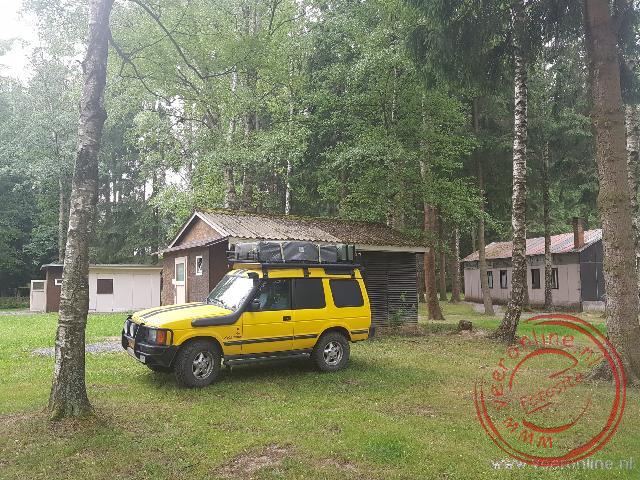
Before we return to the car, we take a look at the special Old Town Hall. The tower is the oldest building in Brno, built in 1240.The last destination of the day is the Pilgrimage Church of St. John of Nepomuk in Zdar nad Sázavou. This fortified church from 1719 is on the UNESCO list. Our travel guide says the church closes at five, but the last guided tours start at four. Since it’s at least an hour’s drive, we won’t make it in time. We decide to go anyway, even if just for a look at the exterior.At a little after 4:30, we arrive at the church. The round church, surrounded by a defensive wall, towers above the village. We walk through the open entrance gate into the courtyard. In the middle stands the round pilgrimage church. People are just coming out of the church, so we quickly slip inside. The simply furnished church features Baroque architecture with Gothic elements. It turns out the people inside were part of the last tour. Behind us, new visitors are being turned away at the door. We’re also told the church is closing. At the last moment, we’ve still managed to see this UNESCO World Heritage church.For the night, we’ve booked a wooden cabin in a nature park near Zdar. We drive through the rolling Czech countryside — it feels rural, and occasionally smells that way too. Just before reaching our lodging, we pass a large lake, crowded with Czechs enjoying themselves. The accommodation is also busy — all the wooden cabins are occupied. In broken German, we are shown our cabin: number 5. But the key appears to be missing. We think we understand that they’re not sure who has it and therefore don’t want to let us stay in that cabin. We get an upgrade to a four-person cabin, which has been recently renovated. For us, this is perfect for the night.Because of the public holiday, many Czechs are here for a long weekend. In the evening, we sit on the terrace, but the menu is only in Czech. The waitress doesn’t seem inclined to help us. We take a photo of the menu and have it translated with Google Translate. We choose two dishes and point to our selection. Once again, we’ve made an excellent choice.
 Hungary
 Albania
 Kosovo

Travelogue A Road Trip Through Europe
Dag 2 | Austria > The Neuschwanstein castle
Dag 3 | Slovenia > The lake of Bled
Dag 4 | Croatia > The Plitvice lakes and Una N.P.
Dag 5 | Bosnia and Herzegovina > The old town of Sarajevo
Dag 6 | Montenegro > The Montenegrin mountains
Dag 7 | Kosovo > Monasteries of Kosovo
Dag 8 | Albania > The ferry to Koman
Dag 9 | Albania > Tirana and Berat
Dag 10 | Albania > The old town Butrint
Dag 11 | North Macedonia > Through the mountains to Ohrid
Dag 12 | North Macedonia > The church of Ohrid
Dag 13 | North Macedonia > The capital Skopje
Dag 14 | Bulgaria > Smoke in the car
Dag 15 | Romania > The old town Veliko Tarnovo
Dag 16 | Romania > The huge parliament building
Dag 17 | Romania > The Dracula castle
Dag 18 | Romania > Climbing Mt Tâmpa
Dag 19 | Moldova > Gagauzia
Dag 20 | Moldova > Driving in the wine cellar
Dag 21 | Moldova > Transnistria
Dag 22 | Romania > The castle of Soroca
Dag 23 | Romania > The beautiful monasteries of Bukovina
Dag 24 | Hungary > Swimming in a cave
Dag 25 | Slovakia > The Tatra mountains
Dag 26 | Slovakia > The wooden houses of Vlkolínec
Dag 27 | Slovakia > The castle of Bratislava
Dag 28 | Czech Republic > Valtice and Lednice
Dag 29 | Germany > The old center of Dresden
Dag 30 | Netherlands > On the way home