
154 countries
(and areas)
 - Belize
- Benin
- Bhutan
- Bolivia
- Bonaire
- Bosnia and Herzegovina
- Botswana
- Brazil
- British Virgin Islands
- Brunei
- Bulgaria
- Cambodia
- Canada
- Cape Verde
- Chile
- China
- Costa Rica
- Croatia
- Cuba
- Curacao
- Cyprus
- Czech Republic
- Denmark
- Dominica
- Dominican Republic
- Egypt
- El Salvador
- England
- Estonia
- Eswatini (Swaziland)
- Ethiopia
- Fiji
- Finland
- France
- French Guiana
- Georgia
- Germany
- Gibraltar
- Greece
- Grenada
- Guadeloupe
- Guatemala
- Honduras
- Hong Kong
- Hungary
- Iceland
- India
- Indonesia
- Iran
- Ireland
- Israel
- Italy
- Jamaica
- Japan
- Jordan
- Kazakhstan
- Kenya
- Kosovo
- Kuwait
- Kyrgyzstan
- Laos
- Latvia
- Lebanon
- Lesotho
- Liechtenstein
- Lithuania
- Luxembourg
- Macau
- Madagascar
- Malawi
- Malaysia
- Maldives
- Malta
- Martinique
- Mexico
- Moldova
- Monaco
- Mongolia
- Montenegro
- Morocco
- Mozambique
- Namibia
- Nepal
- Netherlands
- New Zealand
- Nicaragua
- North Macedonia
- Northern Ireland
- Norway
- Oman
- Pakistan
- Palestine
- Peru
- Philippines
- Poland
- Portugal
- Qatar
- Republic of Korea
- Romania
- Russia
- Saint Kitts and Nevis
- Saint Lucia
- Saint Martin
- Saint Vincent and the Grenadines
- San Marino
- São Tomé and Principe
- Saudi Arabia
- Scotland
- Senegal
- Serbia
- Singapore
- Sint Maarten
- Slovakia
- Slovenia
- South Africa
- Spain
- Sri Lanka
- Suriname
- Sweden
- Switzerland
- Tajikistan
- Tanzania
- Thailand
- The Gambia
- Tibet
- Togo
- Transnistria
- Trinidad and Tobago
- Tunisia
- Turkey
- Turkmenistan
- Uganda
- United Arab Emirates
- United States
- Uruguay
- Uzbekistan
- Vatican City
- Vietnam
- Wales
- Zambia
- Zanzibar
- Belize
- Benin
- Bhutan
- Bolivia
- Bonaire
- Bosnia and Herzegovina
- Botswana
- Brazil
- British Virgin Islands
- Brunei
- Bulgaria
- Cambodia
- Canada
- Cape Verde
- Chile
- China
- Costa Rica
- Croatia
- Cuba
- Curacao
- Cyprus
- Czech Republic
- Denmark
- Dominica
- Dominican Republic
- Egypt
- El Salvador
- England
- Estonia
- Eswatini (Swaziland)
- Ethiopia
- Fiji
- Finland
- France
- French Guiana
- Georgia
- Germany
- Gibraltar
- Greece
- Grenada
- Guadeloupe
- Guatemala
- Honduras
- Hong Kong
- Hungary
- Iceland
- India
- Indonesia
- Iran
- Ireland
- Israel
- Italy
- Jamaica
- Japan
- Jordan
- Kazakhstan
- Kenya
- Kosovo
- Kuwait
- Kyrgyzstan
- Laos
- Latvia
- Lebanon
- Lesotho
- Liechtenstein
- Lithuania
- Luxembourg
- Macau
- Madagascar
- Malawi
- Malaysia
- Maldives
- Malta
- Martinique
- Mexico
- Moldova
- Monaco
- Mongolia
- Montenegro
- Morocco
- Mozambique
- Namibia
- Nepal
- Netherlands
- New Zealand
- Nicaragua
- North Macedonia
- Northern Ireland
- Norway
- Oman
- Pakistan
- Palestine
- Peru
- Philippines
- Poland
- Portugal
- Qatar
- Republic of Korea
- Romania
- Russia
- Saint Kitts and Nevis
- Saint Lucia
- Saint Martin
- Saint Vincent and the Grenadines
- San Marino
- São Tomé and Principe
- Saudi Arabia
- Scotland
- Senegal
- Serbia
- Singapore
- Sint Maarten
- Slovakia
- Slovenia
- South Africa
- Spain
- Sri Lanka
- Suriname
- Sweden
- Switzerland
- Tajikistan
- Tanzania
- Thailand
- The Gambia
- Tibet
- Togo
- Transnistria
- Trinidad and Tobago
- Tunisia
- Turkey
- Turkmenistan
- Uganda
- United Arab Emirates
- United States
- Uruguay
- Uzbekistan
- Vatican City
- Vietnam
- Wales
- Zambia
- Zanzibar


Copyright 2004 - 2026
Veeronline.nl Travel Adventures
Home > North Macedonia > A Road Trip Through Europe > Travelogue day 13
Travelogue A Road Trip Through Europe
June 8 July 7 2018 (30 days)
North Macedonia > The capital Skopje
Dag 13 - Wednesday, June 20, 2018The sun is already shining fully on the tent at seven o’clock in the morning. It immediately becomes warm in our roof tent. We get out. This comes in handy, as the warm water supply at the campsite is limited to three times a day. In the morning, there is only hot water between six and eight o’clock.After breakfast, we pack our things and leave Struga. When we told the campsite owner yesterday that we wanted to visit the Sveta Jovan Monastery, he immediately got excited. “The road to Debar is so beautiful with the lakes alongside it,” he said. “You should also definitely stop at the Rajcica women’s monastery,” he explained.The mountainous road is indeed beautiful. The sun shines through the trees. The water in the reservoir is perfectly still, reflecting the opposite shore. Just past Debar, a sign indicates the Rajcica Monastery. The path to the monastery descends steeply. The door of the monastery seems closed, although a sign says we are welcome. When someone comes out, it turns out we just needed to push harder against the gate.We can visit the small church of the monastery for about two euros per person. Photos are not allowed. A girl opens the door of the small church just for us. Inside, the church is overwhelmingly decorated. Impressive! Beautiful frescoes cover all walls and ceilings. A huge chandelier hangs above the altar, and behind it is a finely gilded iconostasis. The splendor in this small church is indescribable.The girl guiding us is not a nun herself; she helps as a volunteer. She shows a book with photos of beautifully gilded mitre crowns. The nuns in this monastery make these headpieces for the bishops. Impressed, we leave the monastery. We are grateful to the campsite owner for this tip.About half an hour further is the Sveti Jovan Biogrdski Monastery. It is said that in the eleventh century the incarnation of John the Baptist was seen at this place. The monastery has been expanded several times. During the communist period, the monastery fell into disrepair. Fortunately, the complex has been restored.
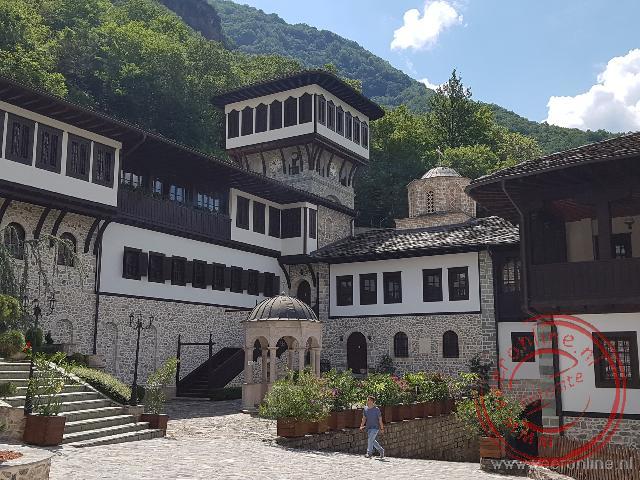
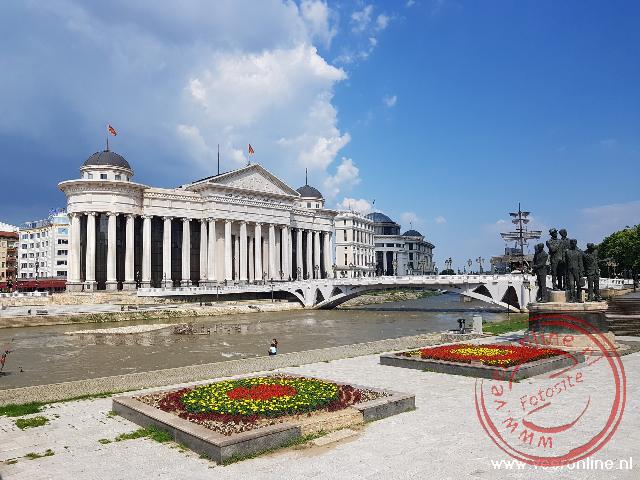
Through the entrance gate, we walk into the monastery. A man rushes after us. Tickets! We must pay an entrance fee. In this monastery, there are still about thirty monks and around thirty volunteers. One of the volunteers shows us the church. This church is just as beautiful and decorated as the previous one. It is impressive how so much splendor can be gathered together.After this monastery, we leave the mountains and drive via the toll road to Skopje. At the first toll booth, we pay 60 denar (about one euro). Ten kilometers further, we pass another toll booth. Up to the capital, we pass four toll booths. It seems as if we have to pay again every ten kilometers.Via a wide boulevard, we finally enter Skopje. It does not feel like we are already in the city center when we park our Land Rover at the hotel. Still, it is only 700 meters to walk to the central square of Skopje. The city has a unique architecture. It seems as if all architectural styles have been mixed. Old and new buildings stand around the central square. Ostentatious fountains and numerous statues decorate the square. It all seems bombastic.In a restaurant along the river, we order a sandwich. On the opposite side, the town hall is built in Greek style from white marble. After lunch, we walk across the river into the Carsija district, a neighborhood resembling an oriental bazaar. Small shops are everywhere: souvenirs, Turkish cafés, but also antiques or military items. We wander through the narrow streets. It is not difficult to get lost here. Fortunately, the nearby castle rises above the district—a good point of orientation.On the way to the castle lies the Jovas Pass Church.
This church is built lower than ground level. In the fourteenth century, according to Ottoman law, it was not allowed to build higher than the mosque. By digging the church two meters into the ground, it could be built. The church can be visited until five o’clock. Although it is not yet five, the ticket office is already closed. The security guard complains that the seller has left fifteen minutes ago. The manager is not here today, so she went home earlier. He apologizes that he cannot open the church for us. “Tomorrow morning,” he sighs.From the castle, we have a view of the city. The castle grounds are somewhat overgrown and have lost some of their charm. The two museums are closed. We return to the old town for a drink.In the evening, we go to eat near the hotel. The receptionist recommended several restaurants. When we step onto the terrace, a table is free under the awning. It is drizzling lightly. It seems that many tables have already been reserved. The waiters continuously move tables, place extra umbrellas, and then remove them again. The arrangement on the terrace becomes increasingly messy. There is hardly any room left for the waiters to pass. Some waiters are visibly annoyed. You would think they deal with this every evening. We give them a hand by paying the bill, which frees up a table again.
 Moldova
  The castle in Soroca dates from the Middle Ages
 The limestone caves house the largest wine collection in the world
 Bosnia and Herzegovina
  The trbacki Buk waterfall in Una National Park
 A perfect spot for a drink
Travelogue A Road Trip Through Europe
Dag 2 | Austria > The Neuschwanstein castle
Dag 3 | Slovenia > The lake of Bled
Dag 4 | Croatia > The Plitvice lakes and Una N.P.
Dag 5 | Bosnia and Herzegovina > The old town of Sarajevo
Dag 6 | Montenegro > The Montenegrin mountains
Dag 7 | Kosovo > Monasteries of Kosovo
Dag 8 | Albania > The ferry to Koman
Dag 9 | Albania > Tirana and Berat
Dag 10 | Albania > The old town Butrint
Dag 11 | North Macedonia > Through the mountains to Ohrid
Dag 12 | North Macedonia > The church of Ohrid
Dag 13 | North Macedonia > The capital Skopje
Dag 14 | Bulgaria > Smoke in the car
Dag 15 | Romania > The old town Veliko Tarnovo
Dag 16 | Romania > The huge parliament building
Dag 17 | Romania > The Dracula castle
Dag 18 | Romania > Climbing Mt Tâmpa
Dag 19 | Moldova > Gagauzia
Dag 20 | Moldova > Driving in the wine cellar
Dag 21 | Moldova > Transnistria
Dag 22 | Romania > The castle of Soroca
Dag 23 | Romania > The beautiful monasteries of Bukovina
Dag 24 | Hungary > Swimming in a cave
Dag 25 | Slovakia > The Tatra mountains
Dag 26 | Slovakia > The wooden houses of Vlkolínec
Dag 27 | Slovakia > The castle of Bratislava
Dag 28 | Czech Republic > Valtice and Lednice
Dag 29 | Germany > The old center of Dresden
Dag 30 | Netherlands > On the way home