
154 countries
(and areas)
 - Azerbaijan
- Bahrain
- Barbados
- Belgium
- Belize
- Benin
- Bhutan
- Bolivia
- Bonaire
- Bosnia and Herzegovina
- Botswana
- Brazil
- British Virgin Islands
- Brunei
- Bulgaria
- Cambodia
- Canada
- Cape Verde
- Chile
- China
- Costa Rica
- Croatia
- Cuba
- Curacao
- Cyprus
- Czech Republic
- Denmark
- Dominica
- Dominican Republic
- Egypt
- El Salvador
- England
- Estonia
- Eswatini (Swaziland)
- Ethiopia
- Fiji
- Finland
- France
- French Guiana
- Georgia
- Germany
- Gibraltar
- Greece
- Grenada
- Guadeloupe
- Guatemala
- Honduras
- Hong Kong
- Hungary
- Iceland
- India
- Indonesia
- Iran
- Ireland
- Israel
- Italy
- Jamaica
- Japan
- Jordan
- Kazakhstan
- Kenya
- Kosovo
- Kuwait
- Kyrgyzstan
- Laos
- Latvia
- Lebanon
- Lesotho
- Liechtenstein
- Lithuania
- Luxembourg
- Macau
- Madagascar
- Malawi
- Malaysia
- Maldives
- Malta
- Martinique
- Mexico
- Moldova
- Monaco
- Mongolia
- Montenegro
- Morocco
- Mozambique
- Namibia
- Nepal
- Netherlands
- New Zealand
- Nicaragua
- North Macedonia
- Northern Ireland
- Norway
- Oman
- Pakistan
- Palestine
- Peru
- Philippines
- Poland
- Portugal
- Qatar
- Republic of Korea
- Romania
- Russia
- Saint Kitts and Nevis
- Saint Lucia
- Saint Martin
- Saint Vincent and the Grenadines
- San Marino
- São Tomé and Principe
- Saudi Arabia
- Scotland
- Senegal
- Serbia
- Singapore
- Sint Maarten
- Slovakia
- Slovenia
- South Africa
- Spain
- Sri Lanka
- Suriname
- Sweden
- Switzerland
- Tajikistan
- Tanzania
- Thailand
- The Gambia
- Tibet
- Togo
- Transnistria
- Trinidad and Tobago
- Tunisia
- Turkey
- Turkmenistan
- Uganda
- United Arab Emirates
- United States
- Uruguay
- Uzbekistan
- Vatican City
- Vietnam
- Wales
- Zambia
- Zanzibar
- Azerbaijan
- Bahrain
- Barbados
- Belgium
- Belize
- Benin
- Bhutan
- Bolivia
- Bonaire
- Bosnia and Herzegovina
- Botswana
- Brazil
- British Virgin Islands
- Brunei
- Bulgaria
- Cambodia
- Canada
- Cape Verde
- Chile
- China
- Costa Rica
- Croatia
- Cuba
- Curacao
- Cyprus
- Czech Republic
- Denmark
- Dominica
- Dominican Republic
- Egypt
- El Salvador
- England
- Estonia
- Eswatini (Swaziland)
- Ethiopia
- Fiji
- Finland
- France
- French Guiana
- Georgia
- Germany
- Gibraltar
- Greece
- Grenada
- Guadeloupe
- Guatemala
- Honduras
- Hong Kong
- Hungary
- Iceland
- India
- Indonesia
- Iran
- Ireland
- Israel
- Italy
- Jamaica
- Japan
- Jordan
- Kazakhstan
- Kenya
- Kosovo
- Kuwait
- Kyrgyzstan
- Laos
- Latvia
- Lebanon
- Lesotho
- Liechtenstein
- Lithuania
- Luxembourg
- Macau
- Madagascar
- Malawi
- Malaysia
- Maldives
- Malta
- Martinique
- Mexico
- Moldova
- Monaco
- Mongolia
- Montenegro
- Morocco
- Mozambique
- Namibia
- Nepal
- Netherlands
- New Zealand
- Nicaragua
- North Macedonia
- Northern Ireland
- Norway
- Oman
- Pakistan
- Palestine
- Peru
- Philippines
- Poland
- Portugal
- Qatar
- Republic of Korea
- Romania
- Russia
- Saint Kitts and Nevis
- Saint Lucia
- Saint Martin
- Saint Vincent and the Grenadines
- San Marino
- São Tomé and Principe
- Saudi Arabia
- Scotland
- Senegal
- Serbia
- Singapore
- Sint Maarten
- Slovakia
- Slovenia
- South Africa
- Spain
- Sri Lanka
- Suriname
- Sweden
- Switzerland
- Tajikistan
- Tanzania
- Thailand
- The Gambia
- Tibet
- Togo
- Transnistria
- Trinidad and Tobago
- Tunisia
- Turkey
- Turkmenistan
- Uganda
- United Arab Emirates
- United States
- Uruguay
- Uzbekistan
- Vatican City
- Vietnam
- Wales
- Zambia
- Zanzibar


Copyright 2004 - 2026
Veeronline.nl Travel Adventures

Home > Kosovo > A Road Trip Through Europe > Travelogue day 7
Travelogue A Road Trip Through Europe
June 8 July 7 2018 (30 days)
Kosovo > Monasteries of Kosovo
Dag 7 - Thursday, June 14, 2018Even though the tent was slightly tilted last night, we slept very well. Since we went to bed early yesterday, we are up on time again. At seven o’clock, the water is ready for coffee, and we set the breakfast table. After breakfast, we pack everything up again and fold down the roof tent. We drive out of Biogradska Gora National Park and turn right toward Mojkovac. From there, we want to head south toward Rozaje. However, the navigation directs us to turn right earlier—a narrow mountain road. The narrow path quickly turns into a rutted track. This route over the mountain is probably faster than driving sixty kilometers per hour on the main road. We crawl along the mountain track in our Land Rover. When we want to descend on the other side, an older woman gestures from her house that it is not possible. In a bit of German and with some help in English from her daughter, we learn that the suggested route is not accessible. We must go back a short distance and then pass behind the house. We thank them warmly. This route leads back to the main road. At Rozaje, we leave the main road and drive toward the only border crossing between Montenegro and Kosovo. The road climbs steeply with hairpin turns. Even truck traffic must use this narrow road to reach Kosovo. The truck drivers indicate with their hazard lights when it is safe to overtake. At the top of the mountain is the border post. Our insurance turns out to be invalid in Kosovo. We first have to take out insurance at a small office. The insurance costs one euro per day, but the minimum period is fifteen days. We take out the insurance, even though we have no idea what exactly is covered. We have no choice. Immediately after the border, the descent begins. Kosovo is much flatter than Montenegro. From the mountain pass, we can see the landscape below. At the bottom of the pass, we enter Peja. Peja is the second-largest city, after the capital, Pristina. Near Peja should be the Visoki Decani Monastery. We expect to see signs upon entering the city, but unfortunately, there are none. We decide to ask for directions. A man on the phone interrupts his conversation to help us. The monastery is at Decani, about fifteen kilometers further. He also strongly advises us to visit the Patriarchate Monastery in Peja, emphasizing that it might be even more beautiful. He shows us the route and explains that we must report to the police station at the monastery. Due to tensions between the Serbian minority and the Albanian majority in Kosovo, Orthodox Serbian monasteries are permanently guarded by police and NATO forces.
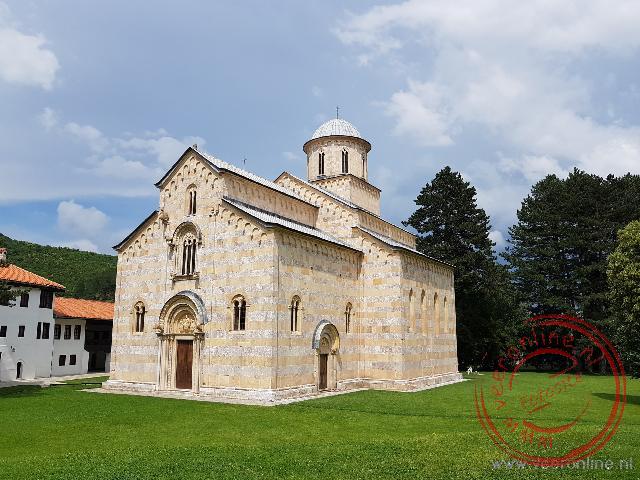
The officers register our information, and then we are allowed into the monastery grounds. The burgundy-colored church in the middle of the monastery courtyard is decorated with beautiful, colorful frescoes. The monastery was founded in the 13th century and houses archbishops and patriarchs. The various rooms are fabulously ornate. It is understandable that photography is prohibited, though it is a pity. We are grateful to our tipster for advising us to stop here. On the way to Decani, we stop at a restaurant for a bite to eat. The menu is only in Serbian. We ask if they have sandwiches, and they say yes, with a hamburger. A little later, it turns out there are no hamburgers, or no buns, or maybe both—we’re not quite sure. The owner helps us choose something else. The chicken curry, which had initially been “finished,” turns out to be available. Perfect. When paying, the waiter gives us a note showing how to reach the Visoki Decani Monastery. Following his instructions, we drive there. Roadblocks from KFOR, the NATO troops, appear along the way. We report to the military post. It feels more like entering a military area than visiting a monastery. After leaving our passports, a young man meets us and asks if we would like to tour the church. He can just give us a quick tour before his lunch. He explains that the beautifully decorated church was built in the 14th century by order of King Stefan Uros III Decanski. This church is also wonderfully furnished. It is astonishing to think that since 2004, there have been five attacks on this monastery. Outside, we collect our passports from the soldiers and drive the final stretch to Prizren. Prizren is the second city of the country, with a charming old town. Our guesthouse is near the center. In the narrow streets, we cannot immediately find the address—it is certainly not where the navigation system says it should be.

A young man is helpful. He checks online and walks with us to the guesthouse. Then it is quite a challenge to maneuver the car into the courtyard. The small space already contains five cars. Our roof tent barely fits under the grapevines. The old town center revolves around the Our Lady of Ljevis Church and the Sinan Pasha Mosque. Behind them lies Prizren Fortress on the hill. Behind the fortress, dark clouds loom. We quickly stroll through the old town streets. Terraces are set up everywhere. I wonder if this town has enough visitors to fill all the terraces. For us, there is plenty of choice to order a drink and maybe take shelter from the rain. And that rain comes. Just as we sit at a terrace, a downpour begins. Within minutes, the square is flooded. Even the waiters take photos. This extreme weather probably doesn’t happen here very often. The canopy begins to leak, and splashing water blows across the terrace. The waiter advises us to go inside. There, we order another drink, hoping it will soon clear. It doesn’t. We end up eating in the neighboring restaurant. At the price, it’s a bargain: the two of us eat for less than ten euros, drinks included.
 Czech Republic
  The rooms of Lednice Castle
 Romania
  The grand staircase in the parliament building
 Bulgaria
  The old Orthodox cathedral in Veliko Tarnovo
 Austria
  From the viewpoint at 2500 meters on the Grossglockner pass
Travelogue A Road Trip Through Europe
Dag 2 | Austria > The Neuschwanstein castle
Dag 3 | Slovenia > The lake of Bled
Dag 4 | Croatia > The Plitvice lakes and Una N.P.
Dag 5 | Bosnia and Herzegovina > The old town of Sarajevo
Dag 6 | Montenegro > The Montenegrin mountains
Dag 7 | Kosovo > Monasteries of Kosovo
Dag 8 | Albania > The ferry to Koman
Dag 9 | Albania > Tirana and Berat
Dag 10 | Albania > The old town Butrint
Dag 11 | North Macedonia > Through the mountains to Ohrid
Dag 12 | North Macedonia > The church of Ohrid
Dag 13 | North Macedonia > The capital Skopje
Dag 14 | Bulgaria > Smoke in the car
Dag 15 | Romania > The old town Veliko Tarnovo
Dag 16 | Romania > The huge parliament building
Dag 17 | Romania > The Dracula castle
Dag 18 | Romania > Climbing Mt Tâmpa
Dag 19 | Moldova > Gagauzia
Dag 20 | Moldova > Driving in the wine cellar
Dag 21 | Moldova > Transnistria
Dag 22 | Romania > The castle of Soroca
Dag 23 | Romania > The beautiful monasteries of Bukovina
Dag 24 | Hungary > Swimming in a cave
Dag 25 | Slovakia > The Tatra mountains
Dag 26 | Slovakia > The wooden houses of Vlkolínec
Dag 27 | Slovakia > The castle of Bratislava
Dag 28 | Czech Republic > Valtice and Lednice
Dag 29 | Germany > The old center of Dresden
Dag 30 | Netherlands > On the way home