
154 countries
(and areas)
 - Belize
- Benin
- Bhutan
- Bolivia
- Bonaire
- Bosnia and Herzegovina
- Botswana
- Brazil
- British Virgin Islands
- Brunei
- Bulgaria
- Cambodia
- Canada
- Cape Verde
- Chile
- China
- Costa Rica
- Croatia
- Cuba
- Curacao
- Cyprus
- Czech Republic
- Denmark
- Dominica
- Dominican Republic
- Egypt
- El Salvador
- England
- Estonia
- Eswatini (Swaziland)
- Ethiopia
- Fiji
- Finland
- France
- French Guiana
- Georgia
- Germany
- Gibraltar
- Greece
- Grenada
- Guadeloupe
- Guatemala
- Honduras
- Hong Kong
- Hungary
- Iceland
- India
- Indonesia
- Iran
- Ireland
- Israel
- Italy
- Jamaica
- Japan
- Jordan
- Kazakhstan
- Kenya
- Kosovo
- Kuwait
- Kyrgyzstan
- Laos
- Latvia
- Lebanon
- Lesotho
- Liechtenstein
- Lithuania
- Luxembourg
- Macau
- Madagascar
- Malawi
- Malaysia
- Maldives
- Malta
- Martinique
- Mexico
- Moldova
- Monaco
- Mongolia
- Montenegro
- Morocco
- Mozambique
- Namibia
- Nepal
- Netherlands
- New Zealand
- Nicaragua
- North Macedonia
- Northern Ireland
- Norway
- Oman
- Pakistan
- Palestine
- Peru
- Philippines
- Poland
- Portugal
- Qatar
- Republic of Korea
- Romania
- Russia
- Saint Kitts and Nevis
- Saint Lucia
- Saint Martin
- Saint Vincent and the Grenadines
- San Marino
- São Tomé and Principe
- Saudi Arabia
- Scotland
- Senegal
- Serbia
- Singapore
- Sint Maarten
- Slovakia
- Slovenia
- South Africa
- Spain
- Sri Lanka
- Suriname
- Sweden
- Switzerland
- Tajikistan
- Tanzania
- Thailand
- The Gambia
- Tibet
- Togo
- Transnistria
- Trinidad and Tobago
- Tunisia
- Turkey
- Turkmenistan
- Uganda
- United Arab Emirates
- United States
- Uruguay
- Uzbekistan
- Vatican City
- Vietnam
- Wales
- Zambia
- Zanzibar
- Belize
- Benin
- Bhutan
- Bolivia
- Bonaire
- Bosnia and Herzegovina
- Botswana
- Brazil
- British Virgin Islands
- Brunei
- Bulgaria
- Cambodia
- Canada
- Cape Verde
- Chile
- China
- Costa Rica
- Croatia
- Cuba
- Curacao
- Cyprus
- Czech Republic
- Denmark
- Dominica
- Dominican Republic
- Egypt
- El Salvador
- England
- Estonia
- Eswatini (Swaziland)
- Ethiopia
- Fiji
- Finland
- France
- French Guiana
- Georgia
- Germany
- Gibraltar
- Greece
- Grenada
- Guadeloupe
- Guatemala
- Honduras
- Hong Kong
- Hungary
- Iceland
- India
- Indonesia
- Iran
- Ireland
- Israel
- Italy
- Jamaica
- Japan
- Jordan
- Kazakhstan
- Kenya
- Kosovo
- Kuwait
- Kyrgyzstan
- Laos
- Latvia
- Lebanon
- Lesotho
- Liechtenstein
- Lithuania
- Luxembourg
- Macau
- Madagascar
- Malawi
- Malaysia
- Maldives
- Malta
- Martinique
- Mexico
- Moldova
- Monaco
- Mongolia
- Montenegro
- Morocco
- Mozambique
- Namibia
- Nepal
- Netherlands
- New Zealand
- Nicaragua
- North Macedonia
- Northern Ireland
- Norway
- Oman
- Pakistan
- Palestine
- Peru
- Philippines
- Poland
- Portugal
- Qatar
- Republic of Korea
- Romania
- Russia
- Saint Kitts and Nevis
- Saint Lucia
- Saint Martin
- Saint Vincent and the Grenadines
- San Marino
- São Tomé and Principe
- Saudi Arabia
- Scotland
- Senegal
- Serbia
- Singapore
- Sint Maarten
- Slovakia
- Slovenia
- South Africa
- Spain
- Sri Lanka
- Suriname
- Sweden
- Switzerland
- Tajikistan
- Tanzania
- Thailand
- The Gambia
- Tibet
- Togo
- Transnistria
- Trinidad and Tobago
- Tunisia
- Turkey
- Turkmenistan
- Uganda
- United Arab Emirates
- United States
- Uruguay
- Uzbekistan
- Vatican City
- Vietnam
- Wales
- Zambia
- Zanzibar


Copyright 2004 - 2026
Veeronline.nl Travel Adventures
Home > Georgia > From Amsterdam to Tokyo > Travelogue day 20
Travelogue From Amsterdam to Tokyo
May 1 August 8 2016 (100 days)
Georgia > The mountain road to Ushguli
Dag 20 - Friday, May 20, 2016When we pull back the curtains, the sun is shining. Outside instantly looks much cheerier. The Enguri Dam is also bathed in sunlight. One of the geologists points out that on the way to Mestia there is a viewpoint where you can see the reservoir itself. For this, we have to leave the main road briefly. At breakfast, a minor panic breaks out. From their gestures, we understand that there is no breakfast for us. It seems they are short on ingredients. “You must go,” they gesture—go, go. We can only have breakfast in an hour. Just as we are about to buy some bread ourselves, eggs and bread arrive. Still, a perfectly fine breakfast. On the way to the dam, there is a checkpoint. Will we be allowed to continue? The guard comes over.

We may proceed, but the car must stay outside the gate. From a platform, we have a view of the 271-meter-high dam. Only when I compare the dam to a bus and a few cars all the way below can I imagine its height. The lake behind it is immense. We follow the lake. The winding road goes up and down. There are frequent large holes in the road. We steer carefully around them, not avoiding the other half of the road. Along the steep rock face, there are warnings about falling rocks—and it soon becomes clear that the warnings are not exaggerated. Rocks lie on the road in several places. No one worries about it as long as they can drive around them.

When we enter a tunnel, water seeps through the roof. The asphalt has been damaged and is full of potholes. We had not expected this, nor the large puddles in the tunnel. Heavy braking! We continue cautiously. We drive the next tunnels a bit more carefully. In a small village, we order coffee. The little shop has only two chairs. We take two extra chairs out of our Land Rover. While we drink our coffee, we attract a lot of attention. Just after noon, we drive into Mestia. Mestia is a mountain village in the Caucasus. Many houses in the village have old watchtowers, which were once used both as homes and for defense against raids. On the central, cozy square, we have our lunch. Schoolchildren are preparing a performance on a stage, while the snow-capped peaks of the Caucasus rise in the background. The village gives off a winter-sports vibe. From Mestia, we continue to Ushguli. Mestia lies at 1,400 meters; Ushguli at 2,200 meters. Ushguli is therefore the highest continuously inhabited mountain village in Europe.

We wonder if it might not be higher in the Alps. The road there is poor. Recent rainfall over the past days has certainly not improved it. The first section is still paved, but the last twenty-five kilometers are unpaved. The road is full of potholes filled with rainwater. We drive very slowly. It is unbelievable that this is the only route to Ushguli. The other mountain pass is still closed due to snow. Streams flow across the road, and puddles cover its width. It is a real challenge to climb higher and higher into the mountains. As we near Ushguli after nearly three hours of driving, we see a camper with a Dutch license plate. When we stop, we are immediately asked, “Are you from Here to Tokyo?” Marleen and Roderick are traveling in an old Mercedes bus and had already contacted us online. They call their camper Circumbendibus. Last week, they also met friends of ours in Batumi who had heard about our journey. It is a small world. They are camping just outside Ushguli. In the village, there was no flat ground. We stay in a guesthouse in Ushguli. Like in Mestia, most houses have old watchtowers. The village looks poor and has a medieval feel, yet it is set in a stunning location among the mountain peaks. Due to the rainfall, the streets have turned into muddy paths. It is no wonder that residents move around on horseback. In the evening, during dinner, we discover there is no electricity—no lights and no hot water. There is nothing to do but go to bed early—but after such an intense drive, that is not unpleasant.
 Montenegro
  The highest point in Lovcen National Park
 Albania
  View from the Citadel in Berat
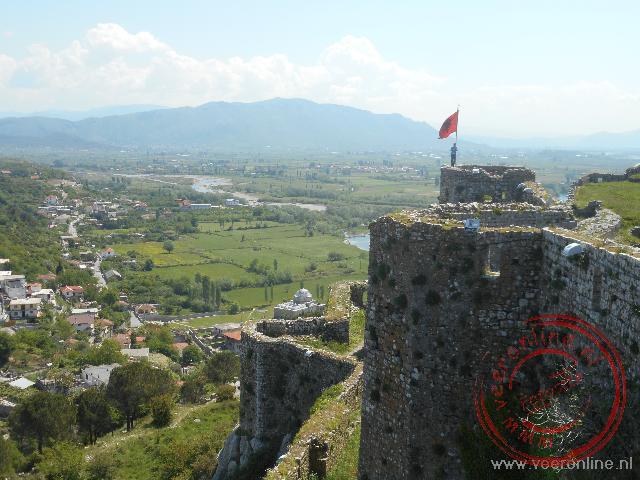 The imposing castle of Shkoder
 Germany
  In the snow in Berchtesgaden National Park
Travelogue From Amsterdam to Tokyo
Dag 2 | Germany > Through Germany
Dag 3 | Austria > Ljubljana Castle
Dag 4 | Croatia > Plitvice Lakes in the rain
Dag 5 | Bosnia and Herzegovina > By the Bay of Kotor
Dag 6 | Montenegro > Across the Albanian border
Dag 7 | Albania > Driving through Tirana
Dag 8 | Albania > Ottoman houses of Berat
Dag 9 | Albania > From Gjirokaster to Metsovo
Dag 10 | Greece > The monasteries of Meteora
Dag 11 | Greece > The caves of Alistrati
Dag 12 | Greece > The Horse of Troy
Dag 13 | Turkey > The Temple of Athena
Dag 14 | Turkey > Historic Safranbolu
Dag 15 | Turkey > Football party in Amasya
Dag 16 | Turkey > Driving license returned
Dag 17 | Turkey > The D915 is 'Kapali' (closed)
Dag 18 | Turkey > To Batumi in Georgia
Dag 19 | Georgia > A typical Russian hotel
Dag 20 | Georgia > The mountain road to Ushguli
Dag 21 | Georgia > Party at the Imperial Hotel
Dag 22 | Georgia > From Kusaisi to Gori
Dag 23 | Georgia > Tsminda Sameba Church Kasbeki
Dag 24 | Georgia > The only hotel seems closed
Dag 25 | Georgia > The heating is broken
Dag 26 | Georgia > Independence Day in Tbilisi
Dag 27 | Georgia > Crossing the border to Azerbaijan
Dag 28 | Azerbaijan > Mud volcanoes of Gobustan
Dag 29 | Azerbaijan > Waiting for the boat
Dag 30 | Azerbaijan > Are we already in Turkmenistan?
Dag 31 | Azerbaijan > Stuck on the Caspian Sea
Dag 32 | Azerbaijan > Finally Turkmenistan
Dag 33 | Turkmenistan > Still going to Yangykala
Dag 34 | Turkmenistan > Swimming in an underground cave
Dag 35 | Turkmenistan > 'No Pictures, No Pictures'
Dag 36 | Turkmenistan > The border is closed
Dag 37 | Uzbekistan > Enchanting Khiva
Dag 38 | Uzbekistan > Wandering through old Khiva
Dag 39 | Uzbekistan > Through the Kyzylkum desert
Dag 40 | Uzbekistan > The Registan Square of Samarkand
Dag 41 | Uzbekistan > The palace of Timur Lenk
Dag 42 | Uzbekistan > Smuggling porn
Dag 43 | Tajikistan > The capital of Tajikistan
Dag 44 | Tajikistan > Landslides
Dag 45 | Tajikistan > The exhaust breaks off
Dag 46 | Tajikistan > Bathing in a mineral bath
Dag 47 | Tajikistan > The Wakhan Valley
Dag 48 | Tajikistan > Over the Khargush pass
Dag 49 | Tajikistan > We lost Wilco
Dag 50 | Tajikistan > Over the high Ak-Baital pass
Dag 51 | Kyrgyzstan > Recovering in Osh
Dag 52 | Kyrgyzstan > The Throne of Solomon
Dag 53 | Kyrgyzstan > Misty on the mountain top
Dag 54 | Kyrgyzstan > Overnight stay in a yurt
Dag 55 | Kyrgyzstan > Plov with salad
Dag 56 | Kyrgyzstan > Vodka by Lake Kolsai
Dag 57 | Kazakhstan > Spectacular Charyn Canyon
Dag 58 | Kazakhstan > The cathedrals of Almaty
Dag 59 | Kazakhstan > To Altyn Emel National Park
Dag 60 | Kazakhstan > The Singing Sand Dunes
Dag 61 | Kazakhstan > Looking for a Gamma store
Dag 62 | Kazakhstan > We are not allowed to pay
Dag 63 | Kazakhstan > 133 km/h on the road
Dag 64 | Kazakhstan > A beer in Semey
Dag 65 | Kazakhstan > Walking tour through Semey
Dag 66 | Kazakhstan > Welcome, welcome in Russia
Dag 67 | Russia > The battery light comes on
Dag 68 | Russia > Everyone seems drunk
Dag 69 | Russia > Desolate Kosh Agach
Dag 70 | Russia > Waiting at the border
Dag 71 | Mongolia > Beautiful valleys and lakes
Dag 72 | Mongolia > The road is being paved
Dag 73 | Mongolia > Traditional wrestling
Dag 74 | Mongolia > From Bayankhongor to Arvaikheer
Dag 75 | Mongolia > Slipping on the muddy road
Dag 76 | Mongolia > The Erdene Zuu Monastery
Dag 77 | Mongolia > Entering Ulaanbaatar
Dag 78 | Mongolia > Wandering through Ulaanbaatar
Dag 79 | Mongolia > The front suspension is broken
Dag 80 | Mongolia > The Genghis Khan equestrian statue
Dag 81 | Mongolia > Collision with an eagle
Dag 82 | Mongolia > Celebration in Choibalsan
Dag 83 | Mongolia > Refused entry at the restaurant
Dag 84 | Russia > Water on the hood
Dag 85 | Russia > The Trans-Siberian Highway
Dag 86 | Russia > Do we have a flat tire?
Dag 87 | Russia > Besieged by flies
Dag 88 | Russia > The border town Blagoveshchensk
Dag 89 | Russia > Jewish Autonomous Oblast Birobidzhan
Dag 90 | Russia > Meeting everyone again
Dag 91 | Russia > Sailing the Amur River
Dag 92 | Russia > Looking for a hotel
Dag 93 | Russia > Entering Vladivostok
Dag 94 | Russia > Farewell to the car
Dag 95 | Russia > On the way to Japan
Dag 96 | South Korea > Six hours in South Korea
Dag 97 | Japan > Paperwork, forms, and stamps
Dag 98 | Japan > The Hiroshima memorial
Dag 99 | Japan > Coolant leak
Dag 100 | Japan > TOKYO