
154 countries
(and areas)
 - Belize
- Benin
- Bhutan
- Bolivia
- Bonaire
- Bosnia and Herzegovina
- Botswana
- Brazil
- British Virgin Islands
- Brunei
- Bulgaria
- Cambodia
- Canada
- Cape Verde
- Chile
- China
- Costa Rica
- Croatia
- Cuba
- Curacao
- Cyprus
- Czech Republic
- Denmark
- Dominica
- Dominican Republic
- Egypt
- El Salvador
- England
- Estonia
- Eswatini (Swaziland)
- Ethiopia
- Fiji
- Finland
- France
- French Guiana
- Georgia
- Germany
- Gibraltar
- Greece
- Grenada
- Guadeloupe
- Guatemala
- Honduras
- Hong Kong
- Hungary
- Iceland
- India
- Indonesia
- Iran
- Ireland
- Israel
- Italy
- Jamaica
- Japan
- Jordan
- Kazakhstan
- Kenya
- Kosovo
- Kuwait
- Kyrgyzstan
- Laos
- Latvia
- Lebanon
- Lesotho
- Liechtenstein
- Lithuania
- Luxembourg
- Macau
- Madagascar
- Malawi
- Malaysia
- Maldives
- Malta
- Martinique
- Mexico
- Moldova
- Monaco
- Mongolia
- Montenegro
- Morocco
- Mozambique
- Namibia
- Nepal
- Netherlands
- New Zealand
- Nicaragua
- North Macedonia
- Northern Ireland
- Norway
- Oman
- Pakistan
- Palestine
- Peru
- Philippines
- Poland
- Portugal
- Qatar
- Republic of Korea
- Romania
- Russia
- Saint Kitts and Nevis
- Saint Lucia
- Saint Martin
- Saint Vincent and the Grenadines
- San Marino
- São Tomé and Principe
- Saudi Arabia
- Scotland
- Senegal
- Serbia
- Singapore
- Sint Maarten
- Slovakia
- Slovenia
- South Africa
- Spain
- Sri Lanka
- Suriname
- Sweden
- Switzerland
- Tajikistan
- Tanzania
- Thailand
- The Gambia
- Tibet
- Togo
- Transnistria
- Trinidad and Tobago
- Tunisia
- Turkey
- Turkmenistan
- Uganda
- United Arab Emirates
- United States
- Uruguay
- Uzbekistan
- Vatican City
- Vietnam
- Wales
- Zambia
- Zanzibar
- Belize
- Benin
- Bhutan
- Bolivia
- Bonaire
- Bosnia and Herzegovina
- Botswana
- Brazil
- British Virgin Islands
- Brunei
- Bulgaria
- Cambodia
- Canada
- Cape Verde
- Chile
- China
- Costa Rica
- Croatia
- Cuba
- Curacao
- Cyprus
- Czech Republic
- Denmark
- Dominica
- Dominican Republic
- Egypt
- El Salvador
- England
- Estonia
- Eswatini (Swaziland)
- Ethiopia
- Fiji
- Finland
- France
- French Guiana
- Georgia
- Germany
- Gibraltar
- Greece
- Grenada
- Guadeloupe
- Guatemala
- Honduras
- Hong Kong
- Hungary
- Iceland
- India
- Indonesia
- Iran
- Ireland
- Israel
- Italy
- Jamaica
- Japan
- Jordan
- Kazakhstan
- Kenya
- Kosovo
- Kuwait
- Kyrgyzstan
- Laos
- Latvia
- Lebanon
- Lesotho
- Liechtenstein
- Lithuania
- Luxembourg
- Macau
- Madagascar
- Malawi
- Malaysia
- Maldives
- Malta
- Martinique
- Mexico
- Moldova
- Monaco
- Mongolia
- Montenegro
- Morocco
- Mozambique
- Namibia
- Nepal
- Netherlands
- New Zealand
- Nicaragua
- North Macedonia
- Northern Ireland
- Norway
- Oman
- Pakistan
- Palestine
- Peru
- Philippines
- Poland
- Portugal
- Qatar
- Republic of Korea
- Romania
- Russia
- Saint Kitts and Nevis
- Saint Lucia
- Saint Martin
- Saint Vincent and the Grenadines
- San Marino
- São Tomé and Principe
- Saudi Arabia
- Scotland
- Senegal
- Serbia
- Singapore
- Sint Maarten
- Slovakia
- Slovenia
- South Africa
- Spain
- Sri Lanka
- Suriname
- Sweden
- Switzerland
- Tajikistan
- Tanzania
- Thailand
- The Gambia
- Tibet
- Togo
- Transnistria
- Trinidad and Tobago
- Tunisia
- Turkey
- Turkmenistan
- Uganda
- United Arab Emirates
- United States
- Uruguay
- Uzbekistan
- Vatican City
- Vietnam
- Wales
- Zambia
- Zanzibar


Copyright 2004 - 2026
Veeronline.nl Travel Adventures
Home > Turkmenistan > From Amsterdam to Tokyo > Travelogue day 36
Travelogue From Amsterdam to Tokyo
May 1 August 8 2016 (100 days)
Turkmenistan > The border is closed
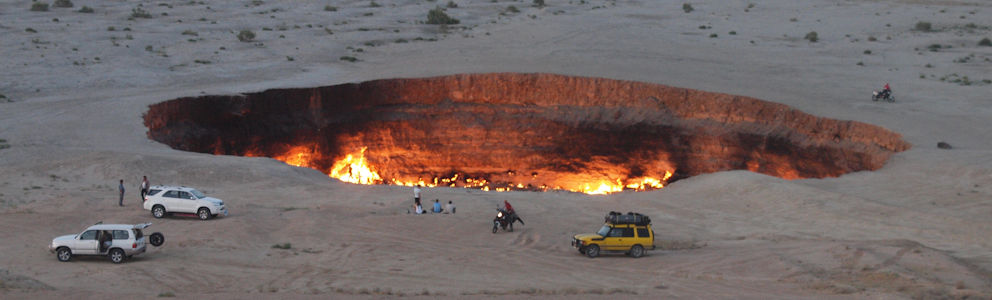
Dag 36 - Sunday, June 5, 2016What a beautiful place to wake up at the Darvaza gas crater. We pack our things again and get ready to drive north toward the border with Uzbekistan. Just before we’re about to leave, one of the villagers rides up on his scooter. He had helped the motorcyclists yesterday with the sandy track. He has a flat rear tire. We help him patch it. Afterwards, he guides us along another, less sandy route back to the main road. In a small roadside restaurant, in the middle of the desert, we have some tea. Chamrat had already said yesterday that the road we took then was good compared to today’s route. In the summer, the asphalt gets so hot that trucks leave tracks in it. In winter, any remaining water freezes and cracks the asphalt. Sometimes it seems as if there are more holes than remaining asphalt. The shoulder is then a good alternative. Some potholes are even ten centimeters deep. It’s hard to imagine that ordinary cars can drive over this. Our vehicle is not unscathed either. One of the cables under the hood has been shaken loose. A door pillar also comes loose. None of this is critical, but it shows how much the car is enduring. We have to plan our fuel stops carefully. There are no gas stations in the desert. The stations are sometimes 250 kilometers apart. Our Land Rover has a range of about 500 kilometers, but the motorcycles only go 250 km on a tank. Oncoming cars often honk and flash their lights—not to warn us of police, but to welcome us.

People wave enthusiastically. Next to the road, a second lane is being built. Only the gravel base is laid. Several drivers choose to drive here. We try it too. It drives more slowly but more consistently. Occasionally, we have to bypass a sand barrier. We drive about 50 kilometers on this parallel track until Chamrat signals us to return to the original road. Further ahead, there is a police checkpoint. In the afternoon, we arrive in Konye Urgench. Here stand minarets and old mausoleums from the 11th century of the Khorezmshah dynasty. We walk rather hastily among the remnants of this UNESCO city. We still have to reach the border before it closes. The Turkmen border closes at five o’clock. Around half past four, we approach the first gate. The usual procedure with forms and stamps is skipped, but there is above-average interest in the luggage. All personal bags must be opened. It’s unclear what the customs officers are looking for—perhaps they just enjoy seeing what we carry. Compared to the personal luggage, the vehicle check is mild. Only the hood has to be opened to see if anything is hidden underneath. The border guards wish us a safe journey. We continue to the border with Uzbekistan. The gate is closed with a padlock. The border is closed. A soldier walks over and confirms this. The border closes at six o’clock. Because the clock moves one hour forward, we are more than an hour late. Quickly, we get some water from the Turkmen colleagues. It looks like we will have to camp tonight in no man’s land between Turkmenistan and Uzbekistan. Bizarre! While we are eating in the evening, the patrol comes by. They patrol around the border. Their boss, with an impressive hat, is not pleased that we are here. “This is a military zone,” he says. He wants us to move our tents to the other side of the border and complete the formalities from there tomorrow. It is almost dark, and packing up is not really an option. Eventually, he gives in, and we are allowed to stay.
 Greece
  Motor trouble on the highway when leaving Xanthi
 Turkey
  The viewing platform over the canyon near Safranbolu
 Kyrgyzstan
  The spectacular mountain pass to Lake Son Kul
 Tajikistan
  The road climbs higher and higher
Travelogue From Amsterdam to Tokyo
Dag 2 | Germany > Through Germany
Dag 3 | Austria > Ljubljana Castle
Dag 4 | Croatia > Plitvice Lakes in the rain
Dag 5 | Bosnia and Herzegovina > By the Bay of Kotor
Dag 6 | Montenegro > Across the Albanian border
Dag 7 | Albania > Driving through Tirana
Dag 8 | Albania > Ottoman houses of Berat
Dag 9 | Albania > From Gjirokaster to Metsovo
Dag 10 | Greece > The monasteries of Meteora
Dag 11 | Greece > The caves of Alistrati
Dag 12 | Greece > The Horse of Troy
Dag 13 | Turkey > The Temple of Athena
Dag 14 | Turkey > Historic Safranbolu
Dag 15 | Turkey > Football party in Amasya
Dag 16 | Turkey > Driving license returned
Dag 17 | Turkey > The D915 is 'Kapali' (closed)
Dag 18 | Turkey > To Batumi in Georgia
Dag 19 | Georgia > A typical Russian hotel
Dag 20 | Georgia > The mountain road to Ushguli
Dag 21 | Georgia > Party at the Imperial Hotel
Dag 22 | Georgia > From Kusaisi to Gori
Dag 23 | Georgia > Tsminda Sameba Church Kasbeki
Dag 24 | Georgia > The only hotel seems closed
Dag 25 | Georgia > The heating is broken
Dag 26 | Georgia > Independence Day in Tbilisi
Dag 27 | Georgia > Crossing the border to Azerbaijan
Dag 28 | Azerbaijan > Mud volcanoes of Gobustan
Dag 29 | Azerbaijan > Waiting for the boat
Dag 30 | Azerbaijan > Are we already in Turkmenistan?
Dag 31 | Azerbaijan > Stuck on the Caspian Sea
Dag 32 | Azerbaijan > Finally Turkmenistan
Dag 33 | Turkmenistan > Still going to Yangykala
Dag 34 | Turkmenistan > Swimming in an underground cave
Dag 35 | Turkmenistan > 'No Pictures, No Pictures'
Dag 36 | Turkmenistan > The border is closed
Dag 37 | Uzbekistan > Enchanting Khiva
Dag 38 | Uzbekistan > Wandering through old Khiva
Dag 39 | Uzbekistan > Through the Kyzylkum desert
Dag 40 | Uzbekistan > The Registan Square of Samarkand
Dag 41 | Uzbekistan > The palace of Timur Lenk
Dag 42 | Uzbekistan > Smuggling porn
Dag 43 | Tajikistan > The capital of Tajikistan
Dag 44 | Tajikistan > Landslides
Dag 45 | Tajikistan > The exhaust breaks off
Dag 46 | Tajikistan > Bathing in a mineral bath
Dag 47 | Tajikistan > The Wakhan Valley
Dag 48 | Tajikistan > Over the Khargush pass
Dag 49 | Tajikistan > We lost Wilco
Dag 50 | Tajikistan > Over the high Ak-Baital pass
Dag 51 | Kyrgyzstan > Recovering in Osh
Dag 52 | Kyrgyzstan > The Throne of Solomon
Dag 53 | Kyrgyzstan > Misty on the mountain top
Dag 54 | Kyrgyzstan > Overnight stay in a yurt
Dag 55 | Kyrgyzstan > Plov with salad
Dag 56 | Kyrgyzstan > Vodka by Lake Kolsai
Dag 57 | Kazakhstan > Spectacular Charyn Canyon
Dag 58 | Kazakhstan > The cathedrals of Almaty
Dag 59 | Kazakhstan > To Altyn Emel National Park
Dag 60 | Kazakhstan > The Singing Sand Dunes
Dag 61 | Kazakhstan > Looking for a Gamma store
Dag 62 | Kazakhstan > We are not allowed to pay
Dag 63 | Kazakhstan > 133 km/h on the road
Dag 64 | Kazakhstan > A beer in Semey
Dag 65 | Kazakhstan > Walking tour through Semey
Dag 66 | Kazakhstan > Welcome, welcome in Russia
Dag 67 | Russia > The battery light comes on
Dag 68 | Russia > Everyone seems drunk
Dag 69 | Russia > Desolate Kosh Agach
Dag 70 | Russia > Waiting at the border
Dag 71 | Mongolia > Beautiful valleys and lakes
Dag 72 | Mongolia > The road is being paved
Dag 73 | Mongolia > Traditional wrestling
Dag 74 | Mongolia > From Bayankhongor to Arvaikheer
Dag 75 | Mongolia > Slipping on the muddy road
Dag 76 | Mongolia > The Erdene Zuu Monastery
Dag 77 | Mongolia > Entering Ulaanbaatar
Dag 78 | Mongolia > Wandering through Ulaanbaatar
Dag 79 | Mongolia > The front suspension is broken
Dag 80 | Mongolia > The Genghis Khan equestrian statue
Dag 81 | Mongolia > Collision with an eagle
Dag 82 | Mongolia > Celebration in Choibalsan
Dag 83 | Mongolia > Refused entry at the restaurant
Dag 84 | Russia > Water on the hood
Dag 85 | Russia > The Trans-Siberian Highway
Dag 86 | Russia > Do we have a flat tire?
Dag 87 | Russia > Besieged by flies
Dag 88 | Russia > The border town Blagoveshchensk
Dag 89 | Russia > Jewish Autonomous Oblast Birobidzhan
Dag 90 | Russia > Meeting everyone again
Dag 91 | Russia > Sailing the Amur River
Dag 92 | Russia > Looking for a hotel
Dag 93 | Russia > Entering Vladivostok
Dag 94 | Russia > Farewell to the car
Dag 95 | Russia > On the way to Japan
Dag 96 | South Korea > Six hours in South Korea
Dag 97 | Japan > Paperwork, forms, and stamps
Dag 98 | Japan > The Hiroshima memorial
Dag 99 | Japan > Coolant leak
Dag 100 | Japan > TOKYO